Combo Lists: How Stolen Data Pairs Create Account Takeover Risks
Combo lists combine usernames and passwords from different sources, allowing attackers to bypass security that relies on unique credentials for every service.

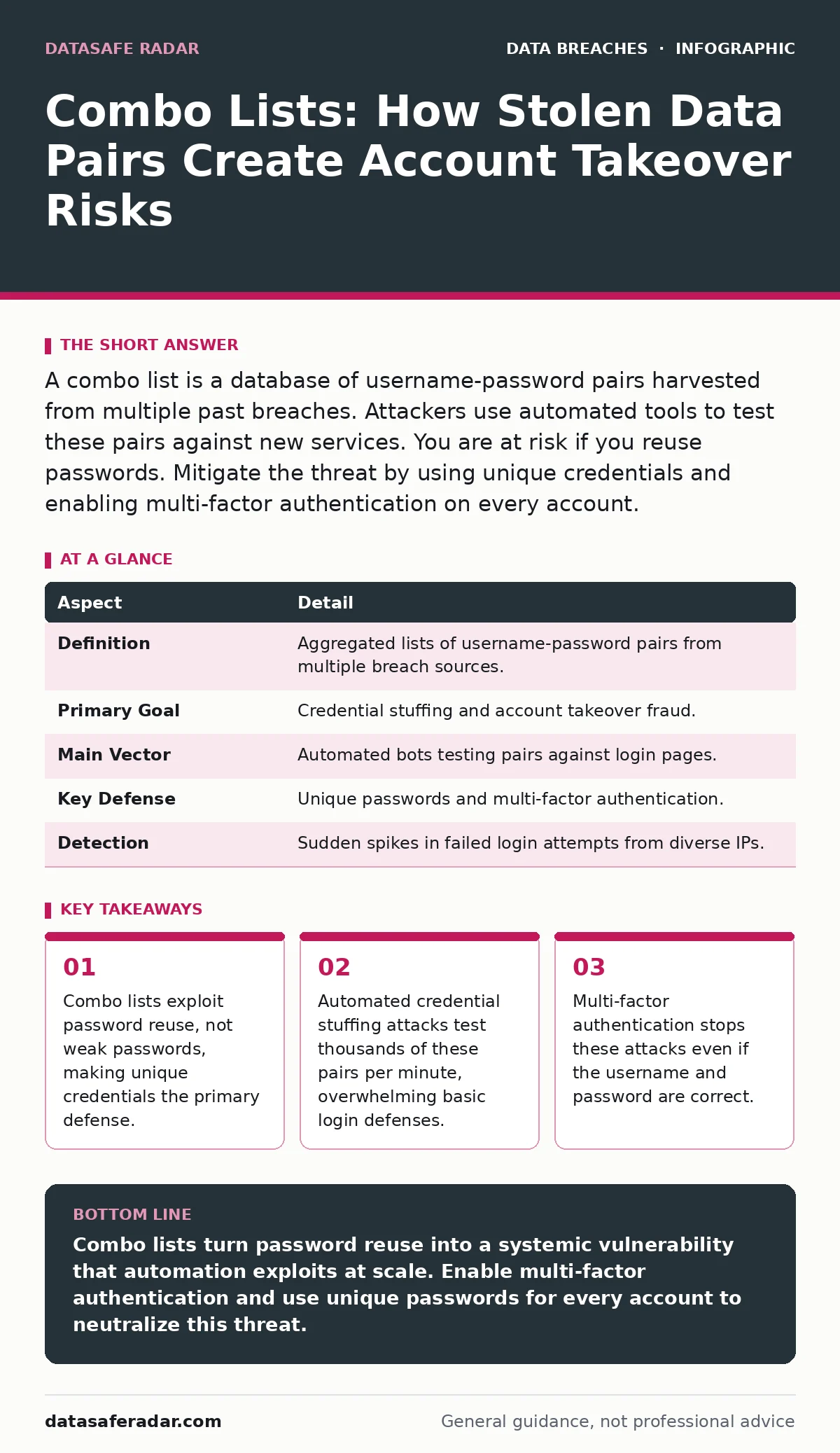
A combo list is a database of username-password pairs harvested from multiple past breaches. Attackers use automated tools to test these pairs against new services. You are at risk if you reuse passwords. Mitigate the threat by using unique credentials and enabling multi-factor authentication on every account.
The Digital Master Key Analogy
Imagine you use the same physical key for your front door, your mailbox, and your gym locker. If a thief copies that one key, they do not need to pick three different locks. They simply try the copy in every entry point until it turns.
Combo lists operate on this exact principle in the digital world. They are not sophisticated hacking tools in the traditional sense. They are massive spreadsheets of username and password combinations that attackers have collected from various sources.
The danger lies in human habit, not technical failure. Most people reuse passwords across multiple services to remember them. Attackers know this. They do not need to crack your encryption. They only need to find one place where you used that password, then try it everywhere else.
| Aspect | Detail |
|---|---|
| Definition | Aggregated lists of username-password pairs from multiple breach sources. |
| Primary Goal | Credential stuffing and account takeover fraud. |
| Main Vector | Automated bots testing pairs against login pages. |
| Key Defense | Unique passwords and multi-factor authentication. |
| Detection | Sudden spikes in failed login attempts from diverse IPs. |
How Combo Lists Are Built
Attackers do not usually steal combo lists directly from a single company. Instead, they aggregate data from many different incidents over time. This process turns isolated data leaks into a powerful weapon.
The sources for these lists are varied. They include credential dumps that appear on underground forums after a breach. They also include data scraped from public websites where users accidentally exposed their information. Sometimes, attackers combine a list of email addresses from one breach with a list of passwords from another, guessing that the user reused the same credentials.
This aggregation is the critical step. A password stolen from a small forum in the past might be useless on its own. But when combined with an email address from a recent retail breach, it becomes a viable entry point for that retail account. The attacker’s job is simply to match the pairs and test them.
The Mechanics of Credential Stuffing
Once the combo list is ready, attackers use automated software to test the pairs. This process is known as credential stuffing. It is distinct from brute force attacks because the attacker already has valid credentials; they are just guessing which service uses them.
These bots send login requests at a high volume. They cycle through thousands of username-password pairs in seconds. If the login fails, they move to the next pair immediately. If it succeeds, they record the access and move on. This speed allows them to test millions of combinations before a human administrator notices the pattern.
The attack often looks like normal traffic at first. Each login attempt comes from a different IP address, often using residential proxies that mimic real user devices. This makes it difficult for basic firewalls to block the traffic based on volume alone. The system sees many different "users" logging in, not one attacker hammering a single door.
Who Is Most at Risk
You are at risk if you reuse passwords. The strength of your password matters less than its uniqueness. A complex password used on five sites is more dangerous than a simple password used on only one.
Users with high-value accounts are prime targets. These include email providers, financial institutions, and social media platforms. Email accounts are particularly valuable because they allow attackers to reset passwords for other services. Social media accounts provide personal data that can be used for further social engineering attacks.
Businesses are also vulnerable. If an employee uses personal credentials for work accounts, or reuses passwords between personal and professional devices, the combo list becomes a bridge into the corporate network. This is why employee offboarding security is vital; if a former employee’s credentials are not revoked immediately, they remain a valid entry point for these automated attacks.
What People Usually Get Wrong
Many users believe that using a long, complex password solves the problem. This is incorrect if that complex password is used on multiple sites. Complexity does not protect against reuse. Uniqueness does.
Another common misconception is that two-factor authentication (2FA) is optional for low-value accounts. Attackers do not care about the value of the account initially. They care about access. Once they take over a low-value account, they use it to gather more information about you or to pivot to higher-value targets.
Some organizations assume that monitoring for brute force attacks is enough. Brute force attacks try many passwords on one account. Credential stuffing tries one password on many accounts. The detection signatures are different. Systems tuned only for brute force may miss the distributed nature of credential stuffing.
Reducing the Risk Effectively
The most effective defense is multi-factor authentication. Even if an attacker has your username and password from a combo list, they cannot log in without the second factor. This could be a code sent to your phone, a hardware key, or a biometric scan.
Enable 2FA on every account that offers it. Prioritize email, banking, and social media. Look for app-based authenticators or hardware keys rather than SMS codes, which can be intercepted through SIM swapping.
Use a password manager. This tool generates and stores unique, complex passwords for every site. You only need to remember one master password. This eliminates the need for reuse, which is the root cause of combo list success.
Monitor your accounts for unusual activity. If you see login attempts from unfamiliar locations or devices, change your password immediately. Enable login notifications if the service provides them. This helps you detect a successful breach before the attacker causes significant damage.
The Role of Monitoring and Response
Organizations must implement systems to detect credential stuffing in real-time. This involves analyzing login patterns for anomalies. A sudden increase in failed logins from diverse geographic locations is a strong indicator of an attack.
Dark web monitoring services can alert you if your credentials appear in new combo lists. This allows you to proactively change passwords before an attacker tests them. However, this is a reactive measure. It does not prevent the initial breach that created the data.
For businesses, integrating with identity providers that offer behavioral analysis can help. These systems look at how a user interacts with the login page. Bots behave differently than humans. They do not hover over buttons or type at variable speeds. Detecting these subtle differences can block automated attempts without hindering real users.
Regular backup testing ensures that if an attacker does gain access and corrupts your data, you can restore it. While this does not stop the initial login, it limits the impact of the breach.
Key takeaways
- Combo lists exploit password reuse, not weak passwords, making unique credentials the primary defense.
- Automated credential stuffing attacks test thousands of these pairs per minute, overwhelming basic login defenses.
- Multi-factor authentication stops these attacks even if the username and password are correct.
Combo lists turn password reuse into a systemic vulnerability that automation exploits at scale. Enable multi-factor authentication and use unique passwords for every account to neutralize this threat.
Frequently asked questions
Can I be safe if I never reuse passwords?
You are significantly safer, but not immune. Other vectors like phishing or malware can still steal unique passwords. Multi-factor authentication remains necessary.
Do combo lists contain hacked passwords?
Yes, they contain passwords stolen from past breaches. They are not cracked; they are simply copied from databases where users stored them in plain text or weakly encrypted formats.
Should I change all my passwords now?
If you suspect reuse, yes. Use a password manager to generate new, unique passwords for each service. Prioritize email and financial accounts first.
Does using a VPN protect me from combo lists?
No. A VPN hides your IP address but does not protect your credentials. If your password is in a combo list, a VPN will not prevent the attacker from logging in.
How this guide was produced: written by the DataSafe Radar editorial team with AI assistance, checked against the public references listed below, and reviewed when the facts change. See our editorial policy or report an error.