Exposed API Keys: How Leaked Access Tokens Compromise Systems
Exposed API keys grant immediate system access without passwords, making them faster to exploit than stolen login credentials and harder to detect until damage occurs.
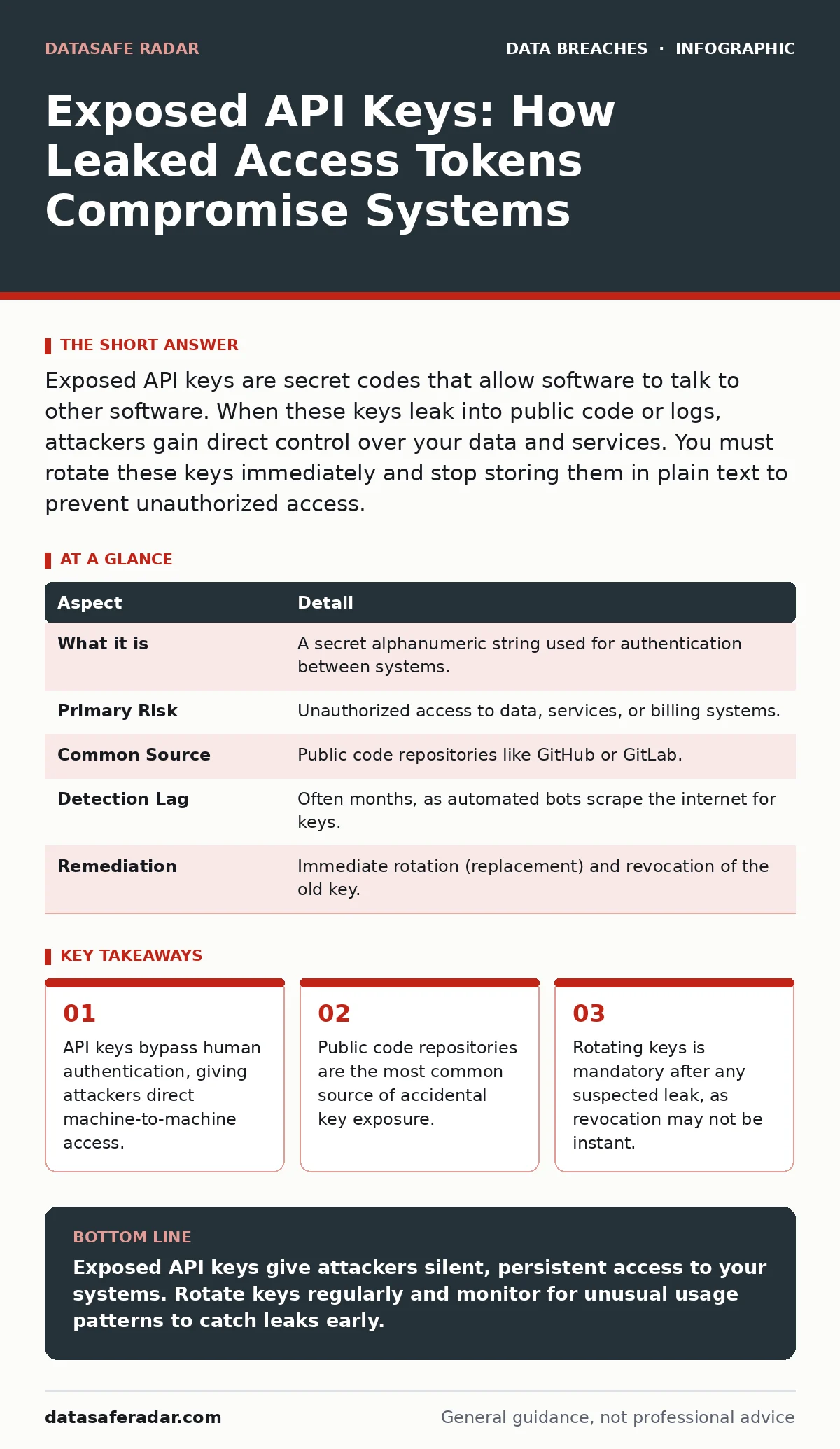
Exposed API keys are secret codes that allow software to talk to other software. When these keys leak into public code or logs, attackers gain direct control over your data and services. You must rotate these keys immediately and stop storing them in plain text to prevent unauthorized access.
The Digital House Key Analogy
Imagine you hire a contractor to install a smart lock on your back door. You give them a specific code that only works for that door. If you write that code on a sticky note and leave it on the front porch, anyone can enter your house without breaking in. They do not need to pick the lock or guess your master password. They just use the code you left out.
API keys work exactly like that contractor code. They are strings of characters that prove one computer has permission to talk to another. When you expose these keys, you are not just leaving a window open. You are handing over the remote control to your servers, databases, and cloud storage.
| Aspect | Detail |
|---|---|
| What it is | A secret alphanumeric string used for authentication between systems. |
| Primary Risk | Unauthorized access to data, services, or billing systems. |
| Common Source | Public code repositories like GitHub or GitLab. |
| Detection Lag | Often months, as automated bots scrape the internet for keys. |
| Remediation | Immediate rotation (replacement) and revocation of the old key. |
Why API Keys Are Different from Passwords
Most people think of security in terms of usernames and passwords. These are human-facing credentials. They often have policies requiring complexity, expiration, and two-factor authentication. API keys are machine-facing credentials. They are designed to be long, random, and static. They rarely expire. They rarely have secondary verification steps.
This design choice creates a hidden risk. Because machines need to run continuously, API keys must be available to the software at all times. This means they are often stored in configuration files, environment variables, or code constants. If an attacker finds one, they do not need to wait for a user to log in. They can start making requests immediately.
The lack of behavioral limits makes this worse. A human might log in from a new city, triggering an alert. An API key might be used by a script that always accesses the same endpoint. The system sees normal activity. The attacker sees open doors.
How Exposure Happens in Practice
Exposure usually happens through carelessness, not malice. Developers often copy and paste keys into code to test a feature. They forget to remove the key before pushing the code to a shared repository. They might think, "I will delete it later." Later rarely comes.
Another common path is logging. Applications often print detailed error messages to help developers fix bugs. If an error occurs during an API call, the log might include the full request. That request often contains the API key in the header or body. If those logs are accessible to users or stored in insecure locations, the keys are exposed.
Who Gets Hit Hardest
This problem affects anyone who uses third-party services. Small startups are frequent targets because they often lack rigorous code review processes. They move fast and forget to secure their secrets. Large enterprises are also at risk, but for different reasons. They have complex environments with many moving parts. A key might be exposed in a legacy system that no one monitors closely.
Service providers face a unique burden. If they issue a key that gets leaked, they must decide how to handle the abuse. Do they block the key immediately? That breaks the legitimate user’s app. Do they rate-limit the key? That might not stop a determined attacker. This tension means that even if you rotate your key, the provider might still be processing requests with the old one for a short window.
Common Forms of Hidden Keys
You might think you only have a few API keys. You likely have more. Every service you connect to needs one. Email services, payment processors, cloud storage, analytics platforms, and mapping services all require keys. These keys often look similar, making them hard to distinguish from other configuration values.
Some keys are partial. You might see the first few characters of a key in a log, but not the rest. Attackers can sometimes use partial keys to guess the rest, especially if the key generation algorithm is weak. Others are embedded in mobile apps. These apps run on devices you do not control. The code is compiled, but attackers can decompile it and extract the keys.
What People Usually Get Wrong
There is a widespread belief that using environment variables solves the problem. Environment variables are settings stored outside the code, in the operating system. This is better than hardcoding keys in the source file. It is not a cure. If the server environment is compromised, the attacker can read the environment variables. If the backup of the server includes the environment configuration, the keys are in the backup.
Another mistake is assuming that private repositories are safe. Private repositories are safer than public ones. They are not immune. If an employee shares access with a contractor who then shares it further, the key is exposed. If the repository provider suffers a breach, the keys are exposed. You must treat all repositories as potentially leaky.
How to Reduce the Risk
You cannot prevent all leaks. You must assume that keys will be exposed eventually. Your goal is to minimize the damage and detect the leak quickly. Start by rotating keys regularly. Do not wait for a breach. Set a schedule to generate new keys and update your configurations. This limits the window of opportunity for an attacker.
Use short-lived tokens where possible. Instead of a master API key that lasts forever, use tokens that expire after an hour or a day. This requires more complex setup, but it drastically reduces the risk. If a token is stolen, it becomes useless quickly.
Monitor your cloud usage and API logs for anomalies. Sudden spikes in usage, requests from unusual locations, or access to endpoints that are rarely used can indicate a compromised key. Integrating this monitoring with dark web monitoring can help you find keys that have been posted on forums or marketplaces before they are used.
The Cost of Inaction
Leaving an exposed key active is a liability. Attackers can use your resources to send spam, host illegal content, or launch attacks against others. You might be held responsible for the damage. They can also access your data. If that data includes customer information, you face regulatory fines and reputational harm. Sending customer breach notification letters is an administrative burden you want to avoid.
Preventing account takeover fraud often starts with securing these backend connections. If an attacker gains access to your admin API, they can reset user passwords or change account settings. This bypasses all the front-end security you have built. Securing API keys is not just a technical task. It is a business continuity requirement.
Key takeaways
- API keys bypass human authentication, giving attackers direct machine-to-machine access.
- Public code repositories are the most common source of accidental key exposure.
- Rotating keys is mandatory after any suspected leak, as revocation may not be instant.
- Environment variables are safer than hardcoding secrets, but still require strict access controls.
Exposed API keys give attackers silent, persistent access to your systems. Rotate keys regularly and monitor for unusual usage patterns to catch leaks early.
Frequently asked questions
How do I know if my API key is exposed?
Search public code repositories and pastebin sites for your key. Use automated scanning tools to check your codebase and logs for hardcoded secrets.
Should I delete my old API keys?
Yes, but only after you have replaced them with new ones. Deleting a key without a replacement breaks your application. Rotate, then delete.
Can I reuse an API key for different services?
No. Each service should have its own unique key. If one is compromised, the others remain safe. This is known as least privilege.
Do environment variables protect my keys?
They protect them from being visible in source code. They do not protect them from an attacker who has access to the server or the application runtime.
How this guide was produced: written by the DataSafe Radar editorial team with AI assistance, checked against the public references listed below, and reviewed when the facts change. See our editorial policy or report an error.