Data Encryption at Rest and in Transit: How to Secure Your Information
Encryption transforms readable data into unreadable code, ensuring that stolen files or intercepted network traffic remain useless to attackers without the specific decryption key.

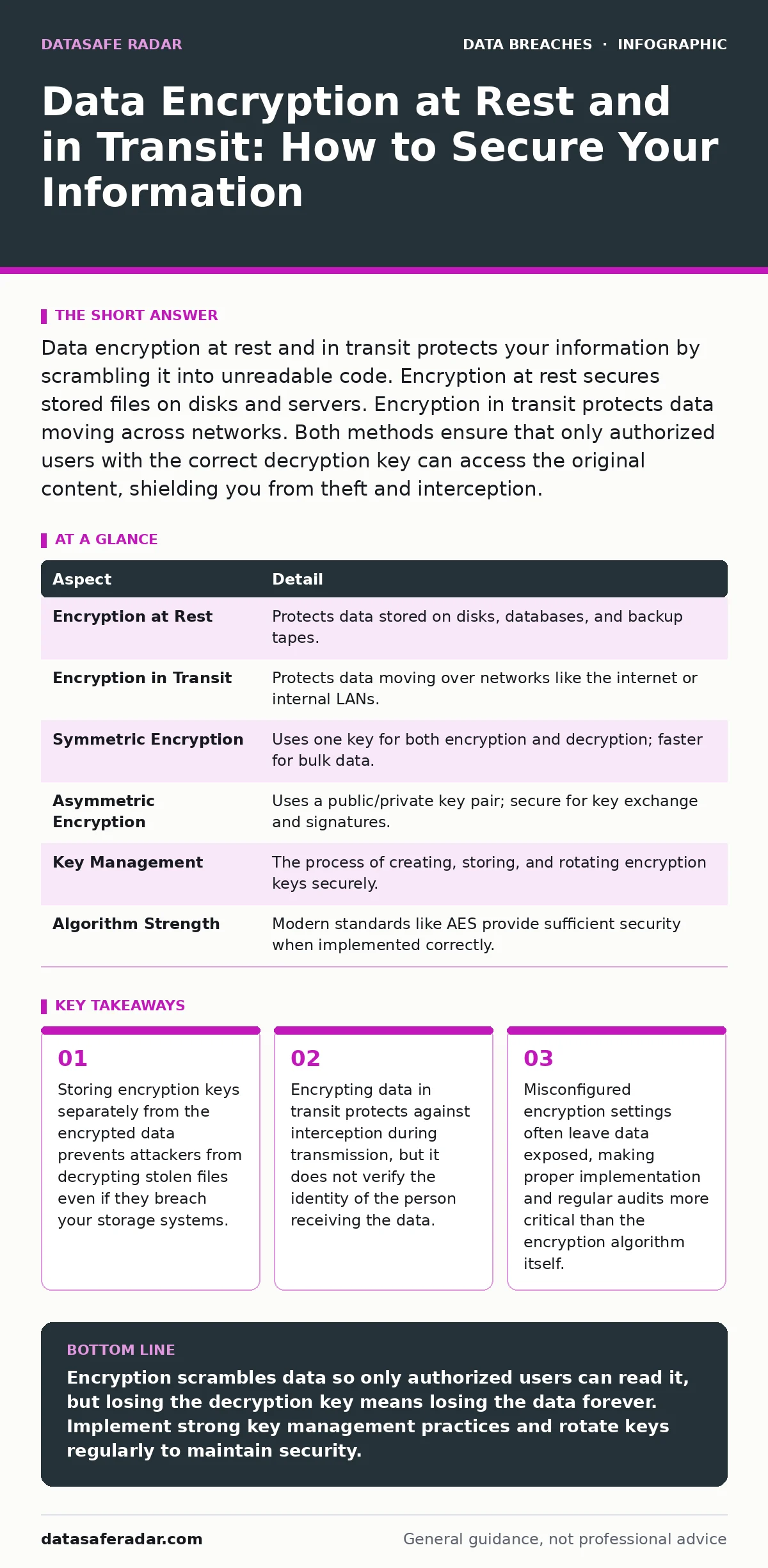
Data encryption at rest and in transit protects your information by scrambling it into unreadable code. Encryption at rest secures stored files on disks and servers. Encryption in transit protects data moving across networks. Both methods ensure that only authorized users with the correct decryption key can access the original content, shielding you from theft and interception.
Everyday Analogy: The Locked Mailbox
Imagine sending a confidential letter. You place the letter inside a steel box, lock it with a key, and mail it. The postal service handles the box, but they cannot read the letter because they lack the key. When the recipient receives it, they use their key to open the box. Data encryption works the same way. It turns plain text into scrambled ciphertext. Only the person with the correct key can reverse the process. This analogy helps you visualize how data remains private even when stored on a server or traveling across the internet.
What Is Data Encryption at Rest and in Transit
Data encryption at rest and in transit refers to two distinct methods of protecting information. Encryption at rest secures data stored on physical devices like hard drives, solid-state drives, and database servers. Encryption in transit protects data as it moves between systems, such as from your browser to a web server. Both methods use mathematical algorithms to transform readable data into unreadable code. This code is useless to anyone without the corresponding decryption key. Understanding the difference helps you apply the right security controls to different parts of your infrastructure.
How Encryption Actually Works
Encryption relies on algorithms and keys to secure data. The algorithm is the set of rules for scrambling the data. The key is the secret value that determines the specific scrambling pattern. Without the key, reversing the process requires guessing every possible combination, which is computationally impossible with modern standards. Symmetric encryption uses the same key for locking and unlocking. Asymmetric encryption uses a public key to lock and a private key to unlock. You must choose the right type for each use case. Symmetric keys are faster for large datasets. Asymmetric keys are better for secure initial exchanges.
| Aspect | Detail |
|---|---|
| Encryption at Rest | Protects data stored on disks, databases, and backup tapes. |
| Encryption in Transit | Protects data moving over networks like the internet or internal LANs. |
| Symmetric Encryption | Uses one key for both encryption and decryption; faster for bulk data. |
| Asymmetric Encryption | Uses a public/private key pair; secure for key exchange and signatures. |
| Key Management | The process of creating, storing, and rotating encryption keys securely. |
| Algorithm Strength | Modern standards like AES provide sufficient security when implemented correctly. |
Who Is Affected by Encryption Requirements
Every organization that stores or transmits sensitive data is affected by encryption requirements. This includes healthcare providers, financial institutions, and small businesses handling customer records. Individuals are also affected when they store personal photos or documents on cloud services. Regulatory frameworks often mandate encryption for specific types of data. These mandates aim to reduce the impact of a breach. If data is encrypted, a stolen database is just a pile of random noise. This reduces liability and protects user privacy. You must identify which data falls under these regulations to ensure compliance.
Common Mistakes People Make
Many people assume that enabling encryption is enough to secure their data. This is a dangerous misconception. Poor key management can render encryption useless. If you store the decryption key in the same location as the encrypted data, an attacker who steals the data also gets the key. Another common mistake is using weak or outdated algorithms. Legacy systems may support older standards that are no longer considered secure. You must audit your systems regularly. Ensure that keys are rotated periodically. Never share keys via unsecured channels. Misconfiguration is the leading cause of encryption failures, not the mathematics itself.
See also: Online Anonymity for Small Businesses and Practical Privacy Controls · Detect Medical Device Vulnerabilities: Signals, Tools and Blind Spots
Real-World Application: The Cloud Upload
Suppose you upload a financial report to a cloud storage service. The service encrypts the file on their servers. This is encryption at rest. When you download it later, the data travels over the internet. This is encryption in transit. If an attacker intercepts the download, they see only scrambled code. They cannot read the financial details. However, if the cloud provider loses control of the decryption keys, your data becomes inaccessible. This highlights the hidden cost of managed encryption. You rely on the provider’s security practices. You must verify that they use strong key management protocols.
What To Do About Encryption Gaps
You must implement a defense-in-depth strategy. Start by identifying all sensitive data in your environment. Classify it based on sensitivity. Apply encryption at rest for all stored sensitive data. Use encryption in transit for all network communications. Do not rely solely on perimeter defenses. Assume that attackers will eventually reach your internal network. Key management is the most critical component. Use a dedicated key management system. Rotate keys regularly. Revoke access immediately when employees leave. Monitor for exposed API keys and credential leaks that could compromise your encryption infrastructure.
Integrating with Other Security Measures
Encryption is not a standalone solution. It works best when combined with other security practices. You should use database activity monitoring to detect unusual access patterns. Even with encryption, you need to know who is accessing the data. Dark web monitoring can alert you if your credentials or keys appear in illegal markets. If you find combo lists containing your user data, change passwords immediately. Encryption protects the data itself, but it does not stop attackers from trying to log in. Combining these tools creates a layered defense that is much harder to bypass.
The Hidden Cost of Key Loss
The biggest risk with encryption is not being hacked. It is losing your keys. If you lose the decryption key, your data is permanently gone. No amount of hacking can recover it. This is a real business risk. You must have a reliable backup strategy for your keys. Test your recovery process regularly. Ensure that only authorized personnel can access the keys. Document the key rotation schedule. Failure to plan for key loss can lead to catastrophic data loss. This is often overlooked in security planning. Prioritize key availability alongside key security.
Conclusion on Encryption Strategy
Data encryption at rest and in transit is a fundamental security control. It protects your data from theft and interception. It does not prevent all attacks. It mitigates the impact of a breach. You must implement it correctly. Focus on strong algorithms and secure key management. Combine encryption with monitoring and access controls. Regular audits ensure your configuration remains secure. Stay updated on new threats and standards. Encryption is a journey, not a destination. Continuous improvement ensures your data remains protected over time.
Key takeaways
- Storing encryption keys separately from the encrypted data prevents attackers from decrypting stolen files even if they breach your storage systems.
- Encrypting data in transit protects against interception during transmission, but it does not verify the identity of the person receiving the data.
- Misconfigured encryption settings often leave data exposed, making proper implementation and regular audits more critical than the encryption algorithm itself.
Encryption scrambles data so only authorized users can read it, but losing the decryption key means losing the data forever. Implement strong key management practices and rotate keys regularly to maintain security.
Frequently asked questions
Does encryption stop hackers from accessing my system?
No, encryption does not prevent unauthorized access to systems. It only ensures that if data is stolen, the attacker cannot read it without the decryption key.
Can I use the same encryption key for all my data?
Using the same key for all data is risky. If one key is compromised, all protected data is exposed. Use unique keys for different data sets or applications to limit the damage of a breach.
Is free encryption software safe to use?
Free encryption software can be safe if it uses standard, well-vetted algorithms. However, you must verify the source and ensure it has no backdoors or vulnerabilities. Open-source tools often undergo community review.
How often should I change my encryption keys?
You should rotate encryption keys regularly, typically every year or when a potential compromise is suspected. More frequent rotation reduces the window of opportunity for attackers who may have stolen a key without detection.
How this guide was produced: written by the DataSafe Radar editorial team with AI assistance, checked against the public references listed below, and reviewed when the facts change. See our editorial policy or report an error.