Dark Web Monitoring: How It Works and What It Actually Finds
Dark web monitoring scans hidden networks for leaked credentials, revealing that compromised data often circulates long before an organization detects the intrusion through traditional logs.

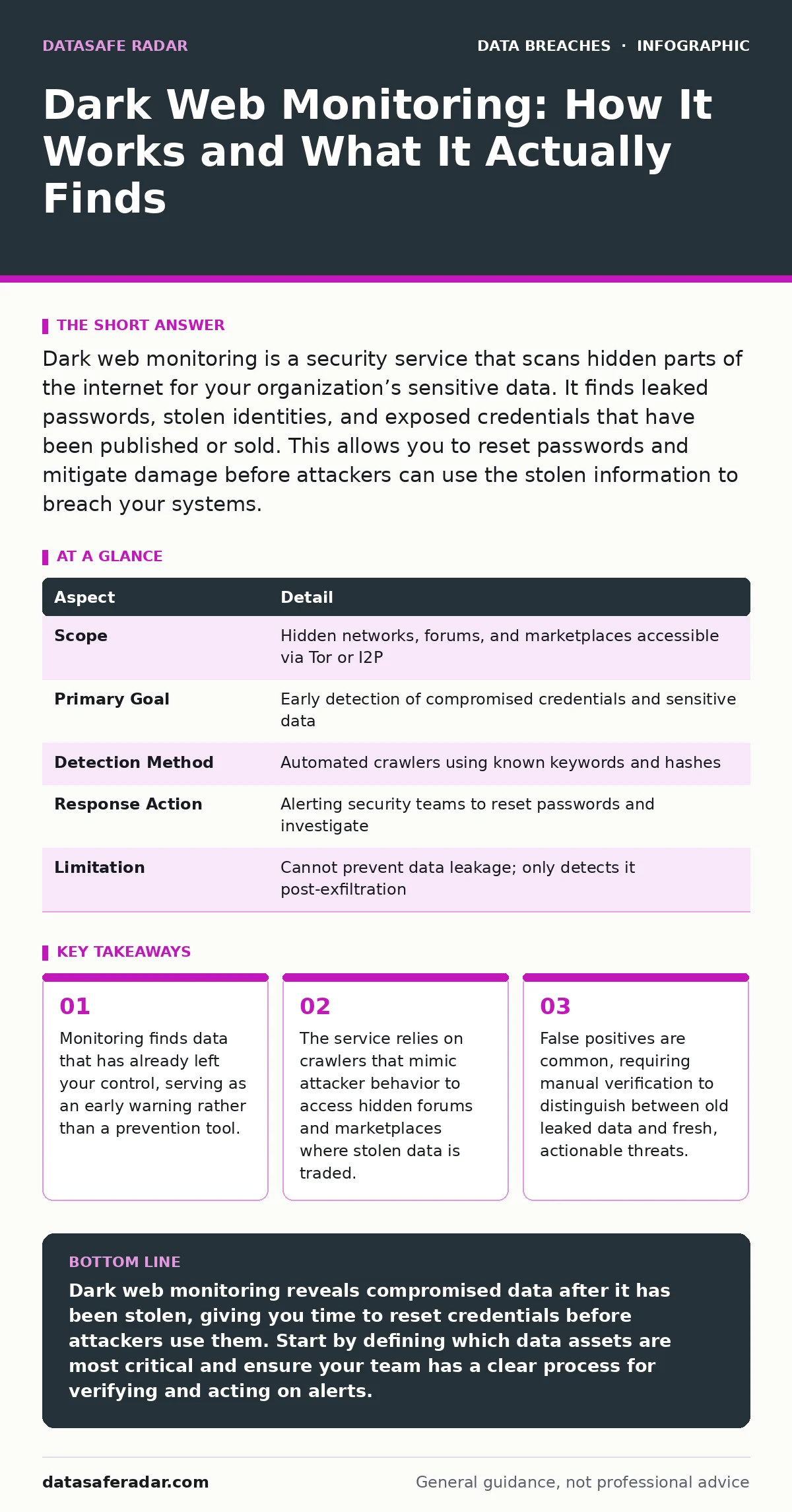
Dark web monitoring is a security service that scans hidden parts of the internet for your organization’s sensitive data. It finds leaked passwords, stolen identities, and exposed credentials that have been published or sold. This allows you to reset passwords and mitigate damage before attackers can use the stolen information to breach your systems.
The Library Analogy for Hidden Threats
Imagine a public library where anyone can read books. This is the surface web. Now imagine a private club where you need a specific invitation and special software to enter. This is the dark web. It is not inherently evil, but it provides anonymity for those who wish to remain untracked.
In this private club, stolen data is bought and sold. Dark web monitoring acts like a discreet observer who has access to these clubs. The observer looks for your name, your email addresses, or your company’s internal documents. They do not stop the theft. They only tell you that your data is now in circulation so you can change your locks.
What the Service Actually Solves
Traditional security tools look inward. Firewalls and intrusion detection systems watch your network perimeter. They catch active attacks but miss data that was stolen months ago. A breach might have occurred through a phishing click or a misconfigured server, leaving your defenses unaware that data has already escaped.
Dark web monitoring addresses this blind spot. It looks outward to the places where attackers congregate to sell their loot. By finding your credentials before an attacker uses them, you gain a window of opportunity to react. You can force password resets and revoke access tokens. This reduces the likelihood of account takeover fraud, which relies heavily on valid, stolen login details.
| Aspect | Detail |
|---|---|
| Scope | Hidden networks, forums, and marketplaces accessible via Tor or I2P |
| Primary Goal | Early detection of compromised credentials and sensitive data |
| Detection Method | Automated crawlers using known keywords and hashes |
| Response Action | Alerting security teams to reset passwords and investigate |
| Limitation | Cannot prevent data leakage; only detects it post-exfiltration |
The Mechanics of Discovery
The process begins with indexing. Automated bots, known as crawlers, navigate the dark web just as search engines index the surface web. These crawlers are programmed to look for specific patterns. They search for email domains, IP addresses, and unique identifiers associated with your organization.
When a crawler finds a match, it extracts the data. This might be a simple username and password pair, or it could be a full database dump. The service then analyzes the freshness of the data. Old credential dumps are less dangerous because you may have already changed those passwords. Fresh listings indicate an active threat.
Where It Fits in Your Defense
Dark web monitoring is a detection layer, not a prevention layer. It does not stop an attacker from stealing your data. It helps you respond faster after the theft has occurred. Think of it as a burglar alarm that sounds after the window is broken, rather than a lock that prevents the break-in.
This fits alongside other detection methods. For example, file integrity monitoring alerts you when system files change unexpectedly. Dark web monitoring alerts you when those files appear for sale online. Both provide evidence of a compromise, but from different angles. One looks at your servers; the other looks at the criminal marketplace.
The Hidden Cost of Verification
The biggest challenge is not finding the data; it is verifying it. A monitoring tool might report that your CEO’s email appears in a credential dump. Before you lock the account, you must confirm the match is real. False positives waste time and erode trust in the tool.
This requires human analysis. Security staff must cross-reference the leaked data with their internal records. They check if the password is still in use. They determine if the data is recent or from an old breach. This manual step is labor-intensive. It means that dark web monitoring is only as effective as the team interpreting the results.
Common Misconceptions About Coverage
Many organizations believe that dark web monitoring covers the entire hidden internet. This is false. The dark web is vast and decentralized. No single service can index every forum, chat room, or marketplace. Some areas are invite-only or require payment to access.
Another misconception is that finding data means you are currently under attack. Often, the data was stolen long ago and is being resold multiple times. The presence of your data indicates past exposure, not necessarily active intrusion. However, it does mean your attack surface is larger. Attackers now have valid credentials to try against your systems.
Integration With Broader Security Hygiene
Monitoring is useless if you do not act on the findings. The value comes from the response. When you find leaked credentials, you must enforce a password reset. You should also review access logs for that account to see if unauthorized access has already occurred.
This process ties into employee offboarding security. When an employee leaves, their accounts are disabled. If their credentials appear on the dark web later, it is less risky because the account is closed. Proper offboarding reduces the window of opportunity for attackers using stale credentials. Similarly, monitoring for exposed API keys can reveal developers who hardcoded secrets into public repositories, a common source of credential dumps.
The Limits of Automated Alerts
Automated alerts are only as good as the keywords you provide. If you only monitor your corporate domain, you miss personal accounts used for business. Attackers often target individual employees on social media or personal email services.
You must define what constitutes a threat. Is a leaked phone number a priority? What about a leaked IP address? Prioritization helps your team focus on high-impact incidents. Without clear priorities, your team will drown in low-value alerts. This leads to alert fatigue, where real threats are ignored because they look like noise.
Key takeaways
- Monitoring finds data that has already left your control, serving as an early warning rather than a prevention tool.
- The service relies on crawlers that mimic attacker behavior to access hidden forums and marketplaces where stolen data is traded.
- False positives are common, requiring manual verification to distinguish between old leaked data and fresh, actionable threats.
Dark web monitoring reveals compromised data after it has been stolen, giving you time to reset credentials before attackers use them. Start by defining which data assets are most critical and ensure your team has a clear process for verifying and acting on alerts.
Frequently asked questions
Does dark web monitoring prevent data breaches?
No, it does not prevent breaches. It only detects data that has already been stolen and published online. Prevention requires strong access controls and regular security training.
How accurate are dark web monitoring alerts?
Accuracy varies. Automated tools often produce false positives. Human verification is required to confirm that the leaked data is recent and relevant to your current security posture.
Can it find data on private forums?
It can only find data on forums that its crawlers can access. Many high-value forums are invite-only or require payment, limiting the scope of any single monitoring service.
Is dark web monitoring enough on its own?
No. It is one part of a layered defense. It must be combined with firewalls, multi-factor authentication, and regular backup testing to create a resilient security program.
How this guide was produced: written by the DataSafe Radar editorial team with AI assistance, checked against the public references listed below, and reviewed when the facts change. See our editorial policy or report an error.