Email Encryption: Real Benefits and Hidden Limits
Email encryption protects data in transit but fails to stop attackers who already have access to your inbox or your device.
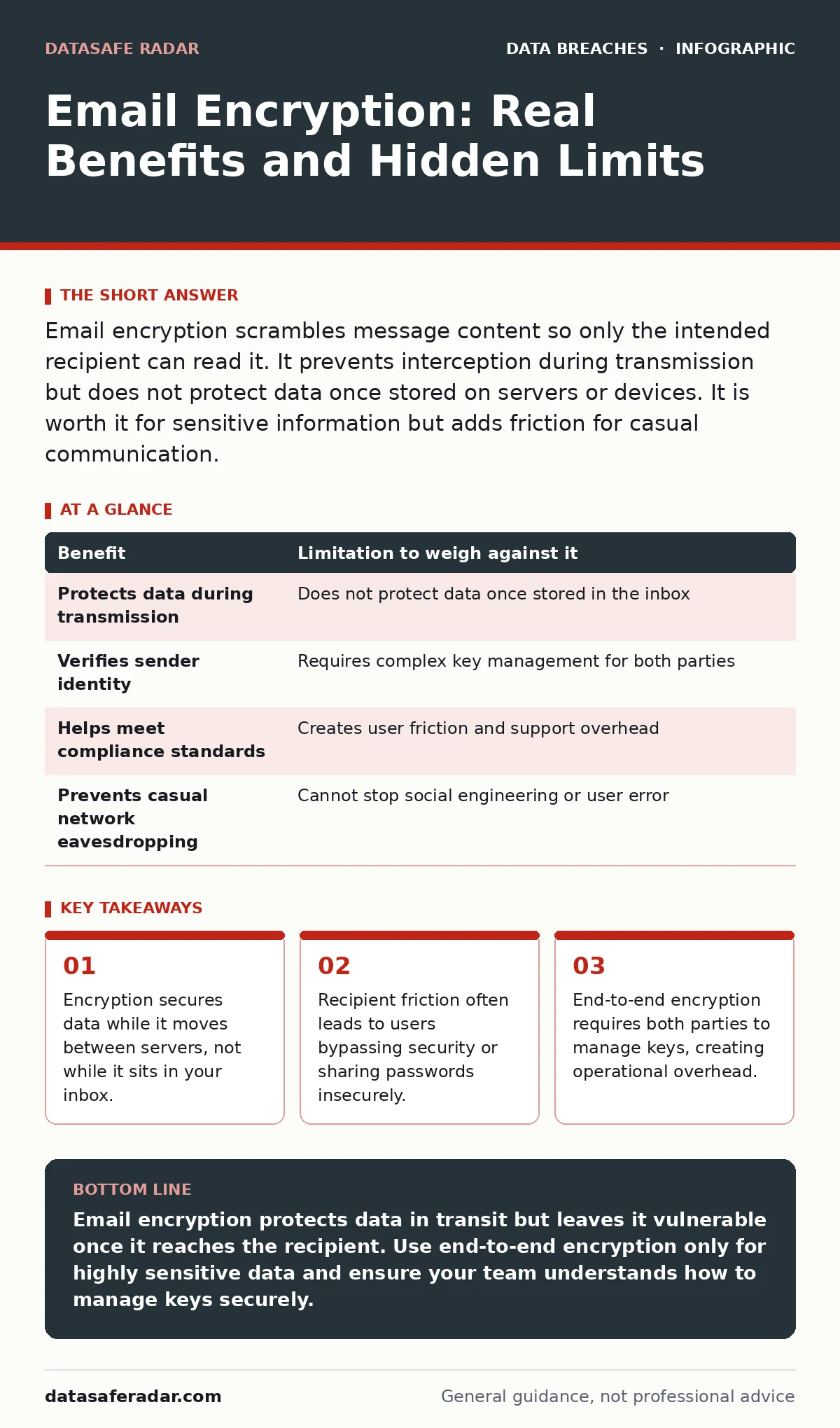
Email encryption scrambles message content so only the intended recipient can read it. It prevents interception during transmission but does not protect data once stored on servers or devices. It is worth it for sensitive information but adds friction for casual communication.
How Email Encryption Actually Works
Standard email travels in plain text. When you send a message, it passes through multiple servers before reaching the recipient. At each hop, an administrator or a network observer can read the content. Encryption changes this by scrambling the text into unreadable code. Only someone with the correct decryption key can turn that code back into readable words.
There are two main approaches. Transport-level encryption, such as TLS (Transport Layer Security), encrypts the connection between servers. It protects the message while it is moving. End-to-end encryption, such as PGP (Pretty Good Privacy) or S/MIME (Secure/Multipurpose Internet Mail Extensions), encrypts the message itself. The message stays scrambled until it reaches the specific recipient’s device.
The Concrete Benefits of Scrambling Data
The primary benefit is confidentiality during transit. If a network administrator or a third party intercepts the data stream, they see only random characters. This prevents casual eavesdropping and automated scraping of sensitive information.
It also provides a layer of authentication. With end-to-end encryption, the recipient can verify that the message came from the claimed sender. This helps reduce the effectiveness of simple spoofing attacks. The digital signature attached to the encrypted message proves the identity of the sender, assuming the key was not compromised.
For organizations, encryption helps meet compliance requirements. Many regulations require sensitive data to be protected while in motion. Using encryption demonstrates that you have taken technical steps to secure that data. It shifts the burden of proof away from you in the event of a transit interception.
The Honest Limitations You Must Accept
Encryption does not protect data at rest. Once the encrypted email lands in the recipient’s inbox, it is decrypted. If their mail server is compromised, the attacker reads the message just like the recipient does. If their computer has malware, the attacker reads it from the screen.
It also does not protect against social engineering. An attacker can trick a user into revealing the decrypted content. Encryption stops hackers from reading the wire, but it cannot stop a user from forwarding a sensitive message to the wrong person. It cannot stop a user from typing a password into a fake login page.
The Cost of User Friction
The biggest limitation of end-to-end encryption is usability. If a recipient does not have the correct software or key, they cannot read the message. They may receive a prompt to enter a password or download a certificate. This breaks the flow of communication.
Many users will abandon the encrypted message. They may reply with an unencrypted email asking for the content to be sent again. This defeats the purpose of the encryption. You have secured the channel, but the user has chosen to step outside it.
For businesses, this friction slows down operations. Support teams spend time helping users configure their mail clients. IT staff must manage key distribution and rotation. The administrative cost is higher than most organizations anticipate.
When It Is Worth It
You should use end-to-end encryption when sending highly sensitive personal data. This includes medical records, financial account numbers, or legal documents. If the data is regulated, encryption is often mandatory. The risk of exposure outweighs the inconvenience of setup.
It is also worth it for executive communications. High-value targets are often subject to surveillance or targeted attacks. Protecting strategic discussions from interception adds a layer of privacy that standard email cannot provide.
Suppose you are sending a customer breach notification letters draft to legal counsel. The content is privileged and sensitive. Using encryption ensures that only the lawyer and you can read the draft, even if it passes through a shared server.
See also: How to Detect Email Tracking Pixels in Logs and Headers · Online Anonymity for Small Businesses and Practical Privacy Controls
When It Is Not Worth It
Do not use end-to-end encryption for routine internal communications. If you are discussing lunch plans or scheduling a meeting, the overhead is unnecessary. The risk of interception is low, and the friction will annoy your colleagues.
It is not worth it for mass marketing emails. You cannot manage encryption keys for thousands of subscribers. The technical complexity makes it impractical. Standard transport-level encryption is sufficient for these cases.
If your team struggles with basic password hygiene, end-to-end encryption will likely fail. Users who reuse passwords will likely share their decryption passwords. This creates a new vulnerability. It is better to focus on credential dumps prevention and multi-factor authentication first.
Balancing Benefits and Limitations
| Benefit | Limitation to weigh against it |
|---|---|
| Protects data during transmission | Does not protect data once stored in the inbox |
| Verifies sender identity | Requires complex key management for both parties |
| Helps meet compliance standards | Creates user friction and support overhead |
| Prevents casual network eavesdropping | Cannot stop social engineering or user error |
Integrating With Other Security Measures
Email encryption is one tool in a larger toolbox. It works best when combined with other protections. For example, encrypting emails does not help if an attacker steals your login credentials. You must also protect against account takeover fraud by using strong authentication methods.
It does not replace the need for monitoring. If your keys are leaked, encryption becomes a liability. You should monitor for exposed API keys and other secrets that might be used to access your encrypted communications.
Consider dark web monitoring to detect if your credentials or keys have been sold. If they have, you must revoke and rotate your encryption keys immediately. Encryption is only as strong as the secrecy of the keys.
The Bottom Line for Implementation
Start with transport-level encryption. Ensure your email provider uses TLS by default. This protects most messages with zero user effort. Reserve end-to-end encryption for the most sensitive data. Do not force it on all users.
Train your team on when to use encryption. Explain that it protects the journey, not the destination. Encourage them to verify the recipient’s identity before sending sensitive data. Encryption is a shield, not a magic bullet.
Key takeaways
- Encryption secures data while it moves between servers, not while it sits in your inbox.
- Recipient friction often leads to users bypassing security or sharing passwords insecurely.
- End-to-end encryption requires both parties to manage keys, creating operational overhead.
Email encryption protects data in transit but leaves it vulnerable once it reaches the recipient. Use end-to-end encryption only for highly sensitive data and ensure your team understands how to manage keys securely.
Frequently asked questions
Does email encryption stop hackers from reading my inbox?
No. Encryption protects the message while it is moving between servers. Once it is stored in the recipient’s inbox, it is decrypted and readable by anyone with access to that account.
Is TLS encryption enough for sensitive data?
TLS protects data in transit between servers. It is good for general privacy but does not provide end-to-end confidentiality. For highly sensitive data, use end-to-end encryption like PGP or S/MIME.
What happens if the recipient loses their encryption key?
They cannot decrypt the message. The data is effectively lost to them. This is why key management and backup are critical parts of an encryption strategy.
Can encryption prevent phishing attacks?
Encryption can verify the sender’s identity, making spoofing harder. However, it cannot stop a user from clicking a malicious link or entering credentials on a fake site.
How this guide was produced: written by the DataSafe Radar editorial team with AI assistance, checked against the public references listed below, and reviewed when the facts change. See our editorial policy or report an error.