Credential Dumps: How Hackers Resell Stolen Login Data
Most credential dumps contain passwords that users have reused across multiple unrelated services, turning a single leak into a systemic identity crisis.
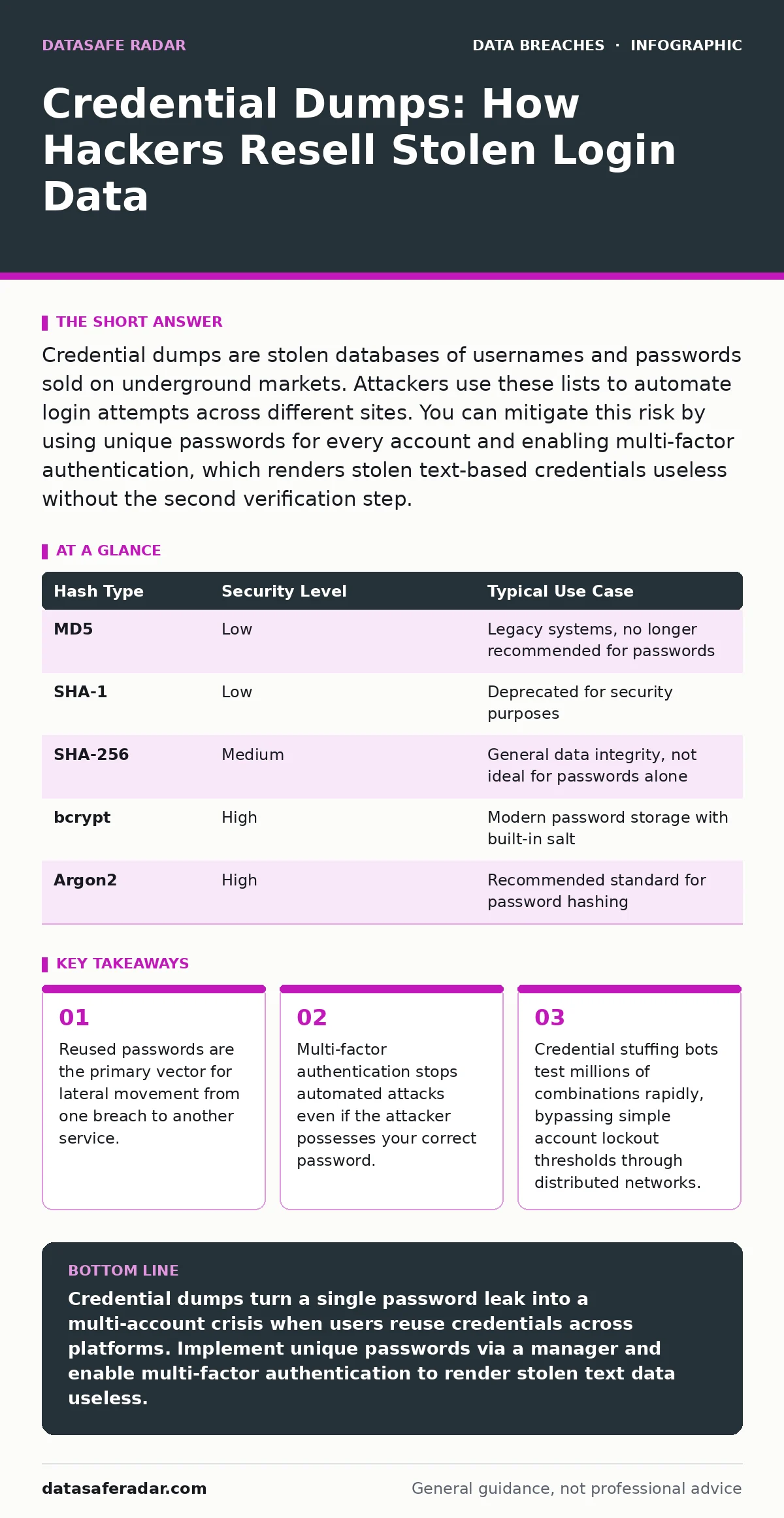
Credential dumps are stolen databases of usernames and passwords sold on underground markets. Attackers use these lists to automate login attempts across different sites. You can mitigate this risk by using unique passwords for every account and enabling multi-factor authentication, which renders stolen text-based credentials useless without the second verification step.
What is a credential dump?
A credential dump is a file containing stolen usernames and passwords, often extracted from a compromised database. These files are typically sold or traded on illicit forums where cybercriminals exchange stolen data. The data usually appears in raw text, comma-separated values, or hashed formats that attackers can attempt to reverse. Understanding that this is a commodity helps explain why small breaches often lead to widespread account compromises.
How do attackers obtain these lists?
Attackers gain access through various methods, including phishing campaigns, malware infections, and exploiting software vulnerabilities. Once inside a network, they search for databases that store user authentication information. They then exfiltrate this data, compress it, and prepare it for sale. The source of the leak matters less to the buyer than the freshness and volume of the credentials.
What is credential stuffing?
Credential stuffing is an automated attack that uses stolen username and password pairs to log into unrelated accounts. Attackers assume that users reuse the same password across multiple platforms, such as email, banking, and shopping sites. They use bots to test millions of combinations per minute against login pages. This method bypasses traditional password cracking because the attacker already knows the correct password.
Why are hashed passwords still a risk?
Hashing converts a password into a fixed-length string of characters that should not be reversible. However, if attackers obtain these hashes, they can use precomputed tables called rainbow tables to find the original password. They can also run brute-force attacks on high-performance hardware to reverse weak or common passwords. The security of a hash depends entirely on the strength of the original password and the complexity of the hashing algorithm used.
| Hash Type | Security Level | Typical Use Case |
|---|---|---|
| MD5 | Low | Legacy systems, no longer recommended for passwords |
| SHA-1 | Low | Deprecated for security purposes |
| SHA-256 | Medium | General data integrity, not ideal for passwords alone |
| bcrypt | High | Modern password storage with built-in salt |
| Argon2 | High | Recommended standard for password hashing |
How do attackers verify the data is real?
Before selling a dump, attackers often run a small subset of credentials through verification tools. These tools attempt to log into target services to confirm the account is active and the password is correct. This process, known as smurfing, filters out dead accounts and increases the value of the dump. Buyers pay more for verified lists because they reduce the time spent testing invalid combinations.
What is the impact of password reuse?
Password reuse creates a single point of failure for your entire digital identity. If you use the same password for a low-security forum and your email, a breach of the forum compromises your email. Email accounts are often used to reset passwords for banking and social media accounts. Therefore, one weak link can cascade into a total identity takeover. This is why unique passwords are the most effective defense against credential dumps.
How do you protect against these attacks?
The most effective defense is using a password manager to generate and store unique passwords for every account. This ensures that a breach on one site does not affect your credentials elsewhere. You should also enable multi-factor authentication on all accounts that support it. Multi-factor authentication requires a second form of verification, such as a code from an app, which attackers cannot obtain from a text-based credential dump.
What should you do if your data appears in a dump?
If you discover your credentials in a dump, change the password for that account immediately. Then, check if you used that same password on any other services and change those as well. Review your account activity for any unauthorized access or changes. Consider reviewing related practices, such as employee offboarding security, if the breach originated from a former employee’s access. Regular backup testing ensures you can restore data if the breach leads to ransomware or data corruption.
Key takeaways
- Reused passwords are the primary vector for lateral movement from one breach to another service.
- Multi-factor authentication stops automated attacks even if the attacker possesses your correct password.
- Credential stuffing bots test millions of combinations rapidly, bypassing simple account lockout thresholds through distributed networks.
Credential dumps turn a single password leak into a multi-account crisis when users reuse credentials across platforms. Implement unique passwords via a manager and enable multi-factor authentication to render stolen text data useless.
Frequently asked questions
Can a password manager be hacked?
Password managers use strong encryption to store your data locally or in the cloud. If the master password is strong and unique, the data remains secure even if the provider is breached.
Is multi-factor authentication enough?
Multi-factor authentication significantly reduces risk but does not eliminate it. It protects against stolen passwords but not against compromised sessions or phishing attacks that intercept the second factor.
How do I check if my email is in a dump?
You can use reputable breach notification services that scan known credential dumps. These services alert you if your email address appears in newly released data.
Why do attackers buy old credential dumps?
Many users do not change their passwords after a breach is reported. Old credentials remain valid for years, making historical dumps valuable for persistent attackers.
How this guide was produced: written by the DataSafe Radar editorial team with AI assistance, checked against the public references listed below, and reviewed when the facts change. See our editorial policy or report an error.