Encryption in Transit Myths: What Data Protection Actually Does
Encryption in transit protects data from network eavesdropping but fails to stop attackers who compromise the endpoints where data is created or consumed.

Encryption in transit secures data while it moves between systems, preventing interception on the wire. It does not protect data at rest, nor does it stop attacks on servers or devices. Misunderstanding this leads to false confidence, leaving endpoints vulnerable to credential theft, API exploitation, and malware that bypasses network-level security entirely.
Misreading: Encryption in transit protects all my data
Correct reading: Encryption in transit only protects data while it is moving between two points. Once the data reaches its destination, it is decrypted and stored in plain text unless you also use encryption at rest. Many organizations assume that because their web traffic is encrypted, their databases are secure. This is incorrect. The data is vulnerable on the server, in backups, and in logs. You must protect data at every stage of its lifecycle. Transport encryption is a single layer, not a complete shield.
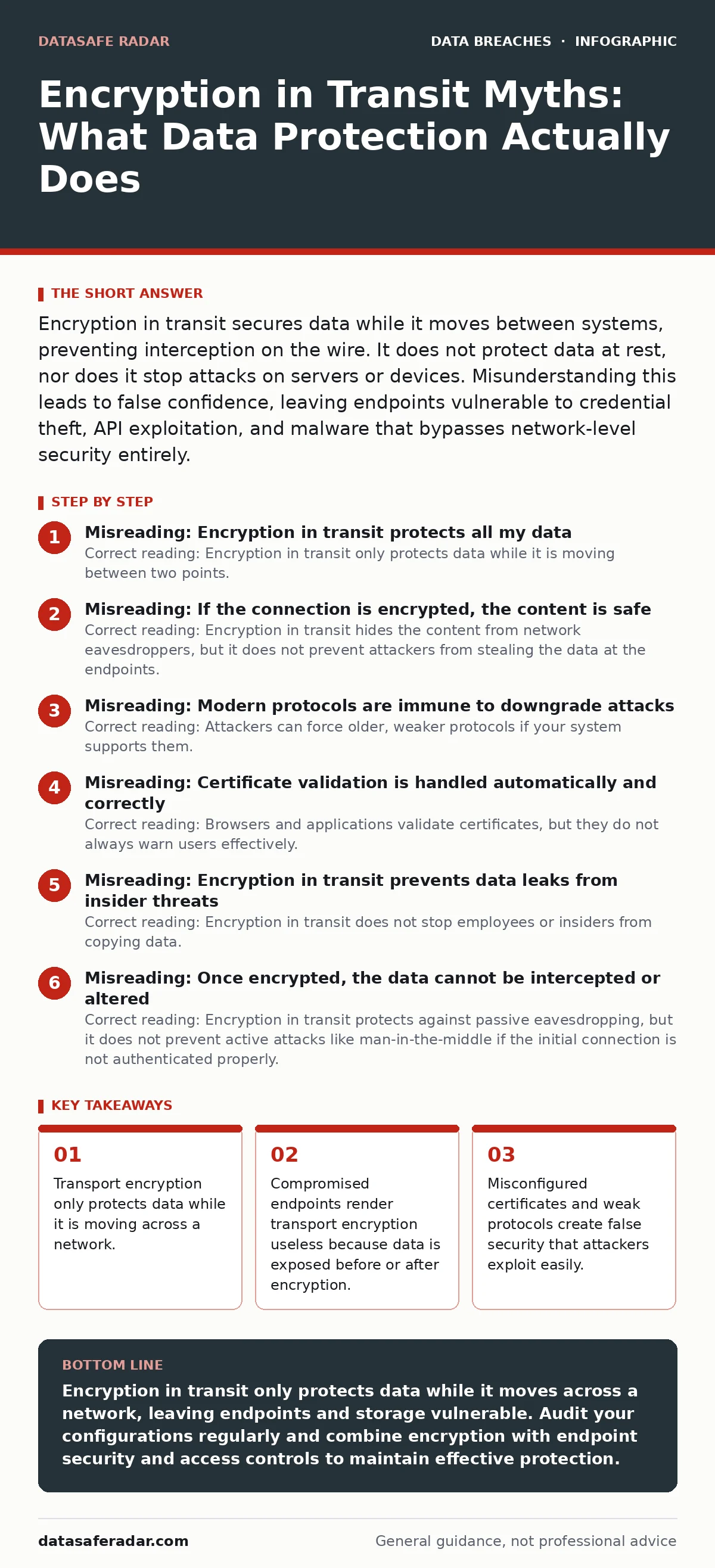
Misreading: If the connection is encrypted, the content is safe
Correct reading: Encryption in transit hides the content from network eavesdroppers, but it does not prevent attackers from stealing the data at the endpoints. Suppose an attacker compromises your web server. They can read the data before it is encrypted for outbound transmission or after it is decrypted from inbound requests. The encryption tunnel is secure, but the rooms at either end are open. This is why endpoint security matters more than network encryption alone. You need to protect the devices that create and consume the data.
Misreading: Modern protocols are immune to downgrade attacks
Correct reading: Attackers can force older, weaker protocols if your system supports them. Even if you prefer strong encryption, a misconfigured server might accept connections using outdated standards. This is called a downgrade attack. The attacker tricks the client into using a weak cipher that they can break. You must disable all legacy protocols and weak ciphers on your servers. Regular audits of your configuration are necessary to ensure that no weak options remain enabled. Do not assume that the default settings are secure.
Misreading: Certificate validation is handled automatically and correctly
Correct reading: Browsers and applications validate certificates, but they do not always warn users effectively. Many users ignore certificate errors or disable warnings to access sites. This allows attackers to use fake certificates to intercept traffic. You must configure your systems to reject invalid certificates strictly. Do not allow users to bypass security warnings. Additionally, monitor for certificate expiration and revocation. A valid certificate from a compromised authority is still dangerous. Trust is not automatic; it requires active management and verification.
Misreading: Encryption in transit prevents data leaks from insider threats
Correct reading: Encryption in transit does not stop employees or insiders from copying data. If an authorized user downloads a file, the encryption protects the transfer, but the file is then plain text on their device. Insider threats often exploit legitimate access to exfiltrate data. You need data loss prevention tools and strict access controls to monitor and limit what users can download. Encryption in transit is invisible to the user, so it provides no deterrent against intentional misuse. Combine it with user behavior analytics to detect abnormal download patterns.
See also: Web Filtering Misconceptions: 6 Errors That Leave Gaps · Data Encryption at Rest and in Transit: How to Secure Your Information
Misreading: Once encrypted, the data cannot be intercepted or altered
Correct reading: Encryption in transit protects against passive eavesdropping, but it does not prevent active attacks like man-in-the-middle if the initial connection is not authenticated properly. If an attacker can intercept the initial handshake, they might inject malicious content or redirect the user to a fake site. This is why certificate pinning and strict validation are necessary. Additionally, encryption does not protect against application-layer attacks. If the application has vulnerabilities, attackers can exploit them regardless of the transport encryption. You must secure the application logic, not just the transport layer.
Misreading: Compliance with encryption standards ensures security
Correct reading: Meeting compliance requirements does not guarantee security. Standards often define minimum thresholds, not best practices. An organization might comply with encryption standards while using weak keys or outdated algorithms that are no longer considered safe. Compliance is a checklist, not a guarantee. You must continuously evaluate your encryption configurations against current threat intelligence. Regular penetration testing and configuration audits reveal gaps that compliance checks might miss. Do not rely on compliance certificates as proof of security.
Misreading: Encryption in transit eliminates the need for network segmentation
Correct reading: Encryption in transit does not replace network segmentation. Segmentation limits the spread of attacks by isolating different parts of your network. If an attacker compromises one segment, they cannot easily move to others. Encryption in transit protects data in motion, but it does not prevent lateral movement within a network. You need both encryption and segmentation to reduce the impact of a breach. Combining these controls creates multiple layers of defense that are harder to bypass.
Misreading: All third-party services use strong encryption by default
Correct reading: Third-party services may use weak encryption or misconfigure their settings. You cannot assume that every vendor you interact with follows best practices. Verify the encryption standards used by your partners and suppliers. Check their security documentation and perform your own tests if possible. If a third-party service uses weak encryption, your data is vulnerable during transmission to or from that service. You are responsible for the security of your data, even when it is in transit to external providers.
Misreading: Encryption in transit protects against credential stuffing and replay attacks
Correct reading: Encryption in transit hides credentials during transmission, but it does not prevent attackers from using stolen credentials. If an attacker obtains valid login details, they can use them to access your systems regardless of encryption. This is why multi-factor authentication is necessary. Additionally, replay attacks involve capturing and reusing valid data packets. Encryption alone does not prevent this; you need session tokens and other mechanisms to ensure that each connection is unique and valid. Do not confuse transport security with authentication security.
Misreading: Encryption in transit is sufficient for protecting sensitive customer data
Correct reading: Encryption in transit is only one part of protecting sensitive customer data. You must also encrypt data at rest, manage access controls strictly, and monitor for breaches. Customer data is valuable to attackers, and they will target any weakness in your security posture. Relying solely on transport encryption leaves your data vulnerable at the endpoints and in storage. Combine encryption with other security measures to create a comprehensive defense. Regularly review your security controls to ensure they are effective against current threats.
Misreading: Encryption in transit prevents data corruption or loss
Correct reading: Encryption in transit protects the confidentiality of data, but it does not ensure its integrity or availability. Data can still be corrupted or lost due to network errors, hardware failures, or malicious tampering. You need additional mechanisms like checksums and digital signatures to verify data integrity. Backup and disaster recovery plans are necessary to ensure availability. Encryption is not a substitute for data integrity and availability controls. You must address all aspects of data security, not just confidentiality.
Misreading: Encryption in transit is a one-time setup task
Correct reading: Encryption in transit requires ongoing management and monitoring. Protocols and algorithms evolve, and old standards become vulnerable over time. You must regularly update your configurations to use the latest secure standards. Monitor for certificate expirations and misconfigurations. Conduct regular audits and penetration tests to identify weaknesses. Security is a continuous process, not a one-time project. Stay informed about new threats and adjust your security measures accordingly.
Misreading: Encryption in transit eliminates the need for employee training
Correct reading: Employees can still make mistakes that compromise security, regardless of encryption. Phishing attacks, social engineering, and poor password practices can lead to breaches. Encryption in transit does not protect against these human factors. You must train employees to recognize and avoid security threats. Regular training and awareness programs are necessary to keep your workforce vigilant. Technology alone cannot prevent all security incidents; human behavior plays a significant role.
Key takeaways
- Transport encryption only protects data while it is moving across a network.
- Compromised endpoints render transport encryption useless because data is exposed before or after encryption.
- Misconfigured certificates and weak protocols create false security that attackers exploit easily.
- Endpoint security and key management are required to make transport encryption effective.
Encryption in transit only protects data while it moves across a network, leaving endpoints and storage vulnerable. Audit your configurations regularly and combine encryption with endpoint security and access controls to maintain effective protection.
Frequently asked questions
Does encryption in transit protect data stored on my servers?
No, encryption in transit only protects data while it is moving between systems. Data stored on servers must be encrypted at rest to protect it from unauthorized access if the server is compromised.
Can encryption in transit stop a phishing attack?
No, encryption in transit does not prevent phishing attacks. Phishing targets users to steal credentials or install malware. You need email filtering, user training, and multi-factor authentication to mitigate phishing risks.
How do I know if my encryption in transit is configured correctly?
Use security scanning tools to check for weak protocols and misconfigurations. Regularly review your server settings and ensure that only strong, modern encryption standards are enabled.
Is encryption in transit enough to comply with data protection regulations?
Encryption in transit is often required by regulations, but it is rarely sufficient on its own. Most regulations require a comprehensive security program that includes encryption at rest, access controls, and incident response plans.
How this guide was produced: written by the DataSafe Radar editorial team with AI assistance, checked against the public references listed below, and reviewed when the facts change. See our editorial policy or report an error.