Stop Java Deserialization Attacks: The Real Prevention Hierarchy
Blocking specific classes fails because attackers write custom payloads; you must block the deserialization process entirely at the entry point.
Disable Java deserialization for untrusted data immediately. Use JSON or XML parsers instead of native Java serialization. If you must deserialize, implement a strict allowlist of classes and reject everything else. Apply runtime application self-protection (RASP) to catch bypasses that static checks miss.
Why Native Serialization Is Dangerous
Java deserialization converts a byte stream back into Java objects. The process reconstructs the object graph by calling methods like readObject. Attackers craft byte streams that trigger these methods during reconstruction. This execution happens before your application logic runs. The attacker controls the object state. You cannot trust the data because the data controls the flow. This mechanism allows remote code execution without needing a traditional injection flaw. The vulnerability exists in the library, not just your code. Any library that accepts serialized data exposes this risk.
The Allowlist Strategy Works
You must define exactly which classes your application expects. An allowlist permits only specific, known-safe classes. Everything else gets rejected immediately. This approach stops unknown exploit chains. It requires maintenance when you update your codebase. You must add new classes to the list as features change. This effort is small compared to the risk. The allowlist acts as a gatekeeper. It prevents the JVM from instantiating unexpected objects. This method is the primary defense when you cannot remove serialization.
Replace Serialization With Safer Formats
The best fix is to remove Java serialization entirely. Use JSON or XML parsers instead. These formats separate data from code. They do not execute methods during parsing. Your application remains functional. The security posture improves dramatically. You lose the convenience of native serialization. You gain predictable behavior. This change requires refactoring your data layer. The effort pays off by removing the attack surface. You no longer worry about gadget chains. This is the most durable solution.
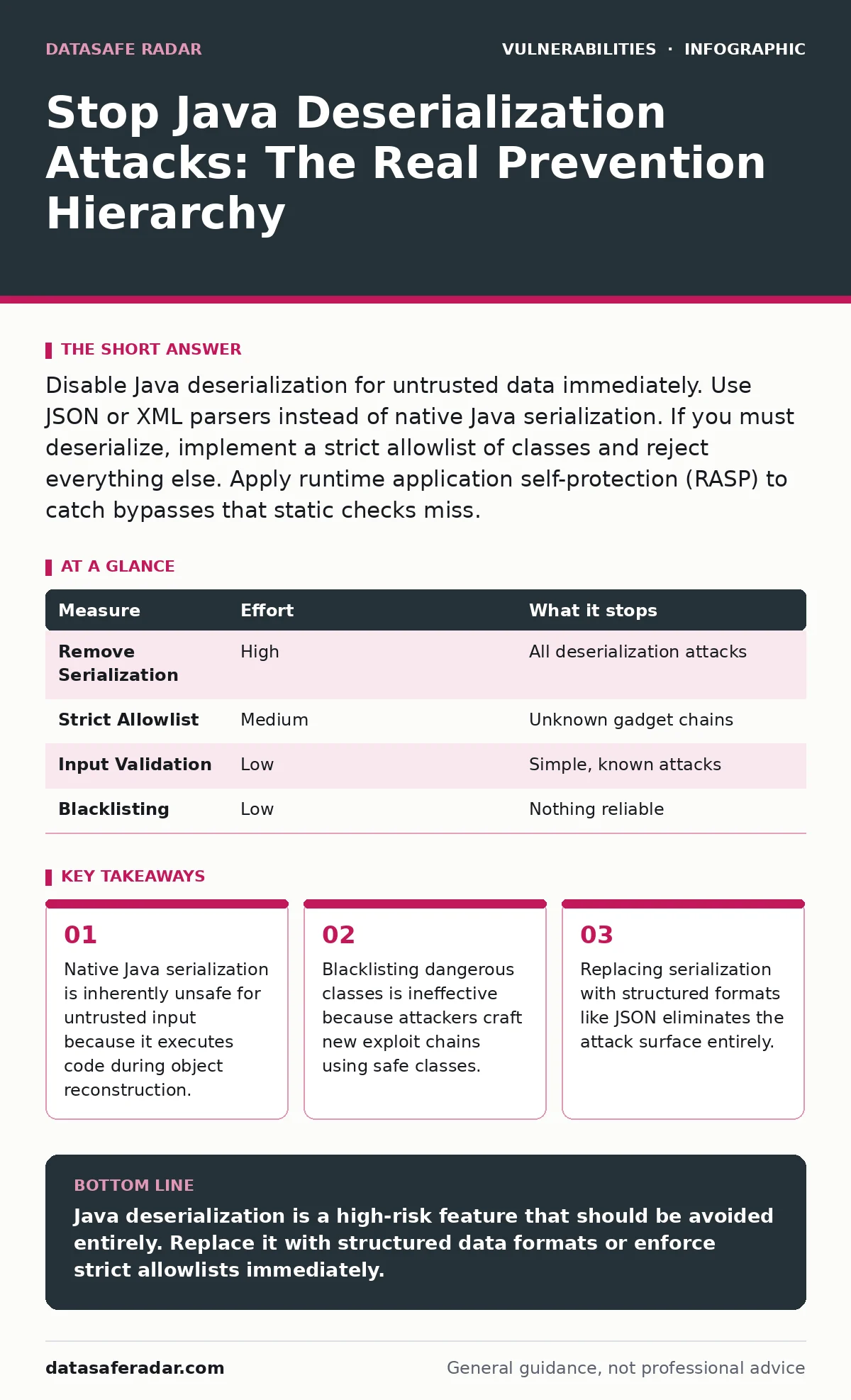
| Measure | Effort | What it stops |
|---|---|---|
| Remove Serialization | High | All deserialization attacks |
| Strict Allowlist | Medium | Unknown gadget chains |
| Input Validation | Low | Simple, known attacks |
| Blacklisting | Low | Nothing reliable |
Blacklisting Fails Against New Chains
Many teams try to block dangerous classes. This is a blacklist approach. It fails because the universe of dangerous classes is large. Attackers find new chains daily. These chains use classes you never considered dangerous. A blacklist can never be complete. You react to threats after they appear. This creates a constant game of catch-up. You will miss new vectors. Do not rely on this as a standalone control. It provides a false sense of security. The maintenance burden is high. The protection is low.
Runtime Detection Catches Bypasses
Static checks and allowlists can have gaps. Runtime application self-protection (RASP) monitors the application while it runs. It inspects the data being deserialized. It detects suspicious patterns in real-time. RASP can block execution even if the allowlist missed something. It adds a layer of defense in depth. The overhead is minimal. It helps you find misconfigurations. This tool complements your preventive measures. It does not replace them. Use it to verify your controls work. It provides visibility into actual attacks.
Input Validation Is Not Enough
You might think validating input size or format helps. This is incorrect for deserialization. The danger lies in the object structure, not the byte count. An attacker can send a small payload that triggers complex logic. Size limits do not stop code execution. Format checks do not inspect object graphs. You must validate the class names explicitly. Generic input validation tools miss this nuance. Do not assume your web application firewall blocks these attacks. Most WAFs do not understand Java object streams. You need specific logic for this threat.
Prioritize Your Remediation Efforts
Start by identifying where you deserialize data. Check all endpoints that accept binary data. Look for libraries that use ObjectInputStream. Replace these with JSON parsers where possible. If replacement is not feasible, implement an allowlist. Ensure the allowlist is strict. Test it with known exploit payloads. Do not skip testing. Verify that rejected classes are truly blocked. Monitor logs for deserialization attempts. This gives you early warning of bypasses. Combine these steps for maximum protection.
What Does Not Work
Do not rely on obfuscation. Hiding the class names does not stop attackers. They can reverse engineer the structure. Do not rely on network segmentation alone. If the application is exposed, the attack surface exists. Do not trust client-side validation. Attackers bypass the browser. They send raw HTTP requests. Server-side controls are mandatory. Do not assume Java version updates fix this. The vulnerability is in the design, not a bug. You must change how you handle data.
Checklist for Immediate Action
- Identify all endpoints that accept Java serialized data.
- Implement a strict allowlist for deserialized classes.
- Replace native serialization with JSON or XML parsers.
Key takeaways
- Native Java serialization is inherently unsafe for untrusted input because it executes code during object reconstruction.
- Blacklisting dangerous classes is ineffective because attackers craft new exploit chains using safe classes.
- Replacing serialization with structured formats like JSON eliminates the attack surface entirely.
Java deserialization is a high-risk feature that should be avoided entirely. Replace it with structured data formats or enforce strict allowlists immediately.
Frequently asked questions
Does updating Java fix deserialization vulnerabilities?
No, the vulnerability exists in the serialization mechanism itself, not in a specific Java version bug. You must change your code or libraries.
Can a firewall stop Java deserialization attacks?
Most network firewalls cannot inspect Java object streams. You need application-level controls or a specialized WAF with Java awareness.
Is JSON serialization safe from these attacks?
Yes, standard JSON parsers do not execute code during parsing. They treat data as data, eliminating the remote code execution risk.
How do I know if my library is vulnerable?
Check the library documentation for unsafe deserialization methods. Look for classes that extend `Serializable` and accept untrusted input.
How this guide was produced: written by the DataSafe Radar editorial team with AI assistance, checked against the public references listed below, and reviewed when the facts change. See our editorial policy or report an error.