Why Is Session Hijacking Successful: The Hidden Flaws in Web Trust
Attackers bypass login screens entirely by stealing the digital ticket that proves you are already authenticated to the server.

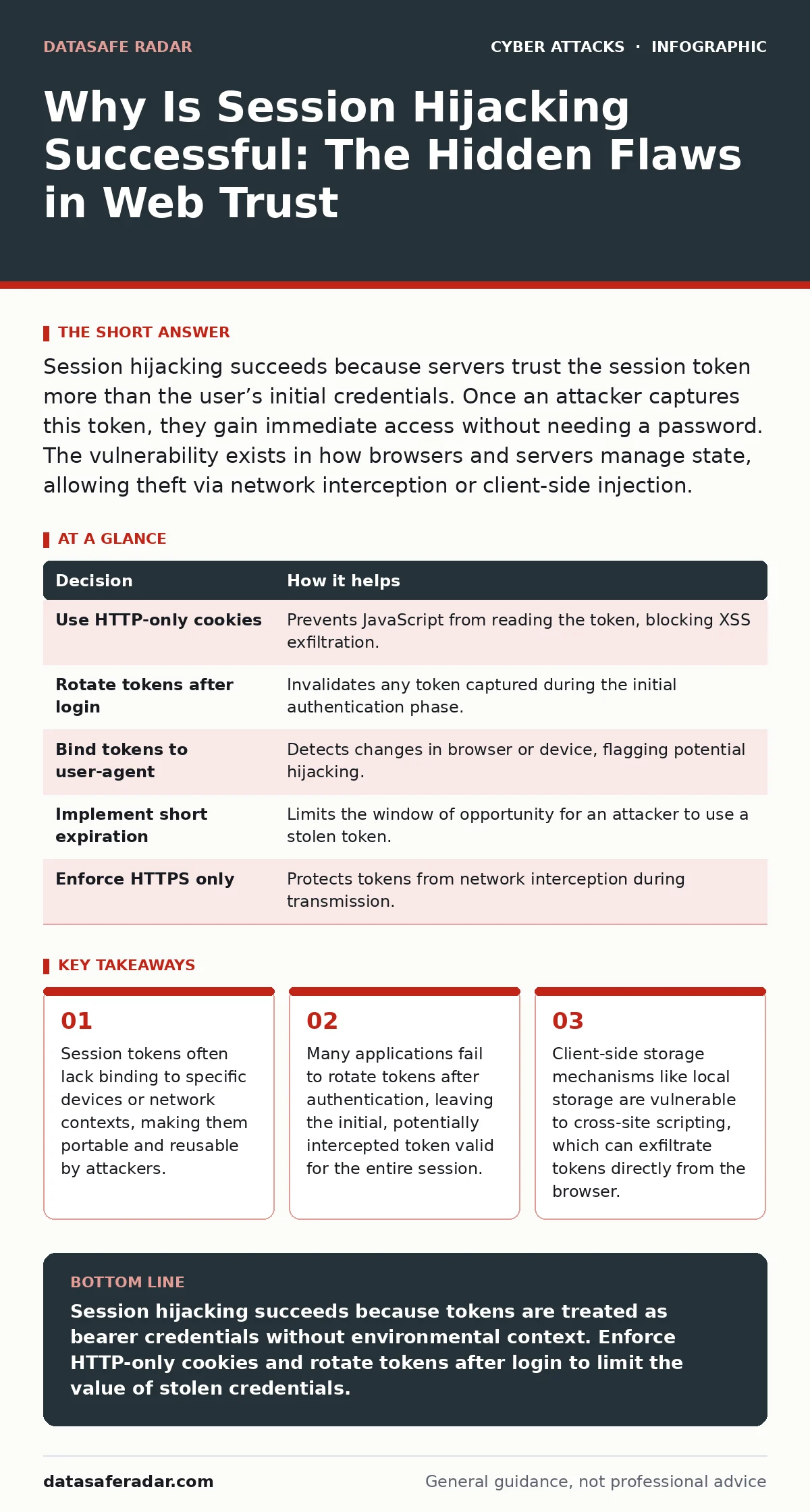
Session hijacking succeeds because servers trust the session token more than the user’s initial credentials. Once an attacker captures this token, they gain immediate access without needing a password. The vulnerability exists in how browsers and servers manage state, allowing theft via network interception or client-side injection.
Why Is Session Hijacking Successful
Session hijacking succeeds because the web relies on stateless protocols that require a persistent identifier to maintain user context. When you log in, the server issues a session token. This token acts as a digital key that grants access without requiring repeated password entry. The success of hijacking stems from the fact that this token is often transmitted in plain text or stored insecurely.
If an attacker intercepts or steals this token, they can present it to the server and be treated as the legitimate user. The server rarely verifies the physical location or device identity behind the token presentation. This design choice prioritizes usability over security, creating a gap that attackers exploit. The token becomes a bearer credential, meaning possession equals authority.
The primary reason session hijacking works is the lack of binding between the token and the user’s environment. Most web applications do not tie the session token to the user’s IP address, user-agent string, or hardware fingerprint. Suppose a user logs in from a café. An attacker on the same network can capture the token. When the attacker presents that same token from their home IP address, the server often accepts it. The server sees a valid token and assumes the user has moved networks. This flexibility is a feature for mobile users but a flaw for security. The system cannot distinguish between a legitimate user changing locations and a malicious actor using a stolen credential.
The Mechanics of Token Theft
Attackers use two main methods to steal these tokens: network interception and client-side injection. Network interception occurs when data travels over an unencrypted or poorly encrypted connection. Even with HTTPS, vulnerabilities in implementation can expose tokens. Client-side injection happens when malicious code runs in the user’s browser. This code can read tokens stored in cookies or local storage and send them to an attacker’s server. The danger lies in the transparency of these methods. The user sees no change in the interface. The browser continues to function normally. The session remains active for the legitimate user, masking the intrusion.
Cross-site scripting (XSS) is a leading cause of client-side token theft. XSS allows an attacker to inject scripts into a trusted website. If the site stores session tokens in JavaScript-accessible locations, the injected script can read and exfiltrate them. Many developers assume that HTTP-only cookies prevent this, but not all frameworks enforce this setting. Some applications store tokens in local storage for ease of access by single-page applications. Local storage is fully accessible to JavaScript, making it a prime target for XSS attacks. The token becomes just another data point that malicious scripts can harvest.
Decision | How it helps
| Decision | How it helps |
|---|---|
| Use HTTP-only cookies | Prevents JavaScript from reading the token, blocking XSS exfiltration. |
| Rotate tokens after login | Invalidates any token captured during the initial authentication phase. |
| Bind tokens to user-agent | Detects changes in browser or device, flagging potential hijacking. |
| Implement short expiration | Limits the window of opportunity for an attacker to use a stolen token. |
| Enforce HTTPS only | Protects tokens from network interception during transmission. |
The Cost of Convenience
Web applications prioritize seamless user experience, which often leads to security compromises. Long-lived sessions reduce friction for users who do not want to log in repeatedly. However, this convenience extends the life of a session token. A longer-lived token increases the probability of theft. If a token is valid for 30 days, an attacker has 30 days to find a way to steal it.
If it is valid for 15 minutes, the attacker must act quickly. The trade-off is clear: convenience expands the attack surface. Developers often ignore this trade-off because the immediate benefit of user retention outweighs the abstract risk of hijacking. This mindset persists across industries, creating a standardized vulnerability.
Another hidden cost is the assumption that encryption solves all problems. Many organizations believe that using HTTPS prevents session hijacking. While HTTPS protects tokens in transit, it does not protect them once they reach the browser. If the application has an XSS vulnerability, HTTPS provides no defense against token theft. The encryption ends at the browser. The token is then processed by JavaScript, which can be compromised. This misconception leads teams to neglect client-side security controls. They focus on network security while ignoring the application logic that manages the session state.
What Goes Wrong Otherwise
Without proper session management, the application relies on the integrity of the client. This is a fundamental flaw because the client is under the attacker’s control. If the application does not validate the session context, it accepts any valid token regardless of origin. The server becomes a blind follower of the token’s authority. It does not question why a token issued to a Chrome browser on Windows is now being used by a Firefox browser on Linux. This lack of contextual awareness allows attackers to use stolen tokens from different environments. The system fails to detect the anomaly because it was not designed to look for it.
Furthermore, many applications fail to invalidate sessions upon logout. The token remains valid until it expires naturally. If an attacker steals the token before the user logs out, they can continue to use it even after the user has closed their browser. The server has no record that the user intended to end the session. This persistence means that a single theft can result in prolonged unauthorized access. The user may not notice the intrusion until damage is done. The application’s failure to actively destroy the token on logout leaves a trail of valid credentials for attackers to follow.
What To Do With That Knowledge
You can mitigate session hijacking by enforcing strict token management policies. Start by ensuring all session cookies are marked as HTTP-only and Secure. HTTP-only prevents JavaScript access, while Secure ensures transmission only over HTTPS. These two flags drastically reduce the surface area for client-side and network-based attacks. Next, implement token rotation after every sensitive action, including login. This ensures that any token captured during the initial handshake becomes useless immediately after authentication. The attacker must steal a new token, which requires a new attack vector.
Bind the session token to the user’s environment where possible. Store the user-agent string and IP address range with the session. If the user-agent changes significantly, invalidate the session. This adds friction for legitimate users who switch devices, but it blocks most hijacking attempts. Attackers rarely match the exact browser and device signature of the victim. This binding creates a contextual lock that makes stolen tokens harder to use. You must balance this security with user experience, but the risk of hijacking justifies the occasional re-authentication prompt.
Integrating Broader Security Measures
Session security does not exist in isolation. It works best when combined with other security layers. For instance, intrusion detection systems can monitor for unusual session patterns, such as rapid geographic changes or multiple concurrent sessions from different devices. These systems provide visibility into attacks that bypass application-level controls. Similarly, incident response plans should include procedures for session revocation. When a breach is detected, the ability to instantly invalidate all active sessions for affected users is critical. This limits the impact of the hijacking and reduces data exposure.
Authentication methods also play a role. While session hijacking bypasses passwords, strong initial authentication makes it harder for attackers to gain the first foothold. Password managers help users create unique, complex passwords, reducing the risk of credential stuffing attacks that often precede session hijacking.
For even stronger protection, consider passkeys. Passkeys use public-key cryptography and are bound to the device, making them resistant to phishing and remote theft. While they do not eliminate session hijacking entirely, they raise the bar for initial access. This layered approach ensures that if one control fails, others remain to protect the user.
Final Considerations for Developers
Developers must understand that session management is a continuous process. It is not a one-time configuration. As applications evolve, new features may introduce vulnerabilities. Single-page applications, for example, often require different token handling strategies than traditional multi-page apps. These apps may need to refresh tokens automatically, which can complicate security.
Developers must ensure that refresh tokens are also protected and rotated. They must also consider the impact of third-party libraries. A vulnerable library can introduce XSS flaws that compromise session security. Regular code reviews and dependency audits are necessary to maintain a secure session management framework.
The goal is to make session tokens useless to attackers. This requires a combination of technical controls and architectural decisions. By limiting token lifetime, restricting access, and binding tokens to context, you reduce the value of a stolen token. You also reduce the window of opportunity for an attacker. This approach acknowledges that theft will happen. It focuses on minimizing the impact rather than preventing the theft entirely. This realistic mindset leads to more resilient systems that can withstand sophisticated attacks.
Key takeaways
- Session tokens often lack binding to specific devices or network contexts, making them portable and reusable by attackers.
- Many applications fail to rotate tokens after authentication, leaving the initial, potentially intercepted token valid for the entire session.
- Client-side storage mechanisms like local storage are vulnerable to cross-site scripting, which can exfiltrate tokens directly from the browser.
Session hijacking succeeds because tokens are treated as bearer credentials without environmental context. Enforce HTTP-only cookies and rotate tokens after login to limit the value of stolen credentials.
Frequently asked questions
Can HTTPS prevent session hijacking?
HTTPS protects tokens during transmission but does not prevent theft from the browser via cross-site scripting. You need additional client-side protections like HTTP-only cookies.
How do I know if my session has been hijacked?
Look for unexpected actions in your account history, such as password changes or data exports from unfamiliar locations. Implement monitoring to alert on suspicious session behavior.
Is session hijacking the same as a man-in-the-middle attack?
No. A man-in-the-middle attack is a method of interception. Session hijacking is the result. An attacker can use a man-in-the-middle attack to steal a session token, but they can also use other methods like XSS.
Do passkeys prevent session hijacking?
Passkeys secure the initial authentication, making it harder to gain the first session. They do not directly prevent the theft of an existing session token, but they reduce the risk of initial compromise.
How this guide was produced: written by the DataSafe Radar editorial team with AI assistance, checked against the public references listed below, and reviewed when the facts change. See our editorial policy or report an error.