AI Model Serving Framework Vulnerabilities: 8 Questions Answered
Model serving frameworks often expose debug endpoints and deserialization vectors that bypass standard web security controls.

AI serving frameworks introduce unique risks like model theft, prompt injection via API, and unsafe deserialization. You must isolate these services, validate all inputs strictly, and disable unused debugging features to prevent data exfiltration and remote code execution.
What makes AI model serving frameworks different from standard web apps?
AI model serving frameworks handle complex binary data and stateful inference processes that standard web applications do not manage. These frameworks often run with higher system privileges because they need direct access to GPU resources and large memory blocks. This privilege elevation means that a vulnerability in the serving layer can lead to remote code execution on the host machine, not just a web page takeover. You must treat these services as high-value targets because they bridge the gap between network input and powerful hardware resources.
Do standard web application firewalls protect AI endpoints?
Standard web application firewalls often fail to protect AI endpoints because they cannot parse the specialized binary formats used for model inference. Many serving frameworks use protocols like gRPC or custom binary streams that traditional firewalls treat as opaque blobs. If the firewall cannot inspect the payload, it cannot detect malicious inputs designed to exploit the model’s logic or the framework’s parsing routines. You need application-level validation that understands the specific schema of your model’s input data to catch these threats.
How does deserialization risk appear in model serving?
Deserialization risk appears when a serving framework reconstructs objects from serialized data sent by a client. If the framework allows arbitrary class instantiation during this process, an attacker can inject crafted data that executes code when the object is rebuilt. This mirrors the dangers found in Java deserialization vulnerabilities, where trusted code processes untrusted data without sufficient validation. You must restrict the classes that can be instantiated and prefer schema-based serialization formats that do not support arbitrary code execution during deserialization.
Can attackers steal the AI model itself?
Attackers can steal the AI model by querying the inference endpoint with many inputs and analyzing the outputs to reconstruct the model’s weights. This technique, known as model extraction, works because the API reveals how the model responds to specific data points. Over time, an attacker can build a surrogate model that behaves identically to yours, effectively stealing your intellectual property. You should implement rate limiting and monitor for anomalous query patterns that suggest systematic probing of the model’s decision boundaries.
What is the risk of prompt injection in serving layers?
Prompt injection occurs when an attacker embeds malicious instructions in the input data, causing the model to ignore its original programming. In a serving framework, this can lead to the model revealing sensitive system information or performing unauthorized actions if the model has tool-use capabilities. The serving layer often lacks context about the user’s intent, so it passes the malicious prompt directly to the model. You must treat all user input as untrusted and implement pre-processing filters to detect and block injection attempts before they reach the model.
Why are debugging endpoints a security liability?
Debugging endpoints expose internal state, memory dumps, and configuration details that attackers can use to map the application’s architecture. Many serving frameworks include these endpoints for development convenience but fail to disable them in production environments. An attacker who discovers an active debug endpoint can often retrieve sensitive keys, model weights, or even execute commands on the server. You must disable all debugging and profiling interfaces in production and restrict access to any remaining diagnostic tools using strict network policies.
How does resource exhaustion affect model serving security?
Resource exhaustion attacks overwhelm the serving framework by requesting computationally expensive inferences, causing denial of service. Unlike traditional web attacks, these requests are valid from a protocol perspective but consume disproportionate GPU or CPU cycles. The framework cannot distinguish between a legitimate complex query and a malicious one designed to crash the service. You must implement resource quotas per user and monitor for requests that trigger unusually high computational costs, blocking them before they degrade service for others.
What isolation strategies protect the underlying infrastructure?
Isolation strategies prevent a compromised serving container from accessing other parts of the infrastructure. Running the model server in a separate network segment with limited outbound connectivity reduces the blast radius of an attack. Using minimal base images removes unnecessary binaries that could be exploited for privilege escalation, similar to mitigating Windows privilege escalation vulnerabilities. You should also use read-only filesystems for the container and ensure that the service account has only the permissions strictly required to load the model and serve requests.
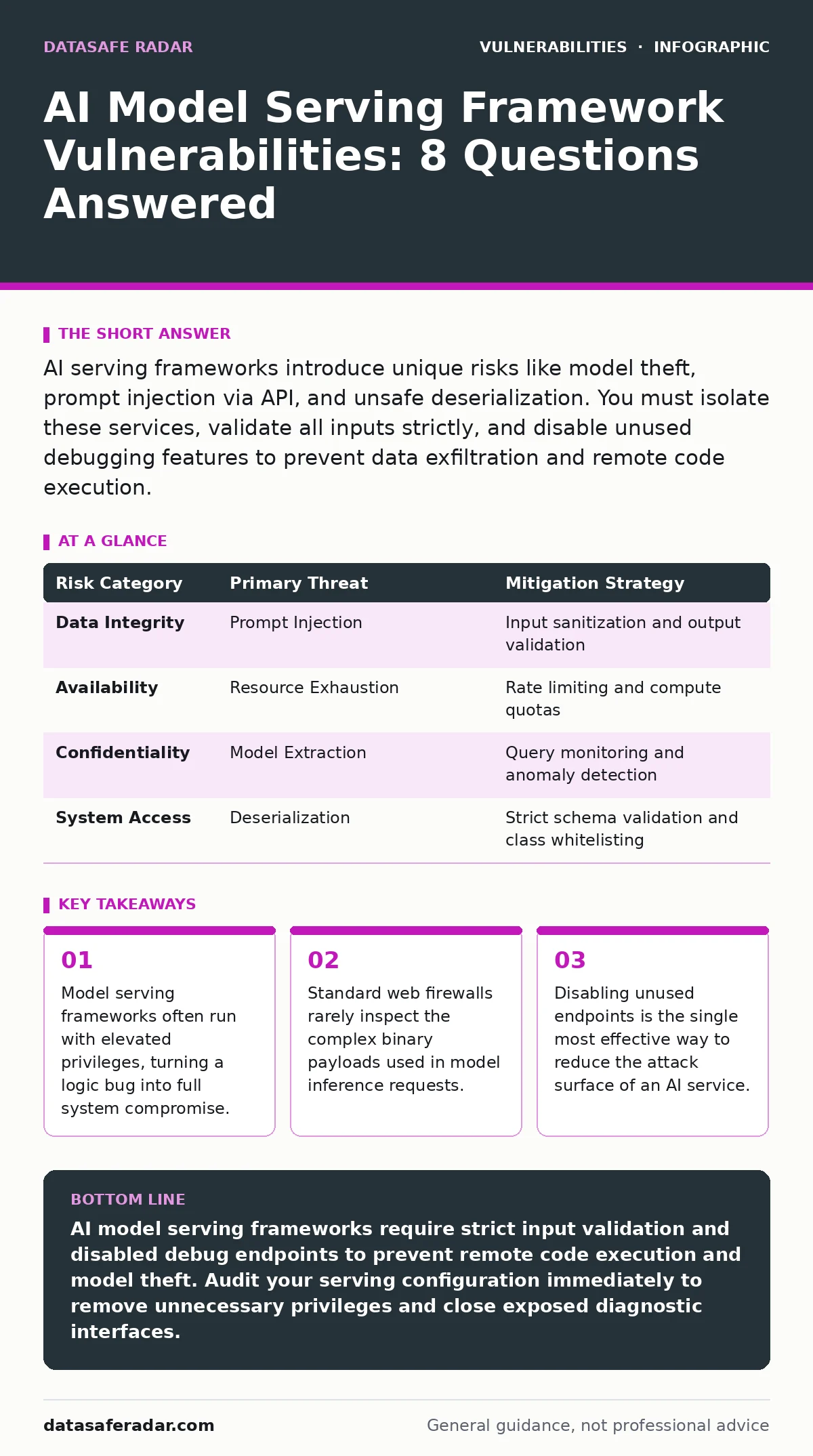
| Risk Category | Primary Threat | Mitigation Strategy |
|---|---|---|
| Data Integrity | Prompt Injection | Input sanitization and output validation |
| Availability | Resource Exhaustion | Rate limiting and compute quotas |
| Confidentiality | Model Extraction | Query monitoring and anomaly detection |
| System Access | Deserialization | Strict schema validation and class whitelisting |
How do you handle updates to serving frameworks?
Updating serving frameworks is challenging because compatibility with existing models and infrastructure must be preserved. Many organizations delay updates to avoid breaking changes, leaving known vulnerabilities unpatched for long periods. This mirrors the risks of end-of-life software management, where unsupported software accumulates security debt. You should establish a testing pipeline that validates new framework versions against your current model inputs before deploying them to production.
What role does input validation play in AI security?
Input validation ensures that the data sent to the model conforms to expected formats and ranges. Without strict validation, malformed inputs can crash the serving process or trigger unexpected behavior in the model. This is similar to how cross-site request forgery (CSRF) protections validate the origin of requests to prevent unauthorized actions. You must define strict schemas for all inputs and reject any data that does not match these schemas before it reaches the model inference engine.
Key takeaways
- Model serving frameworks often run with elevated privileges, turning a logic bug into full system compromise.
- Standard web firewalls rarely inspect the complex binary payloads used in model inference requests.
- Disabling unused endpoints is the single most effective way to reduce the attack surface of an AI service.
AI model serving frameworks require strict input validation and disabled debug endpoints to prevent remote code execution and model theft. Audit your serving configuration immediately to remove unnecessary privileges and close exposed diagnostic interfaces.
Frequently asked questions
Are AI vulnerabilities covered by standard penetration testing?
Standard penetration tests often miss AI-specific risks because testers focus on traditional web vulnerabilities rather than model logic or inference patterns. You need specialized testing that includes adversarial input generation.
Does encrypting traffic stop model extraction attacks?
Encrypting traffic prevents eavesdropping but does not stop model extraction because the attacker interacts directly with the API. The model responds to queries regardless of whether the connection is encrypted.
How do I detect a prompt injection attack?
You can detect prompt injection by monitoring for outputs that deviate from expected formats or contain sensitive information. Anomaly detection on the output side is more effective than input filtering alone.
Is it safer to run models on-premise or in the cloud?
Neither option is inherently safer; both face similar vulnerabilities in the serving framework. The risk depends on your configuration, network isolation, and access controls rather than the hosting environment.
How this guide was produced: written by the DataSafe Radar editorial team with AI assistance, checked against the public references listed below, and reviewed when the facts change. See our editorial policy or report an error.