Malware Obfuscation: How Code Hides in Plain Sight
Obfuscation transforms readable code into chaotic noise, allowing malicious programs to bypass signature-based detection while retaining their harmful functionality.
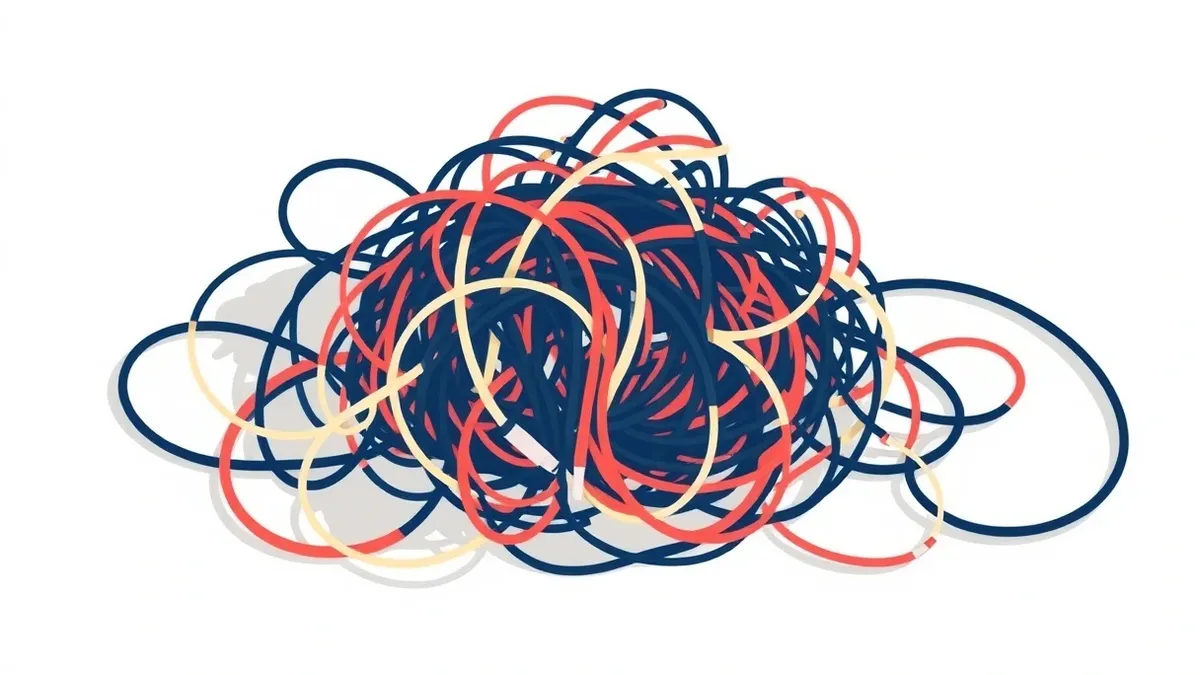
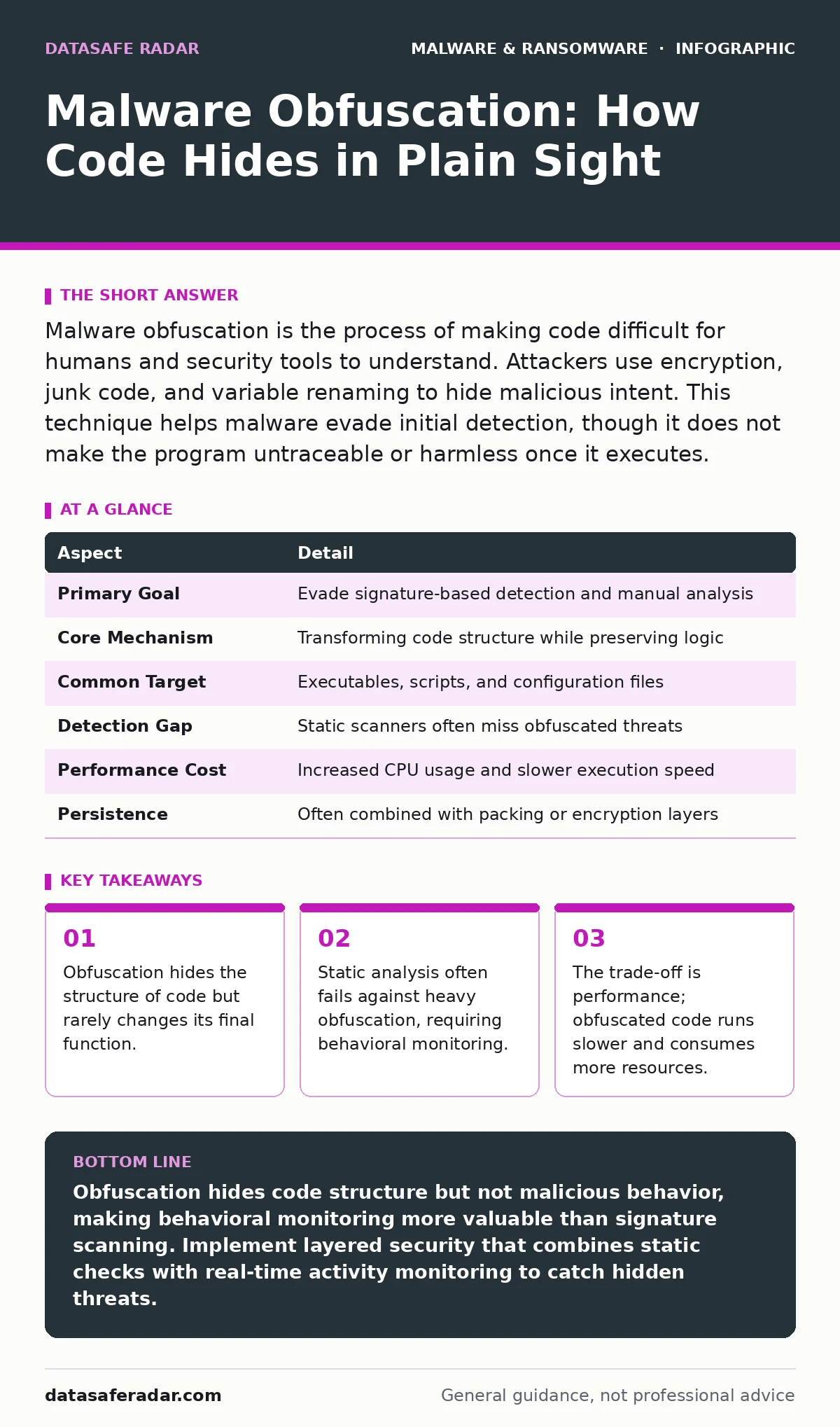
Malware obfuscation is the process of making code difficult for humans and security tools to understand. Attackers use encryption, junk code, and variable renaming to hide malicious intent. This technique helps malware evade initial detection, though it does not make the program untraceable or harmless once it executes.
The Camouflage of Digital Code
Imagine writing a letter in a language only you understand, then shredding it and mixing the pieces with confetti. The message remains, but no one can read it without the correct tools and patience. Malware obfuscation works similarly. It takes functional, malicious code and scrambles it so that security software and human analysts cannot easily recognize what it does.
The term comes from the Latin word for "obscure." In cybersecurity, it refers to any technique that makes code harder to analyze without changing its behavior. Attackers use this to slip past initial security checks.
| Aspect | Detail |
|---|---|
| Primary Goal | Evade signature-based detection and manual analysis |
| Core Mechanism | Transforming code structure while preserving logic |
| Common Target | Executables, scripts, and configuration files |
| Detection Gap | Static scanners often miss obfuscated threats |
| Performance Cost | Increased CPU usage and slower execution speed |
| Persistence | Often combined with packing or encryption layers |
How the Scrambling Works
At its simplest, obfuscation renames variables and functions. Instead of a function named delete_system_files, an attacker might call it calc_tax. This confuses anyone reading the source code. It does not stop the program from running, but it hides the intent.
Attackers also inject "junk" code. This is useless logic that runs but does nothing. It creates noise. Security tools scanning for specific patterns may get lost in the clutter. The malicious instruction is buried under thousands of harmless lines.
Another method is control flow flattening. Normal code runs in a logical order: step one, then step two. Flattened code jumps randomly between states. A central dispatcher decides the next step based on a hidden state variable. This destroys the linear structure that analysts rely on to map out behavior.
The Day-to-Day Reality for Analysts
For security teams, obfuscation turns a quick scan into a deep dive. Static analysis examines the code without running it. This is fast but ineffective against heavy obfuscation. The code looks like random garbage.
Analysts must switch to dynamic analysis. This involves running the malware in a safe, isolated environment called a sandbox. They watch what the program does, not what it says it does. If the obfuscated code tries to contact a known command-and-control server, the behavior reveals the threat.
This process is slow. It requires specialized hardware and skilled personnel. Many organizations lack the resources to reverse-engineer every new sample they encounter. This gap allows obfuscated malware to persist longer in networks.
The Hidden Cost of Hiding
Obfuscation is not free. It adds overhead. Every layer of encryption or junk code increases the file size. It also increases the processing power needed to run the program.
This creates a detectable side effect. An obfuscated program often consumes more CPU cycles than a clean version. It may take longer to start. In a high-performance environment, this lag can be a red flag.
Attackers must balance stealth with performance. If the malware is too slow, users notice. If it is too small and clean, scanners detect it. This tension limits how far attackers can push obfuscation.
What People Usually Get Wrong
A common mistake is assuming obfuscation equals encryption. Encryption hides data using a key. Obfuscation hides logic using complexity. You can reverse engineer obfuscated code. You cannot easily decrypt data without the key.
Another error is believing obfuscation stops all detection. It only stops signature-based detection. Modern security relies on real-time protection that monitors behavior. If a program tries to encrypt files rapidly, it looks like ransomware, regardless of how well the code is hidden.
Some think that if they cannot read the code, it is safe. This is false. Malicious code can be obfuscated and still cause damage. The lack of readability does not imply a lack of danger.
The Limits of Obfuscation
Obfuscation degrades over time. As analysts study a specific obfuscator, they learn its patterns. They create new signatures for the obfuscation engine itself. This is known as "meta-detection."
Attackers must constantly change their methods. This leads to an arms race. Today’s effective technique becomes tomorrow’s known pattern. The cost of development rises as attackers must build new tools to stay ahead.
Also, obfuscation can introduce bugs. Complex code is fragile. A small error in the obfuscation process can break the malware. It may fail to execute or crash the host system. This unreliability is a significant weakness for attackers.
Defense Against the Hidden
You cannot simply scan for obfuscation. You must look for the results of the code. Focus on what the program tries to do. Does it modify system settings? Does it contact unknown domains?
Use layered security. Combine static scanning with behavioral monitoring. If a file is obfuscated, the static scan may pass. The behavioral monitor will catch the action. This combination closes the gap.
Regular updates help. Security vendors add new detection rules for common obfuscation techniques. Keeping your tools current ensures you benefit from the latest meta-detections.
The Bigger Picture
Obfuscation is a tool, not a strategy. It supports other attacks. It is often used with fileless malware that lives in memory. Since there is no file to scan, obfuscation in scripts or commands becomes even more critical.
It also aids DLL sideloading attacks. Attackers hide malicious code in legitimate-looking libraries. The obfuscation makes it hard to distinguish the malicious library from a standard system file.
Understanding obfuscation helps you appreciate why firmware malware is so dangerous. Firmware is rarely scanned in detail. Obfuscation in firmware allows threats to persist across reboots and OS reinstallations.
Summary of Mechanisms
Obfuscation relies on complexity. It hides intent behind noise. While it can bypass initial checks, it cannot hide behavior. The trade-off is performance and reliability.
For defenders, the key is to ignore the code structure and focus on actions. Behavioral analysis remains the most effective countermeasure. Static tools are necessary but insufficient on their own.
Key takeaways
- Obfuscation hides the structure of code but rarely changes its final function.
- Static analysis often fails against heavy obfuscation, requiring behavioral monitoring.
- The trade-off is performance; obfuscated code runs slower and consumes more resources.
Obfuscation hides code structure but not malicious behavior, making behavioral monitoring more valuable than signature scanning. Implement layered security that combines static checks with real-time activity monitoring to catch hidden threats.
Frequently asked questions
Can I remove obfuscation from a file?
You can deobfuscate code using specialized tools, but this is complex and often incomplete. The resulting code may still be difficult to analyze.
Does antivirus software detect obfuscated malware?
Modern antivirus uses behavioral analysis to detect obfuscated threats, but older signature-based systems may miss them. Ensure your software uses advanced detection methods.
Is obfuscation illegal?
Obfuscation itself is a neutral technique used in legitimate software development. It becomes illegal when used to facilitate malicious activities.
How do I know if my code is obfuscated?
Look for unreadable variable names, excessive junk code, and flattened control flow. Legitimate software may use some obfuscation, but malicious code often relies on it heavily.
How this guide was produced: written by the DataSafe Radar editorial team with AI assistance, checked against the public references listed below, and reviewed when the facts change. See our editorial policy or report an error.