Differential Privacy Example: How Noise Protects Your Data
Differential privacy adds calculated noise to datasets, ensuring that the presence or absence of any single individual cannot be determined from the results.
Differential privacy example: A company adds random statistical noise to user data before analysis. This ensures that removing one person’s record does not change the output. You get useful trends without exposing individual identities, balancing utility with strict privacy guarantees for every record in the database.
What is differential privacy?
Differential privacy is a mathematical framework that quantifies the loss of privacy when releasing information about a database. It ensures that the output of a query remains nearly the same whether or not any specific individual’s data is included in the set. This approach shifts the focus from protecting data at rest to protecting the answers derived from that data. Traditional security measures like encryption protect the storage of data but do nothing once the data is accessed and analyzed. Differential privacy addresses this gap by altering the results themselves. It introduces controlled randomness, known as noise, into the calculation.
This noise is calibrated to obscure the contribution of any single user while preserving the overall statistical accuracy of the group. The system does not hide the truth about the population; it hides the truth about the individual within that population. This distinction allows organizations to share valuable insights without violating user trust. The mechanism works regardless of what other information an attacker might already possess. It provides a rigorous guarantee rather than a vague promise of anonymity. Users do not need to trust the organization’s intentions; they can trust the mathematics governing the data release. This creates a provable boundary between public knowledge and private identity.
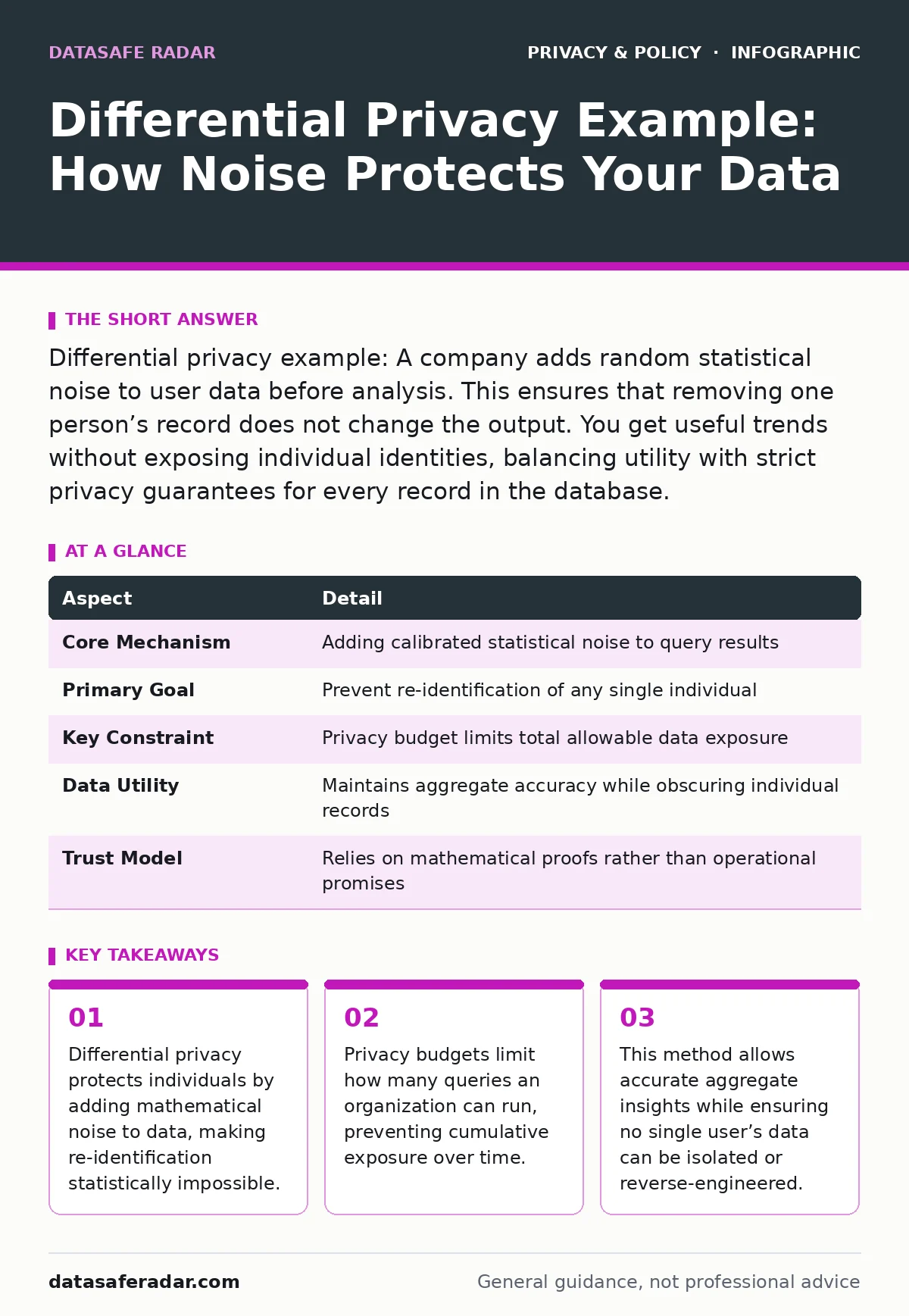
| Aspect | Detail |
|---|---|
| Core Mechanism | Adding calibrated statistical noise to query results |
| Primary Goal | Prevent re-identification of any single individual |
| Key Constraint | Privacy budget limits total allowable data exposure |
| Data Utility | Maintains aggregate accuracy while obscuring individual records |
| Trust Model | Relies on mathematical proofs rather than operational promises |
How differential privacy example works in practice
Imagine a health research group wants to study the average blood pressure of a city. They collect readings from 10,000 residents. Without protection, a clever analyst could potentially isolate a specific person’s data by comparing two different query results. With differential privacy, the system adds a small amount of random noise to the final average. If the true average is 120, the released result might be 120.3 or 119.7. This tiny variance is insignificant for large-scale trends. However, it makes it mathematically impossible to determine if a specific individual with a rare blood pressure reading contributed to the dataset.
The noise level depends on the sensitivity of the query. Queries that could reveal more about a single person require more noise. This trade-off is explicit and measurable. The system calculates exactly how much uncertainty is introduced. It ensures that the probability of any outcome is nearly identical whether your data is present or absent. This property is called the privacy parameter. A lower parameter means more noise and stronger privacy. A higher parameter means less noise but weaker privacy guarantees. Organizations must choose this balance carefully based on the sensitivity of the information they handle.
The role of privacy budgets
A critical component of this framework is the privacy budget. This budget represents the total amount of privacy loss an organization is willing to incur across all queries. Each time a query is run against the data, it consumes a portion of this budget. Once the budget is exhausted, no further queries can be made until new data is collected or the budget is reset. This prevents an attacker from making thousands of small queries to gradually erode privacy protections. Without a budget, an analyst could ask enough questions to reconstruct the entire database through cumulative small leaks.
The budget forces organizations to prioritize their most valuable queries. It encourages efficient data usage and reduces the risk of accidental over-exposure. This constraint often surprises data scientists who are used to unlimited access. They must plan their analysis carefully to stay within the limits. This discipline leads to more intentional and higher-quality research outcomes. It also provides a clear audit trail for how much privacy has been spent. Regulators and users can verify that the organization stayed within its declared limits. This transparency builds trust in the data handling process.
Who is affected by these changes
Organizations that collect large volumes of personal data are the primary adopters of this technology. Tech companies use it to improve services like spell check and location mapping without storing individual user logs. Healthcare providers use it to share research findings without exposing patient records. The general public benefits from these protections even if they never interact with the mechanism directly. However, individuals who opt out of data collection may find their data less useful in aggregate studies.
This creates a tension between individual opt-out rights and group privacy. If too many people opt out, the noise required to protect the remaining users increases. This can degrade the quality of the insights for everyone. Therefore, widespread participation is often necessary for the system to work effectively. Users should understand that their data contributes to the statistical mass that dilutes individual identifiers. Opting out does not always mean greater privacy; it can sometimes make the remaining data more sensitive.
What people usually get wrong
Many people confuse differential privacy with traditional anonymization. Anonymization removes direct identifiers like names and social security numbers. Differential privacy goes further by obscuring the statistical contribution of each record. Anonymized data can often be re-identified by linking it with other public datasets. Differential privacy provides a mathematical guarantee against this type of linkage attack. Another common misconception is that the added noise ruins the data’s usefulness. For large datasets, the noise is negligible and does not affect major trends. The accuracy loss is proportional to the square root of the dataset size. For millions of records, the impact is virtually invisible to analysts.
People also assume that this technology protects against all types of data breaches. It only protects against inference attacks on query results. It does not prevent hackers from stealing the raw database. Organizations must still use standard security measures like encryption and access controls. Differential privacy is a layer of defense, not a complete solution. It works best when combined with other privacy practices. You should view it as part of a broader strategy for privacy by design. It complements tools like secure DNS and app permission management by securing data at the analytical layer.
See also: Privacy Browsers for Small Teams That Work · Private file sharing services explained for secure transfers
What to do about it
You cannot directly control how organizations implement differential privacy. You can, however, verify if they claim to use it. Look for technical white papers or privacy reports that mention specific privacy parameters or budget constraints. Vague claims of "anonymization" are less trustworthy than specific mathematical guarantees. You can also limit the data you share through ad tracking controls and privacy audits. Reducing the amount of personal data you expose lowers the potential harm if a system fails. Use VPNs to hide your location and identity from casual observers.
This limits the external information an attacker could use to link back to your data. Manage your digital footprint by being selective about what services you use. The less unique your data pattern is, the harder it is to isolate you, even without advanced privacy tech. Stay informed about data privacy laws that mandate these protections. Regulatory pressure drives adoption of stronger standards. By supporting companies that prioritize rigorous privacy engineering, you encourage industry-wide improvement. Do not rely on a single tool or method. Layer your protections to create a resilient defense against data misuse.
Comparing privacy approaches
Differential privacy differs significantly from other privacy-enhancing technologies. Federated learning keeps data on the user’s device, only sharing model updates. Differential privacy can be applied to data on servers or devices. Homomorphic encryption allows computation on encrypted data without decrypting it. This is computationally expensive and slower. Differential privacy is generally faster and easier to implement for large-scale analytics. It does not require specialized hardware or complex cryptographic keys. The choice depends on the specific use case and performance requirements.
For real-time analytics, differential privacy is often the preferred method. For highly sensitive individual records, encryption may be necessary alongside it. Each method has trade-offs in speed, complexity, and privacy strength. Understanding these differences helps you evaluate security claims critically. No single method solves every problem. A robust strategy often combines multiple approaches. For instance, using secure DNS to protect traffic while employing differential privacy for backend analytics. This layered approach ensures that even if one layer fails, others remain intact.
Key takeaways
- Differential privacy protects individuals by adding mathematical noise to data, making re-identification statistically impossible.
- Privacy budgets limit how many queries an organization can run, preventing cumulative exposure over time.
- This method allows accurate aggregate insights while ensuring no single user’s data can be isolated or reverse-engineered.
Frequently asked questions
Does differential privacy protect me if I delete my account?
It protects your statistical contribution to past analyses, but it does not remove your raw data from current storage. You must still request full data deletion from the provider.
Can attackers reverse the noise to find my data?
No, the noise is mathematically calibrated to make re-identification statistically impossible, even with significant external knowledge.
Is this technology used by all major companies?
Many large technology firms use it, but it is not universal. Check specific privacy engineering reports to confirm adoption.
Does it slow down data analysis?
It adds minimal computational overhead compared to methods like homomorphic encryption, making it suitable for large-scale real-time analytics.
How this guide was produced: written by the DataSafe Radar editorial team with AI assistance, checked against the public references listed below, and reviewed when the facts change. See our editorial policy or report an error.