Differential Privacy Misconceptions: What the Math Actually Protects
Differential privacy adds mathematical noise to datasets, ensuring that including or excluding any single person cannot change the output enough to identify them.

Differential privacy does not encrypt your data or hide it from the company collecting it. It adds calibrated noise to aggregate results so that no individual’s record can be inferred. This protects you from re-identification attacks but reduces statistical precision. It is a method for safe data sharing, not a shield for raw data storage.
Misreading: It encrypts my personal data
Correct reading: Differential privacy is not encryption. Encryption scrambles data so that only someone with a key can read it. It adds random noise to the results of queries run against a database. The raw data remains visible to the organization collecting it. You should not rely on this method to protect your individual record from the collector. If you want to ensure your data remains unreadable to the provider, you need to understand zero-knowledge encryption.
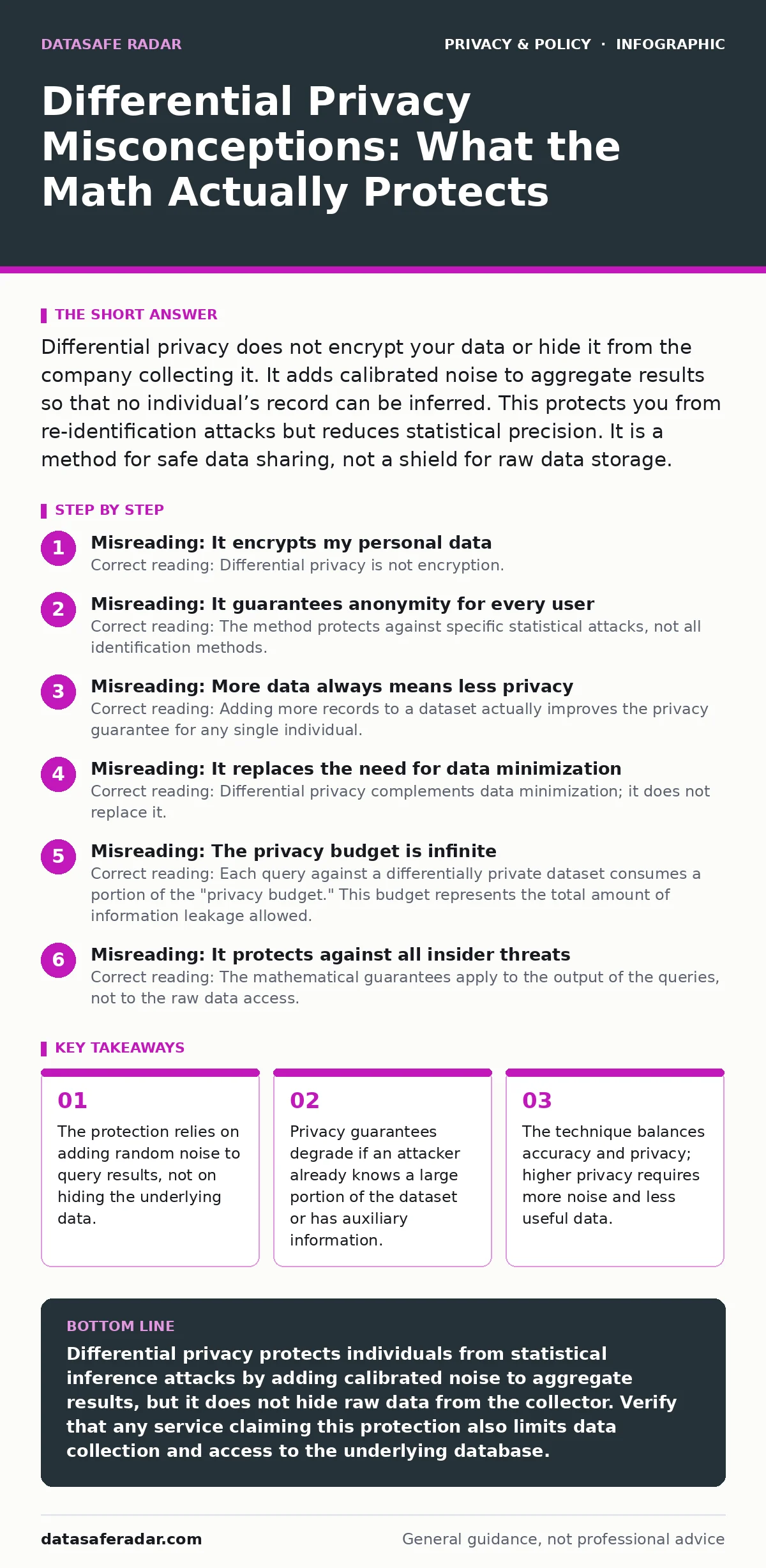
Misreading: It guarantees anonymity for every user
Correct reading: The method protects against specific statistical attacks, not all identification methods. It ensures that the output of a query does not reveal whether a specific person is in the dataset. It does not remove identifiers like names or email addresses. It does not prevent linking data with external sources if those sources are highly specific. Think of it as a shield against mathematical deduction, not a mask against human investigation.
Misreading: More data always means less privacy
Correct reading: Adding more records to a dataset actually improves the privacy guarantee for any single individual. The noise added is calibrated to the sensitivity of the query, not the size of the database. As the dataset grows, the relative impact of any one person’s data shrinks. This means the same amount of noise provides stronger protection in larger populations. This counterintuitive result allows organizations to share more insights as they collect more data, provided the noise mechanism remains consistent.
Misreading: It replaces the need for data minimization
Correct reading: Differential privacy complements data minimization; it does not replace it. Data minimization involves collecting only the data you strictly need. Differential privacy allows you to use that data safely for analysis. If you collect excessive data, you increase the risk of auxiliary information attacks. Even with noise, having too much granular data can allow attackers to cross-reference results with public records. You should still limit collection scope. For details on controlling what apps collect, see app permission management.
Misreading: The privacy budget is infinite
Correct reading: Each query against a differentially private dataset consumes a portion of the "privacy budget." This budget represents the total amount of information leakage allowed. Once the budget is exhausted, further queries cannot guarantee privacy. Organizations must plan their analytical needs in advance. They cannot run unlimited tests and then claim privacy protection. This constraint forces rigorous planning and prevents casual data mining. It also means that reusing data for new purposes often requires recalculating the noise levels.
See also: SaaS Data Exposure Prevention Checklist for Secure Apps · Difference Between ISO 27001 and 27701: Scope, Privacy, and Audit Reality
Misreading: It protects against all insider threats
Correct reading: The mathematical guarantees apply to the output of the queries, not to the raw data access. An insider with direct access to the unnoised database can still view individual records. It assumes the collector is honest in applying the noise mechanism. If an employee bypasses the privacy layer, the protection fails. This is why access controls and audit logs remain necessary. Understanding your digital privacy rights helps you know what legal recourse exists if insiders abuse access.
Misreading: It makes data completely useless for precision
Correct reading: Noise reduces precision, but it does not destroy utility. For large datasets, the signal remains strong enough for trend analysis. The trade-off depends on the sensitivity of the query. Counting how many people live in a city requires little noise. Counting how many people have a rare disease requires more noise to protect those few individuals. Organizations can tune the noise level to balance accuracy and privacy. This allows for meaningful insights without exposing individuals.
Misreading: It is a one-time fix for historical data
Correct reading: Applying differential privacy to historical data does not retroactively fix past breaches. If data was already exposed without noise, the damage is done. The method only protects future queries and releases. It does not scrub the internet or previous leaks. Organizations must apply the mechanism at the point of data collection or before any analysis. This means legacy data often requires careful re-processing or must be excluded from new privacy guarantees.
Misreading: It works the same for all types of data
Correct reading: The effectiveness depends on the data type and query sensitivity. Numerical data like ages or incomes is easier to protect than categorical data like rare diagnoses. Queries that return single values are more sensitive than those returning averages over large groups. Organizations must adjust the noise mechanism for each type of analysis. A one-size-fits-all approach often leads to either excessive noise or insufficient protection. This requires technical expertise to implement correctly.
Key takeaways
- The protection relies on adding random noise to query results, not on hiding the underlying data.
- Privacy guarantees degrade if an attacker already knows a large portion of the dataset or has auxiliary information.
- The technique balances accuracy and privacy; higher privacy requires more noise and less useful data.
- It protects against specific statistical inference attacks, not against all forms of data misuse or surveillance.
Differential privacy protects individuals from statistical inference attacks by adding calibrated noise to aggregate results, but it does not hide raw data from the collector. Verify that any service claiming this protection also limits data collection and access to the underlying database.
Frequently asked questions
Can I use differential privacy for my small personal dataset?
It is technically possible but often impractical. Small datasets require more noise to maintain privacy, which can render the results useless. It is best suited for large-scale organizational data analysis.
How does this compare to anonymization?
Traditional anonymization removes identifiers but can often be reversed using external data. Differential privacy provides a mathematical guarantee that re-identification is statistically unlikely, even with external data. It is a stronger protection method.
Do I need to opt in for differential privacy?
Usually, no. It is applied by the organization collecting the data. You should check their privacy policy to see if they use it. For more on your rights to know how data is used, see **data subject access requests**.
How this guide was produced: written by the DataSafe Radar editorial team with AI assistance, checked against the public references listed below, and reviewed when the facts change. See our editorial policy or report an error.