Difference Between ISO 27001 and 27701: Scope, Privacy, and Audit Reality
ISO 27701 adds privacy controls to ISO 27001 security, but the real complexity lies in managing the gap between generic security and specific data subject rights.

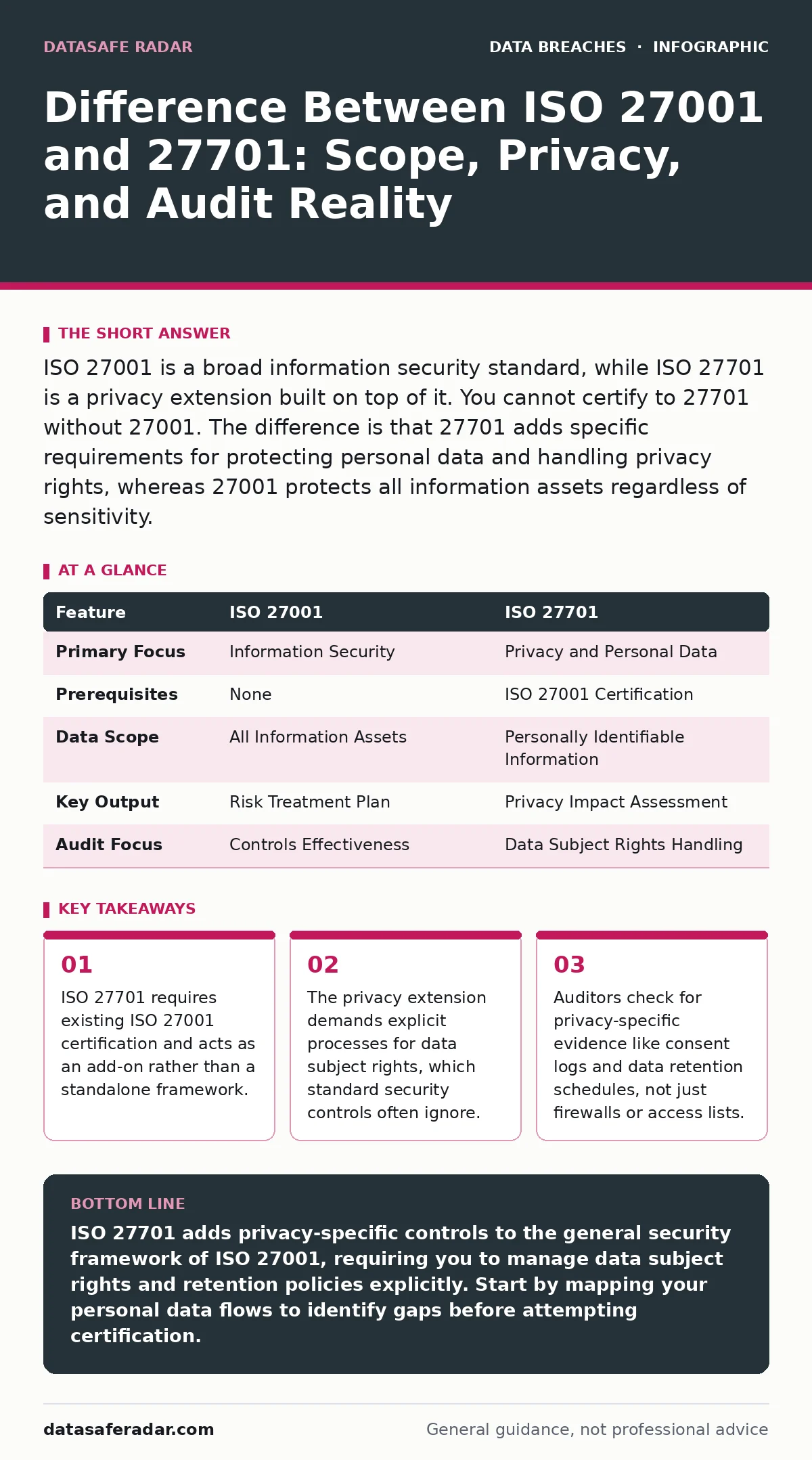
ISO 27001 is a broad information security standard, while ISO 27701 is a privacy extension built on top of it. You cannot certify to 27701 without 27001. The difference is that 27701 adds specific requirements for protecting personal data and handling privacy rights, whereas 27001 protects all information assets regardless of sensitivity.
What is the difference between iso 27001 and 27701?
ISO 27001 covers general information security for any data type, while ISO 27701 adds specific privacy requirements for personal data. ISO 27001 is the foundation that ensures your security management system handles risks to confidentiality, integrity, and availability. ISO 27701 is an extension that builds on that foundation to address how you handle personally identifiable information. You must implement ISO 27001 first.
You cannot achieve ISO 27701 certification without already holding ISO 27001 certification. The privacy standard assumes your base security is solid. It then layers on rules for data protection principles like purpose limitation and data minimization. This means your security team and privacy team must work together. Security protects the vault. Privacy dictates who gets the key and why they can open it.
Can you implement ISO 27701 without ISO 27001?
You cannot implement ISO 27701 without first establishing an ISO 27001 Information Security Management System. ISO 27701 is structured as a code of practice that extends the ISO 27001 framework. It references ISO 27001 clauses directly. If you try to adopt ISO 27701 controls in isolation, you will miss the core governance, risk assessment, and treatment processes defined in the base standard.
Auditors will reject your application if you lack the parent certification. The privacy controls rely on the security controls to function. For example, you cannot protect data subjects’ rights if you cannot prove who accessed their data. That proof comes from the logging and monitoring requirements in ISO 27001. Building privacy on top of weak security is like painting a house with structural cracks.
How do the scopes of the two standards differ?
ISO 27001 applies to all information assets within your defined scope, including intellectual property, financial records, and operational data. ISO 27701 narrows the focus specifically to personally identifiable information. This distinction changes how you classify data. Under ISO 27001, a database might be classified as "highly confidential." Under ISO 27701, you must further analyze that database to identify which fields contain personal data.
You then apply additional controls to those specific fields. This creates a layered classification system. You might have a secure server that holds both public marketing materials and private customer health records. ISO 27001 secures the server. ISO 27701 requires you to isolate the health records and apply stricter access rules to them.
What specific controls does ISO 27701 add?
ISO 27701 introduces new controls that address data subject rights and privacy governance. These include requirements for maintaining a record of processing activities. You must document why you collect data, how long you keep it, and who you share it with. You must also implement processes to handle data subject requests.
This means having a clear workflow for when someone asks to delete their account or correct their address. Standard security controls do not cover this. A firewall does not know how to delete a user’s history across three different databases. ISO 27701 forces you to build that automation or manual process. It also requires you to appoint a privacy lead who reports to senior management.
How does auditing change with the privacy extension?
Auditors for ISO 27701 look for evidence of privacy-specific activities that ISO 27001 auditors ignore. They will ask for your data retention policy and proof that you actually delete data when it expires. They will check your consent logs to ensure you have valid permission for processing. They will review your privacy impact assessments for new projects. This adds a layer of documentation burden. You must keep records that prove compliance over time. It is not enough to have a policy on paper. You must show that employees follow it. This often requires more frequent internal audits. You need to verify that developers are implementing privacy by design in new applications.
See also: Data Encryption at Rest and in Transit: How to Secure Your Information · Data Brokers Examples: How They Collect and Sell Your Personal Info
What happens when security and privacy goals conflict?
Security often wants to keep data as long as possible for forensic analysis. Privacy wants to delete data as soon as it is no longer needed. This tension creates operational friction. You must define clear retention periods that satisfy both legal requirements and security needs. For example, you might keep network logs for 90 days for security monitoring.
However, if those logs contain personal data, you must anonymize or delete that personal data after 30 days if the business purpose expires. This requires technical solutions like automated data masking. You cannot rely on manual deletion. Manual processes fail at scale. This conflict highlights why encryption in transit and at rest is so valuable. Encrypted data can be stored securely while remaining compliant with privacy principles if the keys are managed correctly.
How do you handle data breaches under both standards?
ISO 27001 requires you to report security incidents internally and to relevant parties. ISO 27701 adds the requirement to notify data subjects if their personal data is compromised. The threshold for notification is often lower in privacy law than in general security policy. You must assess whether the breach poses a risk to the rights and freedoms of individuals. This assessment takes time.
It slows down your initial response. You need a pre-approved template for customer breach notification letters. This template must be flexible enough to cover different types of data exposure. You must also coordinate with legal teams to ensure you do not admit liability prematurely. The dual requirement means your incident response plan must have a privacy track.
| Feature | ISO 27001 | ISO 27701 |
|---|---|---|
| Primary Focus | Information Security | Privacy and Personal Data |
| Prerequisites | None | ISO 27001 Certification |
| Data Scope | All Information Assets | Personally Identifiable Information |
| Key Output | Risk Treatment Plan | Privacy Impact Assessment |
| Audit Focus | Controls Effectiveness | Data Subject Rights Handling |
What is the hidden cost of dual certification?
The hidden cost is not the audit fee. It is the ongoing operational overhead of maintaining two sets of documentation. You must update your risk assessments whenever you change how you process data. You must train employees on privacy principles, not just security hygiene. This training must be repeated regularly. You also need specialized tools.
Standard security tools may not track data lineage or consent. You might need to invest in database activity monitoring to see who accesses personal data in real-time. This visibility is critical for proving compliance. Without it, you are guessing during an audit. Guessing leads to non-conformities. Non-conformities delay certification and damage trust.
How do you maintain compliance after certification?
Compliance is not a one-time event. It is a continuous cycle of monitoring and improvement. You must review your data processing activities regularly. Business changes often introduce new data flows. A new marketing campaign might collect different data than your product does. You must assess the privacy impact of these changes. You must also monitor for exposed API keys that could leak personal data.
Third-party vendors are a major risk. You must ensure they meet your privacy standards. This requires rigorous vendor assessments. You must check their security and privacy practices. If they fail, you are still liable for their data handling. Regular reviews of your file integrity monitoring logs can help detect unauthorized changes to privacy policies or data access controls.
What is the first step to starting this journey?
Start by mapping your data. You cannot protect what you do not know you have. Identify all sources of personal data. Trace how it moves through your systems. Document who has access. This inventory is the basis for both ISO 27001 and ISO 27701. It reveals gaps in your current security. It shows where you lack privacy controls. Once you have this map, you can prioritize your efforts. Focus on the highest risk areas first. This approach saves time and money. It also builds a solid foundation for your management system. Do not rush into certification. Build the processes first. Test them. Refine them. Then invite the auditor.
Key takeaways
- ISO 27701 requires existing ISO 27001 certification and acts as an add-on rather than a standalone framework.
- The privacy extension demands explicit processes for data subject rights, which standard security controls often ignore.
- Auditors check for privacy-specific evidence like consent logs and data retention schedules, not just firewalls or access lists.
ISO 27701 adds privacy-specific controls to the general security framework of ISO 27001, requiring you to manage data subject rights and retention policies explicitly. Start by mapping your personal data flows to identify gaps before attempting certification.
Frequently asked questions
Do I need to re-certify ISO 27001 when adding ISO 27701?
No, but the auditor will review your ISO 27001 system to ensure it is still valid. They will then add the ISO 27701 controls to your audit scope. You maintain both certificates simultaneously.
Can ISO 27701 help with GDPR compliance?
Yes, ISO 27701 aligns closely with GDPR requirements. It provides a structured way to implement many GDPR controls. However, it is not a legal substitute for GDPR compliance. You must still meet local legal obligations.
How long does it take to implement ISO 27701?
Implementation time varies based on your existing ISO 27001 maturity. If you already have ISO 27001, it may take 3 to 6 months to add the privacy extension. If you are starting from scratch, it takes longer.
What if I only handle a small amount of personal data?
You still need ISO 27701 if you seek certification. The standard applies regardless of data volume. However, the controls can be scaled to fit your size. Small organizations have fewer data flows to manage.
How this guide was produced: written by the DataSafe Radar editorial team with AI assistance, checked against the public references listed below, and reviewed when the facts change. See our editorial policy or report an error.