What happens if employees ignore privacy policies
Ignoring privacy policies shifts legal liability to the individual employee and exposes the organization to regulatory fines that bypass standard insurance coverage limits.

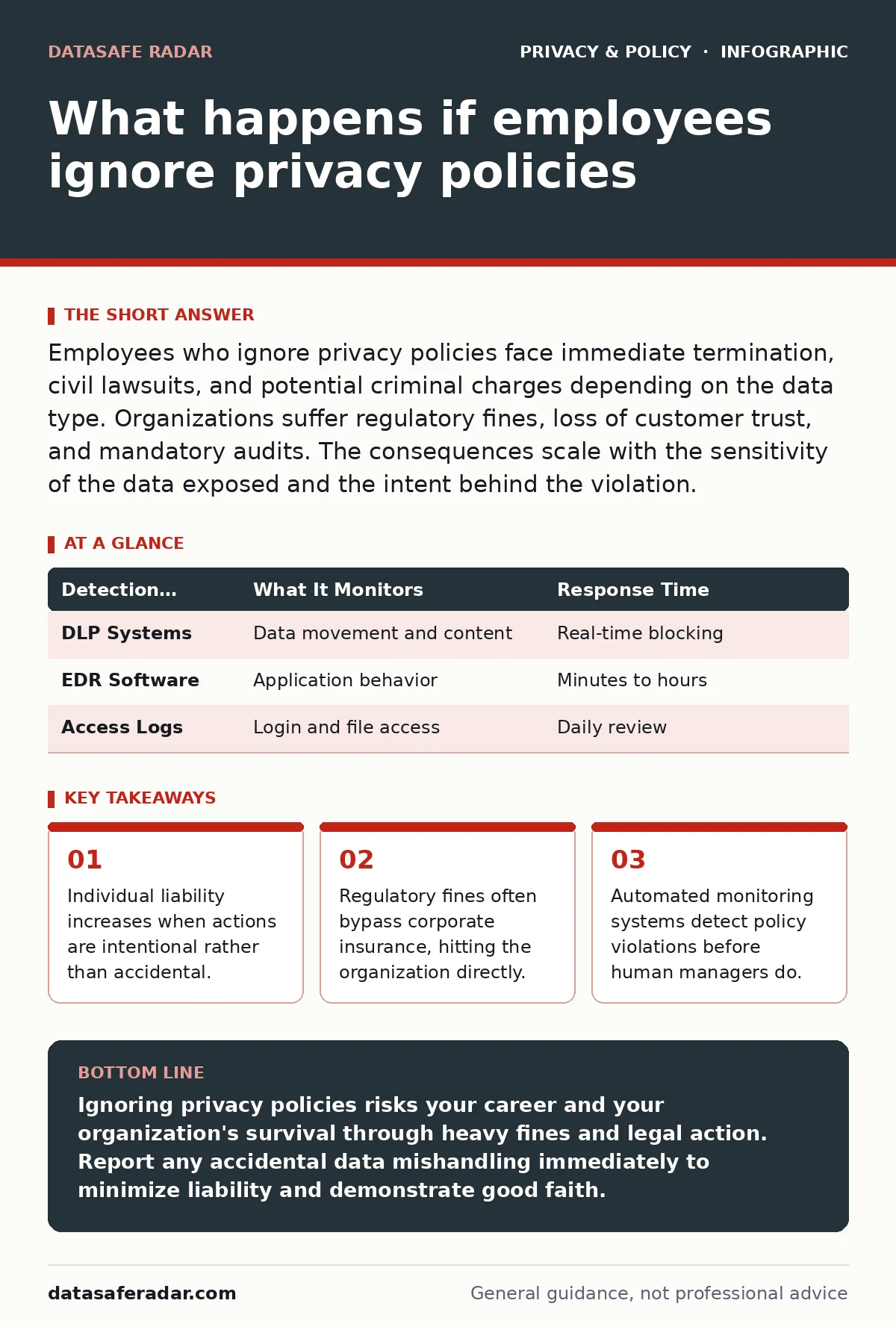
Employees who ignore privacy policies face immediate termination, civil lawsuits, and potential criminal charges depending on the data type. Organizations suffer regulatory fines, loss of customer trust, and mandatory audits. The consequences scale with the sensitivity of the data exposed and the intent behind the violation.
What happens if employees ignore privacy policies
Employees who ignore privacy policies face termination, legal liability, and organizational fines. The specific consequence depends on the severity of the breach and the intent behind the action. Accidental mistakes often result in retraining, while deliberate violations lead to immediate dismissal. Organizations face regulatory penalties that can exceed annual revenue in strict jurisdictions.
The legal framework treats data as a protected asset. When an employee mishandles this asset, they breach their employment contract. This breach allows the employer to terminate the relationship immediately. In severe cases, the employer may sue for damages. Regulatory bodies also impose fines on the organization for failing to protect user data.
Why intent changes the legal outcome
Intent determines whether an action is a training issue or a legal case. Accidental errors, such as sending an email to the wrong recipient, are usually treated as process failures. Organizations address these with retraining and system updates. Deliberate actions, such as copying data to a personal drive, are treated as misconduct.
Courts and regulators view intentional violations as a higher risk. An employee who knowingly bypasses security controls demonstrates a disregard for the law. This behavior suggests a pattern of non-compliance. Employers must act decisively to show regulators they do not tolerate such behavior. Failure to act can increase the organization's liability.
How organizations detect policy violations
Organizations use automated tools to detect policy violations in real time. Data Loss Prevention (DLP) systems monitor data movement across networks. These tools flag unusual transfers, such as large file uploads to personal cloud storage. Endpoint Detection and Response (EDR) software records application usage and file access patterns.
Human oversight cannot catch every violation. Automated systems provide a continuous audit trail. They identify anomalies that suggest policy non-compliance. For example, accessing records outside of normal business hours triggers an alert. These alerts allow security teams to investigate before data leaves the organization.
| Detection Method | What It Monitors | Response Time |
|---|---|---|
| DLP Systems | Data movement and content | Real-time blocking |
| EDR Software | Application behavior | Minutes to hours |
| Access Logs | Login and file access | Daily review |
The financial impact on the organization
Regulatory fines for privacy violations can cripple an organization's finances. Laws like the General Data Protection Regulation impose penalties based on global turnover. Fines are not always covered by standard cyber insurance policies. Insurers often exclude coverage for negligent or intentional acts by employees.
Beyond fines, organizations face operational costs. They must notify affected individuals, which requires legal review and communication efforts. They may need to conduct forensic investigations to determine the scope of the breach. Customer churn accelerates as trust erodes. Rebuilding a reputation takes years and significant marketing investment.
Individual liability for employees
Employees can face personal liability for privacy violations. Civil lawsuits may seek damages from the individual who mishandled the data. Criminal charges apply when employees steal data or sell it for personal gain. These charges carry prison sentences and permanent criminal records.
Employers may also seek restitution from terminated employees. If an employee's actions cause a fine, the employer may sue to recover those costs. This is rare but legally possible in cases of gross negligence. Employees should understand that signing a privacy policy creates a legal obligation.
Exceptions to standard enforcement
Not every violation results in punishment. Organizations may exercise discretion for minor, first-time offenses. Context matters significantly in these decisions. An employee who reports their own mistake promptly may avoid termination. This self-reporting encourages a culture of transparency.
Good faith errors are treated differently than malicious acts. If a system flaw led to the violation, the organization focuses on fixing the system. However, repeated minor violations indicate a lack of attention. This pattern often leads to stricter enforcement, including termination. Organizations must document these decisions to defend against wrongful termination claims.
How to handle accidental violations
Immediate disclosure is the most effective response to accidental violations. Employees should report mistakes to their security team or manager immediately. Delaying disclosure increases the damage and worsens the legal outcome. Prompt reporting allows the organization to contain the breach quickly.
The organization then assesses the risk. They determine if notification to affected individuals is required. They update security controls to prevent recurrence. The employee receives retraining on the specific policy they violated. This approach balances accountability with improvement.
Preventing future policy violations
Prevention requires clear policies and regular training. Policies must be written in plain language, not legal jargon. Employees need to understand the "why" behind the rules. Regular training reinforces these concepts and updates employees on new threats.
Organizations should use privacy by design principles to reduce human error. Systems should default to the most secure settings. This reduces the need for employees to make complex security decisions. For more on building secure systems, see our guide on privacy by design. For understanding your legal standing, review digital privacy rights.
What to do after a violation
After a violation, the organization must follow a strict incident response plan. They isolate affected systems to prevent further data loss. They preserve evidence for potential legal proceedings. They notify regulators and affected individuals within legal timeframes.
Employees must cooperate fully with the investigation. They should not delete emails or files related to the incident. Deleting evidence is considered obstruction and increases legal liability. The organization reviews the incident to identify gaps in policy or training.
Key takeaways
- Individual liability increases when actions are intentional rather than accidental.
- Regulatory fines often bypass corporate insurance, hitting the organization directly.
- Automated monitoring systems detect policy violations before human managers do.
Ignoring privacy policies risks your career and your organization's survival through heavy fines and legal action. Report any accidental data mishandling immediately to minimize liability and demonstrate good faith.
Frequently asked questions
Can an employer sue me for a data breach?
Yes, if your actions were negligent or intentional and caused significant financial damage to the organization, they may seek restitution through civil litigation.
Does cyber insurance cover employee mistakes?
Coverage varies by policy. Most standard policies exclude intentional acts or gross negligence, leaving the organization or individual liable for those specific fines.
How long do I have to report a mistake?
You should report it immediately. Delaying disclosure increases the severity of the breach and can turn a minor error into a termination offense.
Are remote workers held to the same standards?
Yes, privacy policies apply regardless of location. Remote workers often face stricter monitoring because they operate outside the organization's physical security perimeter.
How this guide was produced: written by the DataSafe Radar editorial team with AI assistance, checked against the public references listed below, and reviewed when the facts change. See our editorial policy or report an error.