How Digital Privacy Rights Work: From Data Collection to Deletion
Digital privacy rights are not automatic shields; they are procedural triggers that force organizations to pause, verify, and document their handling of your personal information.

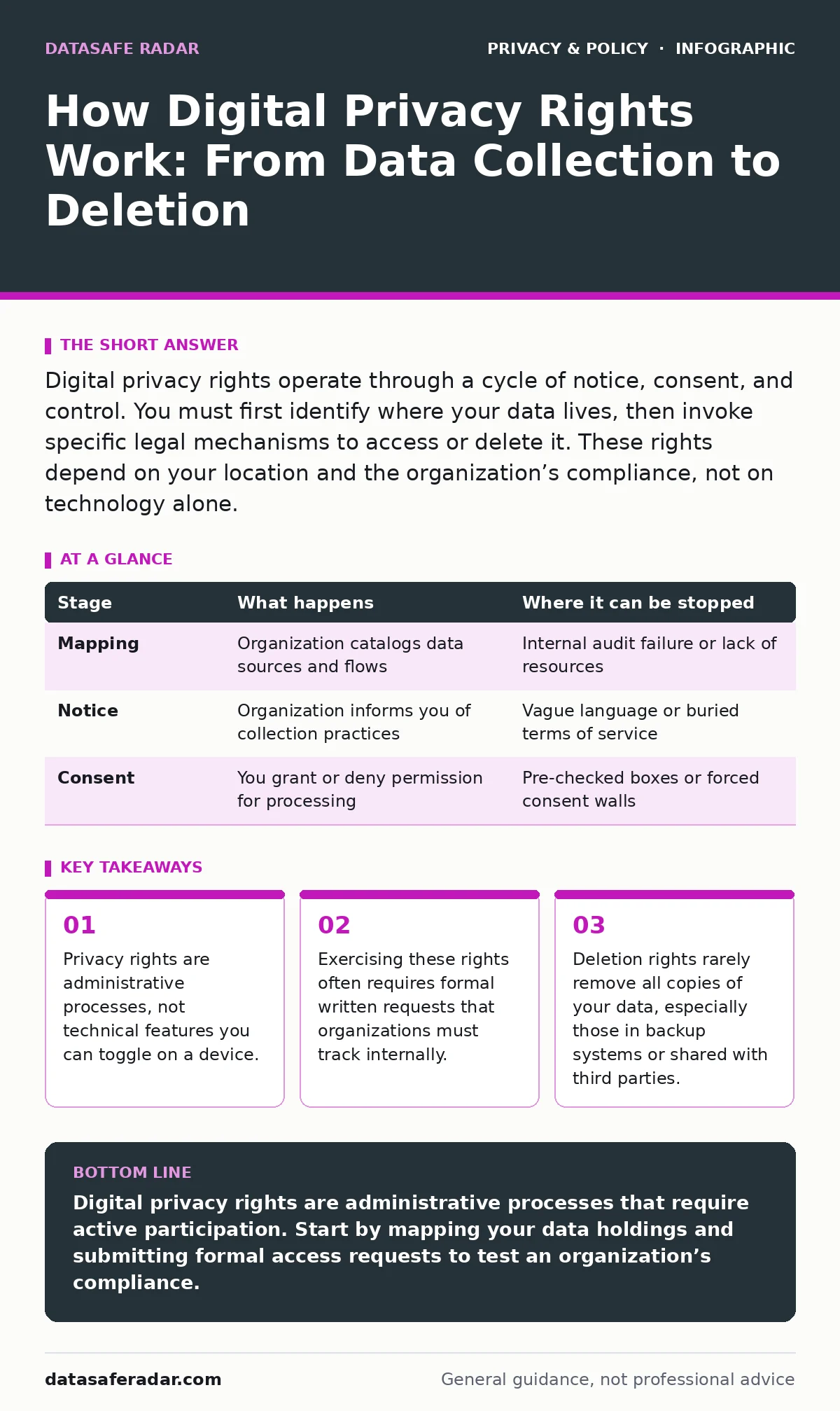
Digital privacy rights operate through a cycle of notice, consent, and control. You must first identify where your data lives, then invoke specific legal mechanisms to access or delete it. These rights depend on your location and the organization’s compliance, not on technology alone.
The Architecture of Consent
Digital privacy rights function as a series of legal and operational checkpoints. They do not prevent data collection by default. Instead, they create obligations for the organization holding your information. You interact with these rights through specific mechanisms like access requests and deletion demands. Understanding this architecture requires looking past the user interface. The interface is a marketing layer. The reality is a backend administrative process.
Stage 1: Data Mapping and Inventory
The first stage happens before you ever see a consent banner. The organization must know what it collects. This process is called data mapping. It involves cataloging every piece of personal information flowing into their systems. They record where the data comes from, where it is stored, and who can access it. If this map is incomplete, the organization cannot respond to your requests later.
Imagine a company that collects email addresses for newsletters but forgets to log the device IDs sent by their analytics script. When you ask for your data, they provide the email list. They omit the device IDs because they do not appear on the map. This is not always malicious. It is often a failure of internal hygiene. This gap is why metadata exposure can persist even after you believe you have cleared your tracks.
| Stage | What happens | Where it can be stopped |
|---|---|---|
| Mapping | Organization catalogs data sources and flows | Internal audit failure or lack of resources |
| Notice | Organization informs you of collection practices | Vague language or buried terms of service |
| Consent | You grant or deny permission for processing | Pre-checked boxes or forced consent walls |
Stage 2: Transparency and Notice
Once the data is mapped, the organization must tell you what they are doing. This is the notice stage. They publish privacy policies that describe the collection methods. The quality of this stage determines your ability to exercise control. If the policy is vague, you cannot target your requests effectively. Many organizations use broad categories like "service improvement" to justify extensive tracking.
You must read the policy to find the specific legal basis for processing. Look for sections labeled "purposes" or "categories of data." If the language is overly general, you have less leverage. This stage sets the baseline for what you can challenge later. Privacy by design principles suggest that these notices should be clear from the start, but industry practice often lags behind this ideal.
Stage 3: Consent and Legitimate Interest
This stage is where you interact with the system. You are asked to consent to data processing. In many jurisdictions, consent must be explicit, informed, and freely given. This means you must say yes actively. Silence or pre-ticked boxes do not count. Some organizations rely on "legitimate interest" instead of consent. This is a legal argument that their business need outweighs your privacy concern in specific contexts.
When legitimate interest is cited, you have the right to object. This objection must be honored unless the organization proves their interest is overwhelming. This is a higher bar for them. It shifts the burden of proof. You do not need to prove harm. You only need to state your objection. This mechanism is often hidden behind multiple clicks. It requires persistence to find and use.
Stage 4: Access and Correction
After data is processed, you can request to see it. This is the right of access. The organization must provide a copy of your personal data in a usable format. They must also explain how it is being used. If the data is inaccurate, you can request correction. This forces the organization to verify its records. It is a check on the accuracy of their internal mapping.
Requesting access can reveal unexpected data. You might find profiles you did not create or links to other services. This transparency helps you understand your digital footprint. It also highlights the limits of app permission management. Even if you restrict app access on your phone, the backend systems may retain aggregated data derived from past permissions. The access request shows you what remains.
Stage 5: Deletion and Portability
The final stage is removal. You can request the deletion of your personal data. This is often called the right to be forgotten. The organization must erase the data and notify any third parties who received it. They must also stop using the data for future purposes. However, they can retain data if required by law or for legitimate archival purposes.
Deletion is rarely instantaneous. Organizations often keep data in backups for a set period. They may also retain anonymized aggregates. This means your specific identifier is removed, but the pattern of your behavior remains. Zero-knowledge encryption does not help here because the organization holds the keys to their own database. They must actively delete the records. Portability allows you to take your data elsewhere, giving you a fallback if deletion is partial.
The Limits of Administrative Control
These rights depend on the organization’s willingness to comply. There is no universal technical switch that enforces deletion across all services. You must file requests individually. This creates a high friction cost. You must identify each service, locate their privacy contact, and submit formal requests. Some organizations automate this. Others require manual intervention.
The effectiveness of these rights varies by jurisdiction. Some regions have strong enforcement agencies. Others rely on individual lawsuits. You must know which laws apply to your data. This often depends on where you live and where the company is based. Opting out of data brokers is a separate process that often falls outside these standard privacy rights. Brokers aggregate data from many sources, making deletion requests complex and fragmented.
Practical Application Steps
To apply these rights, you must be systematic. Start by listing the services you use. Prioritize those that hold sensitive information. Review their privacy policies to understand their data mapping. Identify the contact method for privacy requests. This is often a dedicated email address or a web form.
Submit your requests in writing. Keep copies of your submissions and responses. Track the deadlines for responses. Most laws require a response within a specific timeframe. If the organization ignores you, you can escalate to a regulatory body. This process is slow. It requires patience and documentation. Secure DNS can help protect your traffic from interception, but it does not help you manage the data already collected. These administrative steps are the only way to exert control over stored data.
The Hidden Cost of Compliance
Exercising these rights has a hidden cost. Organizations may treat you differently. Some services restrict features for users who object to tracking. They may deprioritize your account in support queues. This is not always illegal, but it is a consequence. You must weigh the privacy benefit against the service degradation.
There is also the cost of your time. Filing requests takes hours. Monitoring responses takes more. This is a barrier to entry. Only those with the time and knowledge can fully exercise these rights. This creates an inequality in privacy protection. The most vulnerable users often have the least capacity to navigate these systems. Understanding the stages helps you allocate your effort wisely. Focus on the services that hold the most sensitive data. Let the minor ones go.
Navigating the Future Landscape
Digital privacy rights are evolving. New laws are emerging in different regions. They are adding new obligations for organizations. You must stay informed about changes. The mechanisms described here are the foundation. They will likely become more standardized. Automated systems may eventually handle these requests. Until then, you must act as your own advocate.
The key is understanding the difference between technical privacy and legal rights. Encryption protects your data in transit. Privacy rights protect your data at rest. You need both. Differential privacy is a technical method that adds noise to data sets. It does not replace your right to deletion. It complements it. By understanding both, you can build a more resilient privacy posture.
Key takeaways
- Privacy rights are administrative processes, not technical features you can toggle on a device.
- Exercising these rights often requires formal written requests that organizations must track internally.
- Deletion rights rarely remove all copies of your data, especially those in backup systems or shared with third parties.
Digital privacy rights are administrative processes that require active participation. Start by mapping your data holdings and submitting formal access requests to test an organization’s compliance.
Frequently asked questions
Does deleting my account remove all my data?
No, organizations often retain data in backups or for legal reasons. Deletion removes active records, but copies may persist for a period.
How long does an organization have to respond?
Most jurisdictions require a response within thirty days. Some allow for extensions if the request is complex.
Can I request data from a company that does not operate in my country?
Yes, if they offer services to residents of your region, they may be subject to your local laws. Check their policy for jurisdictional claims.
What if the company ignores my request?
You can escalate to a data protection authority. They can investigate and impose fines for non-compliance.
How this guide was produced: written by the DataSafe Radar editorial team with AI assistance, checked against the public references listed below, and reviewed when the facts change. See our editorial policy or report an error.