Opt Out of Data Brokers: The Manual Removal Checklist
Data brokers rarely honor opt-out requests permanently, so you must verify your removal and repeat the process to stop the constant re-aggregation of your personal details.

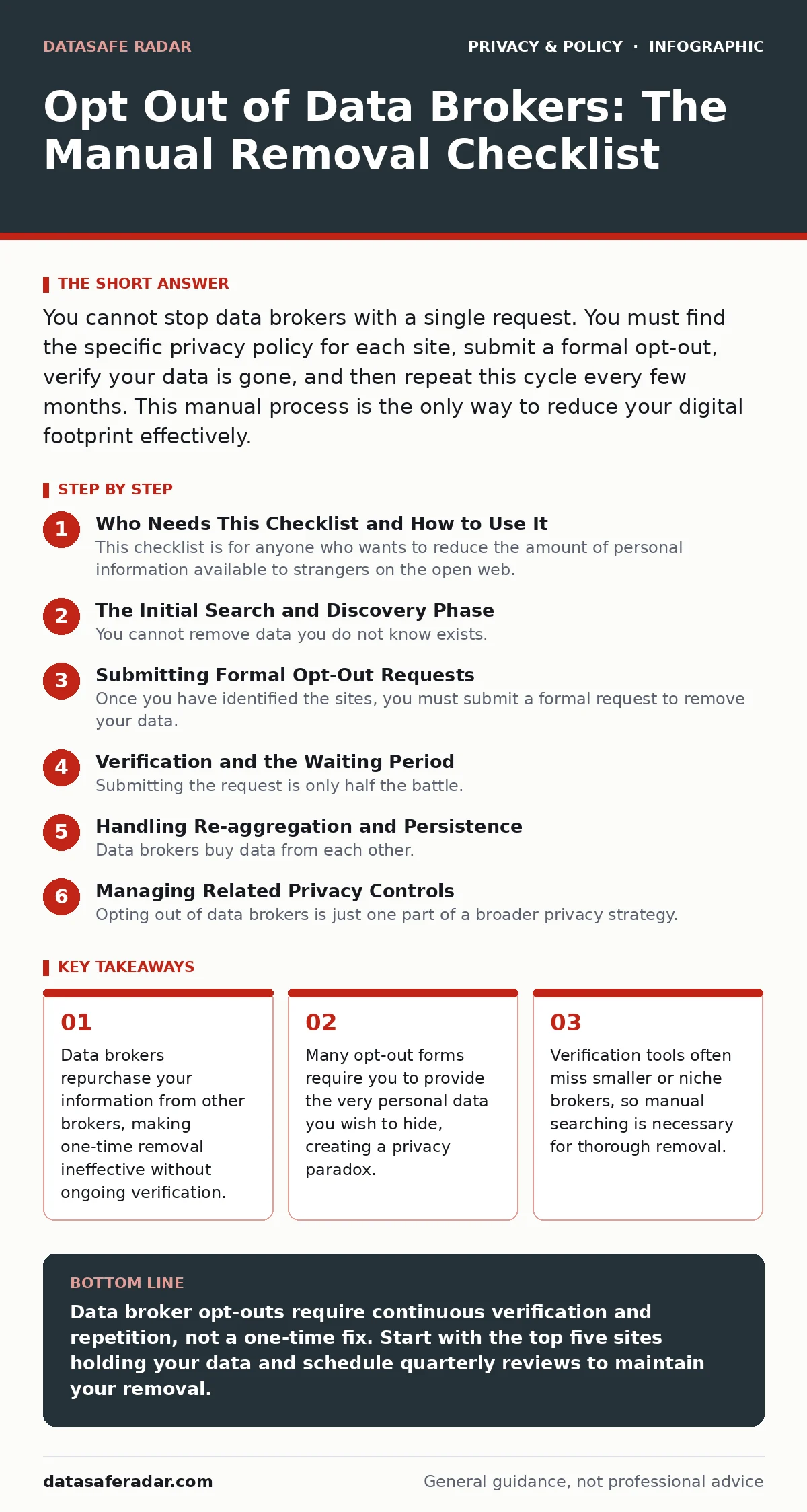
You cannot stop data brokers with a single request. You must find the specific privacy policy for each site, submit a formal opt-out, verify your data is gone, and then repeat this cycle every few months. This manual process is the only way to reduce your digital footprint effectively.
Who Needs This Checklist and How to Use It
This checklist is for anyone who wants to reduce the amount of personal information available to strangers on the open web. Data brokers collect details like your home address, phone number, and family members from public records and other sources. They then sell or display this aggregated data to anyone who asks. You do not need special technical skills to use this list, but you do need patience. The process is manual and repetitive because there is no single switch that turns off all data collection. Use this list as a map. Do not expect to finish it in one sitting. Break it into small sessions and track your progress in a simple spreadsheet or note-taking app.
The Initial Search and Discovery Phase
You cannot remove data you do not know exists. Most people assume their data is only on major social networks, but the real exposure comes from lesser-known aggregator sites. These sites scrape public records and combine them into detailed profiles. Before you start filling out forms, you need to know which sites hold your information. A simple search of your name in quotes often reveals the biggest offenders. Look for sites that list your current and previous addresses, along with relatives.
- Search your name in quotes on major search engines: This reveals the most visible profiles that appear in search results.
- Check for variations of your name: Misspellings or middle initials often appear on different broker sites.
- Identify the top five sites with the most data: Focus on the sites that show the most personal details first, as they are the most harmful.
- Note the specific data points exposed: Knowing exactly what is there helps you verify removal later.
Submitting Formal Opt-Out Requests
Once you have identified the sites, you must submit a formal request to remove your data. This is not a simple unsubscribe link. It is a legal request under state and federal privacy laws. The mechanism varies by site, but most require you to fill out a web form. Some may ask for email confirmation. You will often be asked to provide proof of identity, such as a utility bill or driver’s license. This is a trade-off: you must share sensitive documents to remove public data.
- Locate the privacy policy or do not sell link: This is usually at the bottom of the homepage and defines the legal process.
- Fill out the opt-out form accurately: Provide only the information requested to minimize new data exposure.
- Submit identity verification if required: Some sites require a photo ID to prove you own the data being removed.
- Save the submission confirmation: Keep a screenshot or email confirmation for your records in case of disputes.
For more context on how companies should handle data from the start, see our guide on privacy by design.
Verification and the Waiting Period
Submitting the request is only half the battle. Many brokers claim to remove data within thirty days, but the process can take longer. You must verify that the data is actually gone. Do not trust the "success" message on their website. Search for your name again after the stated processing time has passed. If your data reappears, you must submit a new request. This is the hidden cost of opting out: it is a continuous maintenance task, not a one-time fix.
- Wait the required processing time: Respect the timeline stated in their privacy policy before checking back.
- Search for your name again: Use the same search terms to see if the profile still appears.
- Check for residual data: Sometimes your name remains but the address is gone, indicating partial removal.
- Re-submit if data persists: If the data is still there, start the opt-out process again immediately.
Handling Re-aggregation and Persistence
Data brokers buy data from each other. Even if you remove your data from one site, another broker may sell it back to them. This is why your data often reappears weeks or months after you opt out. It is not a failure on your part; it is the nature of the industry. You must accept that total removal is impossible. The goal is to raise the cost of your data for brokers, making you a less attractive target. Consistency is your best tool. The more often you remove your data, the less useful it becomes to them.
- Schedule quarterly reviews: Set a calendar reminder to check the top sites every three months.
- Monitor new broker sites: New aggregators appear frequently, so expand your search list over time.
- Document repeated violations: If a site consistently fails to remove your data, note this for potential legal action.
- Accept partial success: Aim to reduce the amount of data, not to eliminate it entirely.
See also: First-Party vs Third-Party Cookies: The Difference and Impact
Managing Related Privacy Controls
Opting out of data brokers is just one part of a broader privacy strategy. You should also manage how apps and websites collect data in real time. For instance, controlling app permission management on your phone reduces the data available for brokers to scrape. Similarly, understanding third-party cookies helps you limit tracking across the web. These measures do not replace opt-outs, but they reduce the flow of new data into the broker ecosystem.
- Review app permissions regularly: Disable location and contact access for apps that do not need it.
- Use browser privacy settings: Block third-party cookies to reduce cross-site tracking.
- Enable DNS over HTTPS: This encrypts your domain queries, preventing some network-level data collection.
- Consider using VPNs: While not a cure-all, they hide your IP address from some data collectors.
The Long-Term Maintenance Mindset
This process is not about achieving perfect privacy. It is about reducing your digital footprint to a manageable level. You will never be completely invisible. But by consistently removing your data from the most visible brokers, you make it harder for strangers to build a detailed profile of your life. This effort also protects your family members, who often appear in your data profiles. The work is tedious, but the payoff is a quieter digital life.
Key takeaways
- Data brokers repurchase your information from other brokers, making one-time removal ineffective without ongoing verification.
- Many opt-out forms require you to provide the very personal data you wish to hide, creating a privacy paradox.
- Verification tools often miss smaller or niche brokers, so manual searching is necessary for thorough removal.
Data broker opt-outs require continuous verification and repetition, not a one-time fix. Start with the top five sites holding your data and schedule quarterly reviews to maintain your removal.
Frequently asked questions
Can I use a service to do this for me?
Some services automate the process, but they often miss smaller brokers and may not verify removal as thoroughly as you would.
How long does it take to remove data?
Most sites claim thirty days, but verification often takes longer, and re-aggregation can happen within weeks.
Is it legal for brokers to sell my data?
In many jurisdictions, yes, unless you have explicitly opted out or reside in a region with strict privacy laws.
What if a broker refuses to remove my data?
You can file a complaint with your state attorney general or relevant privacy regulatory body, citing the specific privacy law.
How this guide was produced: written by the DataSafe Radar editorial team with AI assistance, checked against the public references listed below, and reviewed when the facts change. See our editorial policy or report an error.