Opt Out of Data Brokers: A Small Business Playbook
Personal data brokers sell employee records to the highest bidder, creating liability and reputational risk for small firms that lack the budget for enterprise privacy suites.

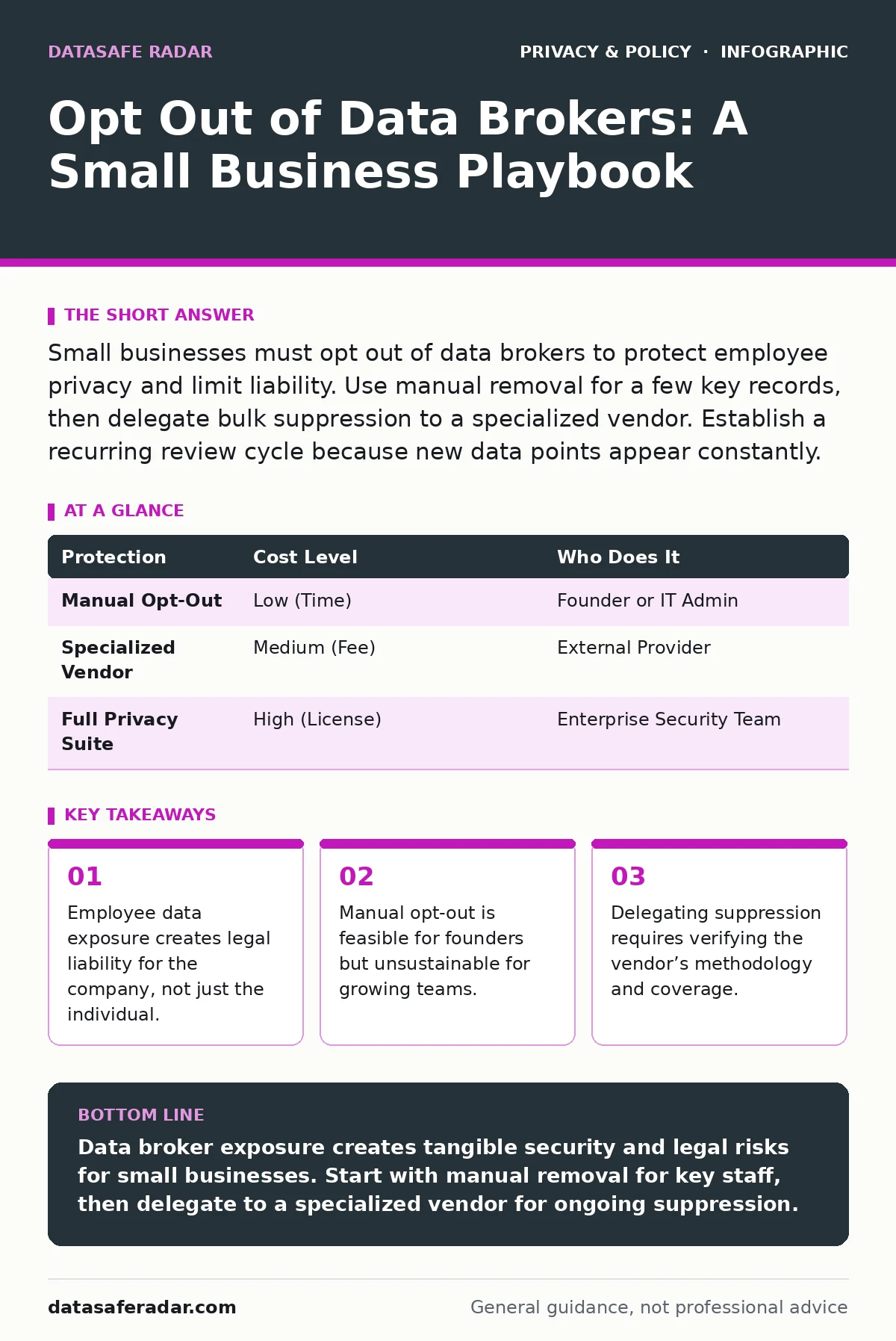
Small businesses must opt out of data brokers to protect employee privacy and limit liability. Use manual removal for a few key records, then delegate bulk suppression to a specialized vendor. Establish a recurring review cycle because new data points appear constantly.
The Hidden Liability of Public Records
Data brokers collect information from public records, social media, and purchase lists. They aggregate these details into profiles and sell access to marketers, insurers, and recruiters. For a small business, this is not just a privacy nuisance. It is a compliance and security risk.
When employee data is publicly available, attackers can craft targeted phishing emails. They know the name, the job title, and sometimes the home address. This makes social engineering attacks significantly more effective. You are not just protecting personal privacy; you are hardening your organization’s perimeter.
Many jurisdictions require companies to safeguard personal data. If you fail to mitigate known exposure vectors, you may be found negligent in a breach investigation. The cost of remediation far exceeds the cost of prevention. You must treat public data exposure as a security vulnerability.
Why Manual Removal Fails at Scale
You can manually request removal from data brokers. Most sites provide a form or an email address for opt-out requests. This works if you have five employees and two hours to spare. It breaks down quickly as you hire more staff.
Data brokers re-ingest data constantly. A profile removed today may reappear next month from a different source. You must repeat the process indefinitely. This is known as the whack-a-mole effect. It consumes staff time that could be spent on revenue-generating activities.
Consider the administrative burden. Each broker has different rules. Some require identity verification. Others demand notarized documents. Tracking which sites have which records requires a spreadsheet that grows more complex every day. Manual management does not scale.
Affordable Mitigation Strategies
You do not need an enterprise-grade privacy platform to start. Begin by mapping your exposure. Search for each employee’s name and business address. Note which sites appear. This baseline helps you prioritize efforts.
For founders and key leadership, manual removal is often sufficient. There are fewer profiles to manage, and these individuals are high-value targets for attackers. Use a separate email address for these requests. Keep records of every submission. This creates an audit trail.
For the broader team, consider a hybrid approach. Handle the most sensitive records manually. Use a low-cost suppression service for the rest. These services automate the requests and monitor for reappearance. They are far cheaper than hiring a full-time privacy officer.
| Protection | Cost Level | Who Does It |
|---|---|---|
| Manual Opt-Out | Low (Time) | Founder or IT Admin |
| Specialized Vendor | Medium (Fee) | External Provider |
| Full Privacy Suite | High (License) | Enterprise Security Team |
When to Delegate the Work
Delegation becomes necessary when the volume of requests exceeds your capacity. If you have more than ten employees, manual tracking becomes error-prone. Mistakes in removal requests can lead to incomplete data deletion.
Look for vendors that specialize in data broker removal. They should provide a dashboard showing which sites have been cleared. Ask for a sample report. Verify that they cover the major brokers in your region. Do not assume global coverage unless stated explicitly.
Delegation also buys you consistency. A vendor follows a standardized process. They handle the back-and-forth communication. This reduces the risk of human error. You shift from doing the work to managing the vendor.
Questions to Ask Your IT Provider
If you hire an IT provider to handle this, you must define the scope clearly. Privacy is not always their primary focus. You need to ensure they understand the difference between network security and data privacy.
- What is your methodology for identifying data broker profiles?
- How do you handle re-ingestion of data after removal?
- Do you provide regular reports on suppression status?
- What happens to the data you collect during the process?
- How do you verify the identity of employees without storing sensitive documents?
These questions reveal whether the provider has a structured approach. Vague answers indicate a lack of experience. You need a partner who treats data minimization as a core principle.
See also: First-Party vs Third-Party Cookies: The Difference and Impact
Integrating with Broader Privacy Efforts
Opting out of data brokers is one part of a larger strategy. It complements other privacy measures. For instance, understanding digital privacy rights helps you know what legal leverage you have. Some regions give you the right to demand deletion.
You should also review your internal data handling. If you collect customer data, you must protect it. This connects to data privacy policies and data subject access requests. When a customer asks for their data, you must be able to find and delete it. External exposure makes this harder.
Consider metadata exposure in your communications. Even if you scrub content, metadata can reveal patterns. Data brokers sometimes use this to enrich profiles. Reducing metadata leaks reduces the fuel for these aggregators.
The Ongoing Nature of Suppression
Data suppression is not a one-time task. It is a continuous process. New brokers emerge. Old ones change their policies. Your employees change jobs and addresses. Each change creates new data points.
Set a recurring review cycle. Quarterly checks are sufficient for most small businesses. Annual checks are too infrequent. You want to catch reappearance before it causes harm. Automate reminders in your calendar.
Budget for this ongoing cost. It is an operational expense, like insurance. It protects your reputation and your employees. Ignoring it invites risk. You cannot afford to be surprised by a leak.
Key takeaways
- Employee data exposure creates legal liability for the company, not just the individual.
- Manual opt-out is feasible for founders but unsustainable for growing teams.
- Delegating suppression requires verifying the vendor’s methodology and coverage.
Data broker exposure creates tangible security and legal risks for small businesses. Start with manual removal for key staff, then delegate to a specialized vendor for ongoing suppression.
Frequently asked questions
How long does it take to remove data from a broker?
Removal times vary by broker. Some process requests in days. Others take weeks or months. Expect a delay before the data disappears from public view.
Can I use a pseudonym for opt-out requests?
Most brokers require identity verification. They may ask for a driver’s license or utility bill. Using a pseudonym often leads to rejection of the request.
How this guide was produced: written by the DataSafe Radar editorial team with AI assistance, checked against the public references listed below, and reviewed when the facts change. See our editorial policy or report an error.