Why Data Privacy Is the Foundation of Strong Security
Treating data as a liability rather than an asset reduces your attack surface by ensuring only necessary information exists in systems that could be compromised.

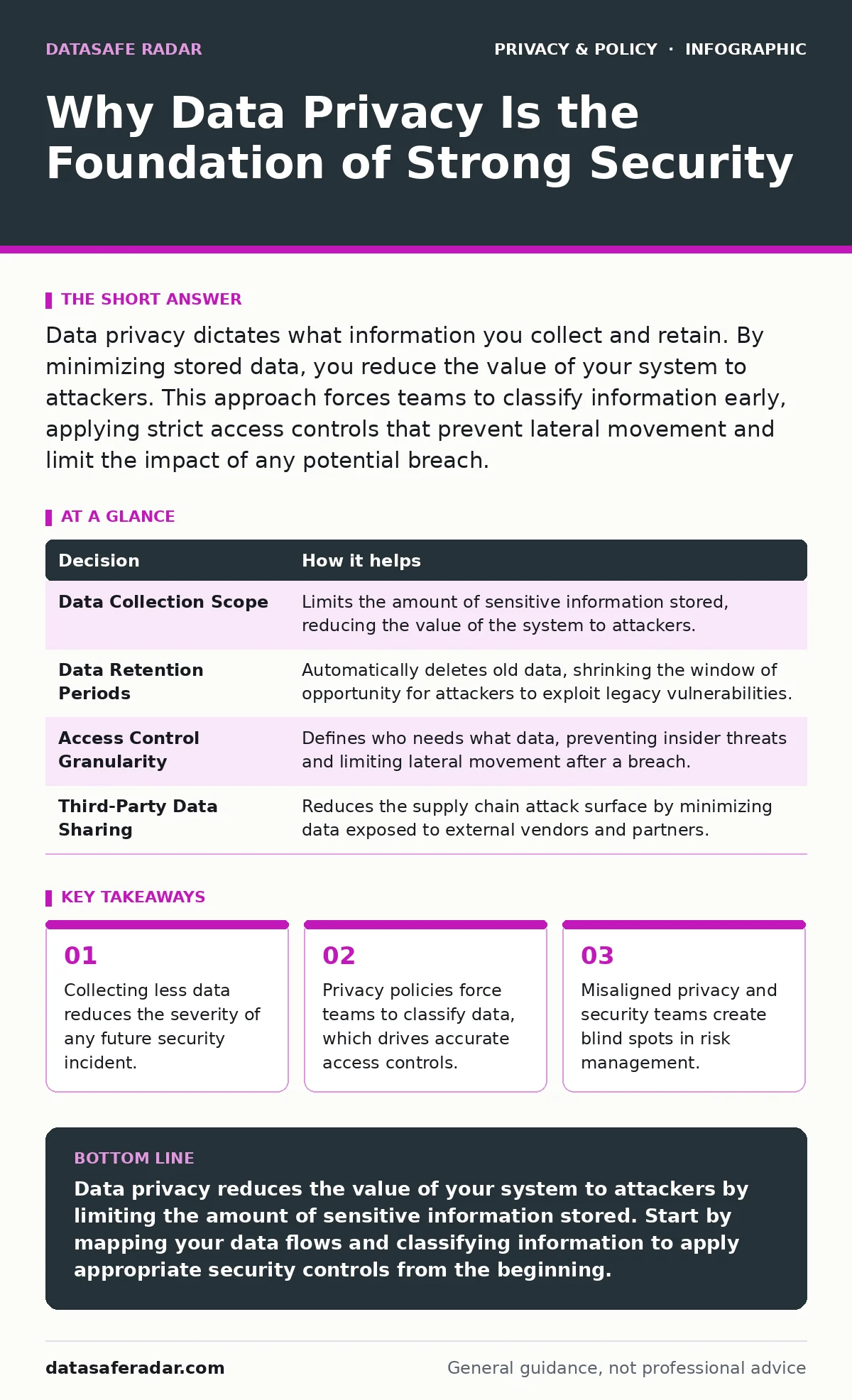
Data privacy dictates what information you collect and retain. By minimizing stored data, you reduce the value of your system to attackers. This approach forces teams to classify information early, applying strict access controls that prevent lateral movement and limit the impact of any potential breach.
The Hidden Cost of Hoarding Data
Security teams often view data as a resource to be protected. Privacy teams view the same data as a liability. This fundamental difference in perspective changes how an organization designs its systems. When you collect more information than you strictly need, you increase the potential damage of every breach.
Imagine a login system that requires an email address and a password. Now imagine that same system also collecting birth dates, physical addresses, and device IDs. If an attacker compromises the first system, they obtain credentials. If they compromise the second, they obtain a complete identity profile. The technical effort to breach both systems might be identical, but the consequence of the second failure is exponentially higher.
This is why data privacy is a security control. It limits the scope of what can be stolen. By enforcing the principle of data minimization, you ensure that even if perimeter defenses fail, the attacker finds little of value. This reduces the incentive for targeting your infrastructure in the first place.
Decisions That Rely on Privacy Frameworks
Privacy is not just a legal checkbox. It is a decision-making framework that informs technical architecture. Every time you design a new feature, you must decide what data is necessary to make it work. This decision determines the security controls you must implement.
If you determine that biometric data is necessary for authentication, you must implement zero-knowledge encryption to ensure the template cannot be reverse-engineered. If you determine that third-party cookies are unnecessary for your core function, you eliminate an entire vector for cross-site tracking and session hijacking. These are not afterthoughts. They are architectural constraints defined by privacy requirements.
Without a clear privacy stance, engineers default to collecting everything. This creates technical debt. Cleaning up excessive data collection after a system is live is difficult and expensive. It requires refactoring databases, updating APIs, and retraining users. Integrating privacy early prevents this costly remediation.
| Decision | How it helps |
|---|---|
| Data Collection Scope | Limits the amount of sensitive information stored, reducing the value of the system to attackers. |
| Data Retention Periods | Automatically deletes old data, shrinking the window of opportunity for attackers to exploit legacy vulnerabilities. |
| Access Control Granularity | Defines who needs what data, preventing insider threats and limiting lateral movement after a breach. |
| Third-Party Data Sharing | Reduces the supply chain attack surface by minimizing data exposed to external vendors and partners. |
What Goes Wrong Without Alignment
When security and privacy teams operate in silos, organizations face unique risks. Security teams focus on keeping data safe. Privacy teams focus on limiting data exposure. If these goals are not aligned, teams may implement controls that conflict with each other.
Suppose a security team implements a comprehensive logging system to detect intrusions. This system records every user action, including sensitive content. A privacy review might reveal that this logging practice violates data minimization principles. If the security team ignores this, they create a high-value target for attackers. The logs become a honeypot.
Conversely, a privacy team might enforce strict data deletion policies that interfere with forensic investigations. If logs are deleted too quickly, security teams cannot trace the origin of an attack. This creates a tension that must be managed through policy. The solution is not to choose one over the other, but to design systems that satisfy both constraints. For instance, you can hash sensitive fields in logs before storage, preserving the utility for detection while reducing the privacy risk.
How Teams Use Privacy as a Control
Effective organizations use privacy frameworks to drive security posture. They start with a data map. This map identifies where data lives, how it moves, and who can access it. This visibility is a prerequisite for effective security. You cannot protect what you cannot see.
Once the data is mapped, teams classify it. Classification determines the level of protection required. Public data needs minimal protection. Confidential data needs strong encryption and strict access controls. This classification drives the implementation of technical controls. It ensures that resources are spent protecting high-value assets rather than low-value data.
Teams also use privacy to manage external risks. When engaging with vendors, privacy clauses dictate how data is handled. This extends security controls beyond the organization’s firewall. It ensures that third parties adhere to similar standards. This is particularly relevant when dealing with data brokers who aggregate information from various sources. Opting out of data brokers can reduce the amount of personal information available to attackers for social engineering attacks.
The Role of User Rights in Security
Privacy laws grant users specific rights, such as the right to access their data or the right to be forgotten. These rights are not just legal obligations. They are security tests. When a user submits a data subject access request, it forces the organization to locate and retrieve all data associated with that user.
This process often reveals hidden data stores. Engineers may have forgotten about temporary files, backup databases, or shadow IT applications. These hidden stores are rarely as well-protected as the primary systems. They represent significant security risks. By responding to these requests, organizations discover and remediate these vulnerabilities.
Similarly, the right to deletion forces teams to ensure that data is actually removed, not just hidden. Incomplete deletion leaves data recoverable. This is a security risk. Implementing secure deletion processes ensures that data is irreversibly destroyed. This reduces the risk of data recovery attacks.
See also: Private file sharing services explained for secure transfers · Differential Privacy Example: How Noise Protects Your Data
Metadata Exposure and Hidden Risks
Data privacy is not just about the content of the data. It is also about the metadata. Metadata describes the data. It includes timestamps, locations, device types, and user behaviors. This information can be just as revealing as the content itself.
Imagine an email that contains no sensitive content. However, the metadata reveals that it was sent from a specific IP address at a specific time. If an attacker correlates this with other data, they can determine the user’s location and habits. This is a form of surveillance that bypasses content encryption.
Security teams often focus on encrypting the payload. They may neglect to protect the metadata. This leaves a trail of breadcrumbs for attackers. Privacy-aware security design considers metadata exposure. It minimizes the collection of metadata and protects what is collected. This includes anonymizing IP addresses in logs and stripping location data from images before storage.
Building a Culture of Privacy
Privacy is not a one-time project. It is a continuous practice. It requires a culture where every team member considers the privacy implications of their work. This means training engineers, product managers, and designers on privacy principles.
It means integrating privacy checks into the development lifecycle. Code reviews should include privacy considerations. Design reviews should assess data necessity. This integration ensures that privacy is baked into the product from the start. It prevents the need for costly retrofits later.
This culture also extends to how teams communicate with users. Transparency about data practices builds trust. Users are more likely to engage with products that respect their privacy. This trust is a competitive advantage. It also reduces the risk of reputational damage in the event of a breach. Users are more forgiving of organizations that have been transparent and respectful of their data.
Key takeaways
- Collecting less data reduces the severity of any future security incident.
- Privacy policies force teams to classify data, which drives accurate access controls.
- Misaligned privacy and security teams create blind spots in risk management.
Data privacy reduces the value of your system to attackers by limiting the amount of sensitive information stored. Start by mapping your data flows and classifying information to apply appropriate security controls from the beginning.
Frequently asked questions
Does focusing on privacy slow down development?
Initially, yes, because teams must consider data implications early. However, it prevents costly rework and security incidents later, speeding up long-term delivery.
Can privacy and security requirements ever conflict?
They can, such as when logging for security violates data minimization. This requires careful policy design to balance detection needs with privacy risks, often using anonymization.
How do I handle metadata in my logs?
Strip or anonymize sensitive metadata like IP addresses and precise timestamps before storing logs. Ensure that the remaining metadata is sufficient for security monitoring without revealing user identity.
Is privacy only relevant for large organizations?
No. Small organizations with limited data can still suffer severe consequences from leaks. Implementing privacy principles early builds a strong security foundation and user trust from day one.
How this guide was produced: written by the DataSafe Radar editorial team with AI assistance, checked against the public references listed below, and reviewed when the facts change. See our editorial policy or report an error.