Why Do People Search Sites Exist: The Business Model Explained
People search sites exist because aggregating public records into searchable databases creates a profitable product that sells access to your personal information.

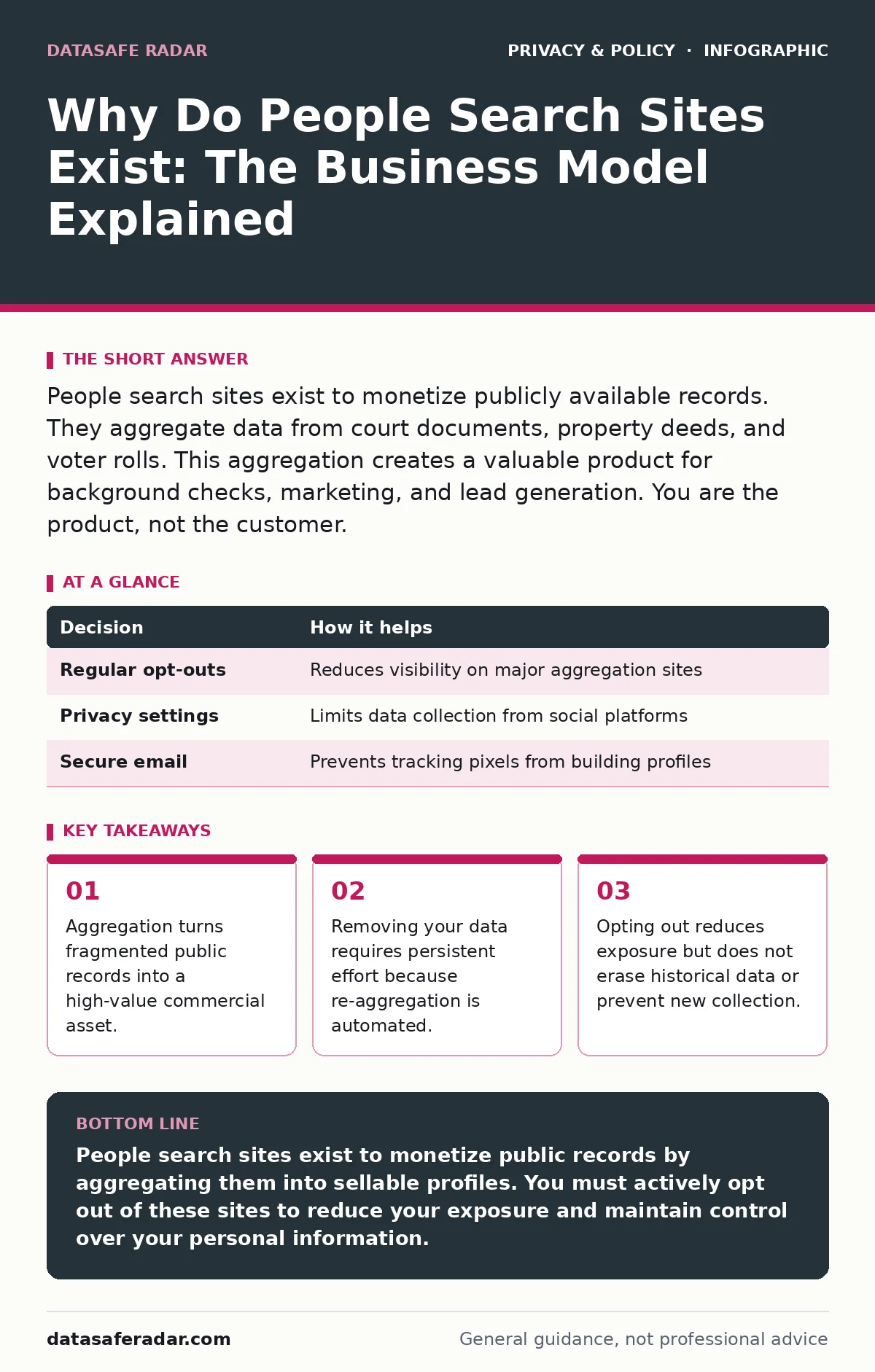
People search sites exist to monetize publicly available records. They aggregate data from court documents, property deeds, and voter rolls. This aggregation creates a valuable product for background checks, marketing, and lead generation. You are the product, not the customer.
Why Do People Search Sites Exist
People search sites exist to solve a specific economic problem: public records are accurate but scattered. Court filings sit in county courthouses. Property deeds are held by municipal offices. Voter registrations are managed by state agencies. No single entity holds this data in a usable format. These sites fill that gap by collecting, cleaning, and indexing information.
They turn fragmented government records into a unified database. The value lies in the connection. Linking a name to an address, phone number, and relative creates a profile. This profile is sold to businesses, investigators, and curious individuals. The business model relies on volume. The more data they collect, the more valuable their service becomes.
The Mechanics of Data Aggregation
Data brokers use automated tools to harvest information. They scrape public websites, purchase lists from other brokers, and ingest leaked databases. This process is continuous. A single record is rarely enough. The goal is to build a comprehensive profile over time. When you publish a photo on a social network, the metadata might contain location data.
When you sign up for a free service, your email might be sold to a marketing list. These small data points are stitched together. The result is a dossier that looks like it came from a single source. It did not. It was assembled from hundreds of disparate inputs. This aggregation creates a hidden cost. You lose control over how your information is combined and presented.
The Primary Drivers of Demand
Several industries rely on this aggregated data. Background checks are the largest driver. Employers, landlords, and dating platforms use these reports to assess risk. They need a quick way to verify identity and history. The second driver is marketing. Companies want to target ads based on demographics and location. A detailed profile allows for precise targeting.
The third driver is lead generation. Real estate agents, insurance agents, and financial advisors buy lists of people who fit specific criteria. They use this data to initiate contact. Without these sites, these industries would have to manually search public records. That process is slow and expensive. The sites offer speed and convenience. You pay for this convenience with your privacy.
The Cost of Inaction
Ignoring these sites has consequences. Your personal information remains visible to anyone with an internet connection. This visibility increases your risk of identity theft. Criminals use these profiles to answer security questions. They know your mother’s maiden name, your previous address, and your pet’s name. This information is often considered sensitive. It is also often public.
The sites do not distinguish between sensitive and non-sensitive data. They present everything equally. This lack of context makes it easier for bad actors to exploit the information. It also makes it harder for you to control your digital footprint. Once the data is online, it is difficult to remove. Other sites may copy it. Search engines may index it. The data persists even if you delete it from the source.
The Limits of Removal
Opting out is not a one-time action. It is a ongoing process. When you remove your data from one site, it may reappear on another. Data brokers share information. If Site A sells your data to Site B, removing it from A does not remove it from B. You must opt out of each site individually. This process is time-consuming. It requires filling out forms, waiting for confirmation, and verifying the removal. Some sites make this process difficult. They hide the opt-out link or require manual verification. This friction is intentional. It keeps your data in their database longer. The longer your data stays, the more they can sell. You are fighting against an automated system with manual tools.
| Decision | How it helps |
|---|---|
| Regular opt-outs | Reduces visibility on major aggregation sites |
| Privacy settings | Limits data collection from social platforms |
| Secure email | Prevents tracking pixels from building profiles |
Strategic Privacy Management
You cannot stop data collection entirely. You can reduce it. Start by understanding where the data comes from. Review your social media privacy settings. Limit who can see your posts and profile information. Disable location services for apps that do not need them. Use a separate email address for sign-ups. This prevents your primary email from being linked to every service you use.
Consider using a VPN to mask your IP address. This makes it harder for sites to track your location and browsing habits. Read privacy policies to understand how data is used. Look for clauses that mention selling or sharing data. If a site sells data, avoid using it. These steps do not erase your past. They limit your future exposure.
The Human Element of Privacy
Privacy is not just about hiding. It is about control. When you allow data brokers to aggregate your information, you lose control over its use. You do not know who buys your profile. You do not know how it is used. You do not know if it is accurate. Regaining control requires effort. It requires understanding the systems that collect your data. It requires taking steps to limit that collection. This is not a technical problem. It is a behavioral one. You must decide what information you are willing to share. You must decide what risks you are willing to take. There is no perfect solution. There is only a balance between convenience and privacy. Choose your balance wisely.
RELATED: For more on how your data is collected, see our guide on data brokers. For steps to remove your information, read opting out of data brokers. To understand how websites track you, check out email tracking pixels. To manage your digital footprint, review privacy policies.
Key takeaways
- Aggregation turns fragmented public records into a high-value commercial asset.
- Removing your data requires persistent effort because re-aggregation is automated.
- Opting out reduces exposure but does not erase historical data or prevent new collection.
People search sites exist to monetize public records by aggregating them into sellable profiles. You must actively opt out of these sites to reduce your exposure and maintain control over your personal information.
Frequently asked questions
Can I sue a people search site for having my data?
In most jurisdictions, these sites operate legally by using public records. Unless they violate specific privacy laws or include protected information, legal action is rarely successful.
Do these sites have criminal records?
Many sites include arrest records and court filings. This data is public but may not indicate a conviction. Always verify the context of any criminal information found.
Is it safe to use a people search site?
Using these sites is generally safe for you as a user. The risk lies in the exposure of your own data. Be cautious about what information you submit in return for a report.
How this guide was produced: written by the DataSafe Radar editorial team with AI assistance, checked against the public references listed below, and reviewed when the facts change. See our editorial policy or report an error.