Social Media Security Risks: Hidden Data Exposures and Fixes
Your social media activity builds a permanent profile that persists even after you delete your account, exposing your habits to data brokers and potential attackers.
Social media security risks involve the collection and misuse of your personal data, location, and connections. Platforms sell insights to advertisers, while hackers exploit weak settings to steal identities. You reduce risk by locking down privacy settings, disabling location tagging, and understanding that deleting an account does not erase your digital footprint.
Understanding Social Media Security Risks
Imagine leaving a diary open on a park bench. Anyone can read your thoughts, see who you meet, and guess where you live. Social media works similarly. You post updates, photos, and status changes that platforms collect, store, and analyze. This is the core of social media security risks. The danger is not just someone reading your posts. It is the silent aggregation of your behavior into a detailed profile. This profile includes your location history, your political leanings, your health concerns, and your financial status.
These platforms do not just store what you post. They infer what you do not post. Algorithms track how long you hover over an ad. They note which articles you skip. They map your daily commute from check-ins. The result is a shadow profile that is often more accurate than your own self-perception. This data fuels targeted advertising, but it also fuels social engineering attacks. Hackers use this rich dataset to craft convincing scams that bypass traditional security checks.
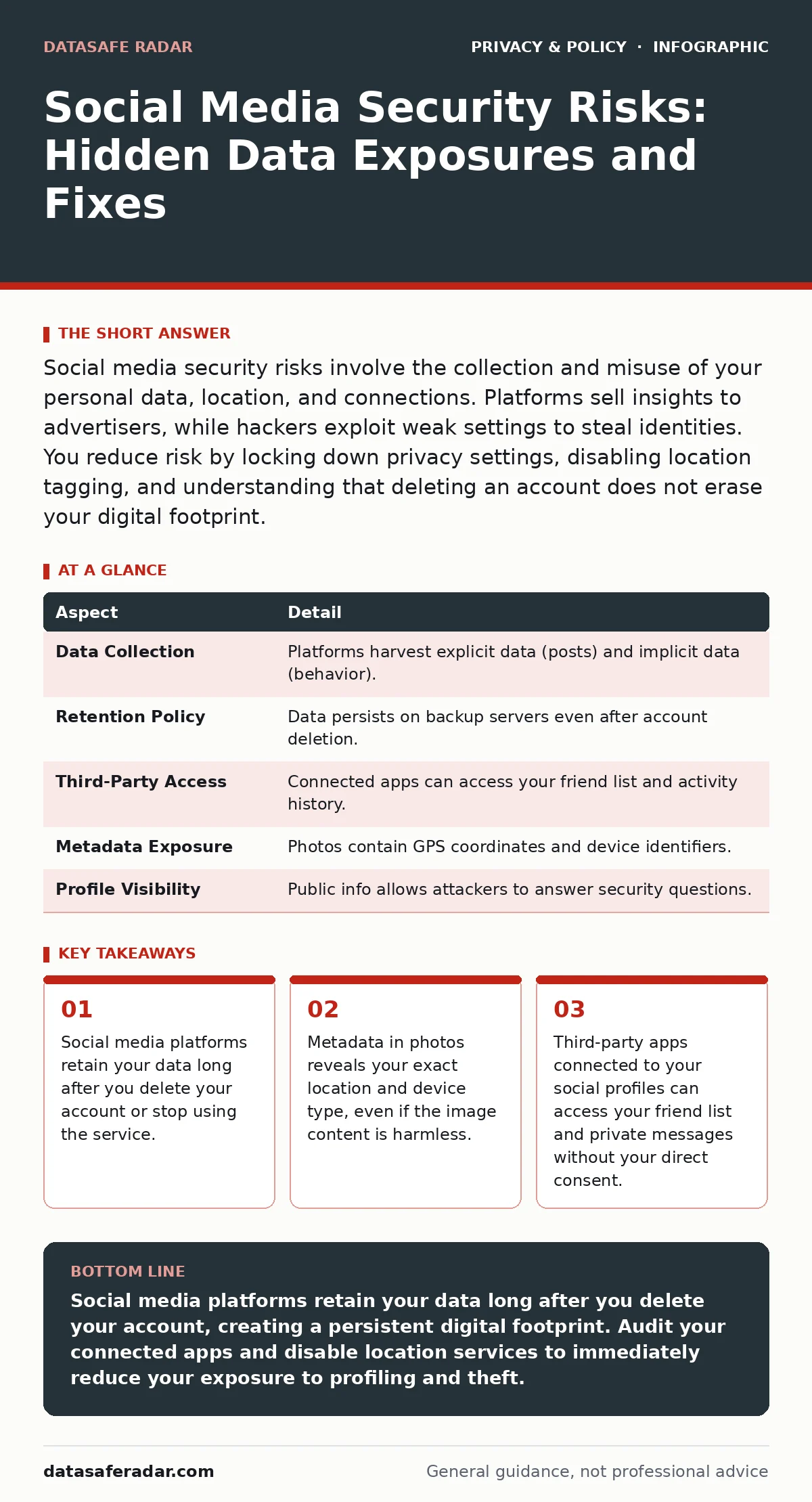
| Aspect | Detail |
|---|---|
| Data Collection | Platforms harvest explicit data (posts) and implicit data (behavior). |
| Retention Policy | Data persists on backup servers even after account deletion. |
| Third-Party Access | Connected apps can access your friend list and activity history. |
| Metadata Exposure | Photos contain GPS coordinates and device identifiers. |
| Profile Visibility | Public info allows attackers to answer security questions. |
How Data Aggregation Works
The mechanism behind these risks is data aggregation. This is the process of combining data from multiple sources to create a comprehensive view of an individual. A single photo may seem harmless. But when combined with your birthday, your employer, and your recent travel check-in, it creates a unique identifier. Attackers use this identifier to bypass identity verification systems. They do not need to hack a bank directly. They only need to answer the security questions correctly.
Social media platforms share this aggregated data with data brokers. These companies buy, clean, and resell consumer information. You rarely see this transaction. It happens in the background through terms of service agreements. You click "I Agree" to use the app. In return, the platform licenses your behavioral patterns. These brokers sell the data to marketers, insurers, and sometimes malicious actors. The more you post, the more valuable your profile becomes.
Who Is Affected by These Risks
You might assume only celebrities or politicians face these threats. This is incorrect. Every person with a social media account is affected. The risk scales with your digital footprint. A quiet user with few friends still leaves traces. These traces include login timestamps, device types, and IP addresses. Attackers target individuals for financial gain. They look for accounts with linked credit cards or banking apps. They also target organizations through their employees.
Business owners face specific dangers. A public LinkedIn profile reveals your company structure. Attackers use this to map out IT departments. They then craft phishing emails that appear to come from senior leadership. This is called spear phishing. It relies on the trust established by your public professional identity. Even if you do not post personally, your professional presence provides the ammunition. The risk is not limited to what you say. It is about what your existence on the platform implies.
Common Misconceptions About Privacy
People often believe that deleting a post removes it from the internet. This is a false sense of security. When you delete a post, the platform may retain it for legal reasons. They also keep it for machine learning training. Other users may have screenshotted the content. These copies persist independently of your account. You cannot control copies once they leave the platform.
Another mistake is trusting privacy policies to protect you. These documents are legal shields for the company, not contracts for your safety. They outline what the company can do, not what they promise not to do. You should read them to understand the worst-case scenario, not to find guarantees. Many users also think that setting a profile to "Private" stops data collection. It only limits who can view your content. The platform still collects and analyzes your behavior.
Mitigating Exposure Through Configuration
You can reduce your risk through careful configuration. Start by auditing your connected apps. These are third-party services linked to your social profile. Many old apps remain connected even after you stop using them. They retain access to your friend list and email address. Revoke access to any app you do not actively use daily. This cuts off a major data leak path.
Next, disable location services for social media apps. GPS tagging adds precise coordinates to your photos. This reveals your home address and daily routine. Turn off location permissions in your phone settings. If you must share a location, do it manually as text. This allows you to generalize the area. You can say "Downtown" instead of letting the app pin your exact street corner.
Finally, review your friend lists regularly. Accept requests only from people you know in real life. Attackers create fake profiles to gain trust. Once accepted, they harvest your private posts. Use the opting out of data brokers process to remove your information from sale lists. This complements your social media efforts by cleaning up the broader data ecosystem.
The Limits of Deletion
Deleting your account does not erase your data immediately. Platforms are required by law to retain certain records. They also keep backups for disaster recovery. Your data may sit on inactive servers for months or years. During this time, it is still vulnerable to breaches. You cannot force a platform to destroy all copies instantly.
This limitation highlights the importance of privacy by design. You should minimize the data you share in the first place. Think of your social media presence as a public square. You cannot un-speak words once shouted. You can only stop shouting. Reduce your digital footprint by posting less. Use ephemeral stories instead of permanent posts. Use direct messages for sensitive information. These measures limit the amount of data available for aggregation.
Long-Term Digital Hygiene
Protecting your privacy is an ongoing process. You must revisit your settings regularly. Platforms change their default privacy options. A setting that was private last year may become public today. Check your profile view settings every few months. Ensure that only your friends can see your friend list. This prevents attackers from mapping your social graph.
Consider using zero-knowledge encryption for sensitive communications. Social media platforms can read your direct messages. Encrypted messaging apps keep the content unreadable to the provider. This adds a layer of security for private conversations. You should also be aware of browser fingerprinting. This technique identifies you based on your browser settings, not just your cookies. Using standard browser configurations reduces your uniqueness in the data pool.
Answering the Search Query
You searched for social media security risks because you want to know how safe your online presence is. The answer is that it is inherently risky. The business model of these platforms relies on your data. You are the product, not the customer. Understanding this dynamic changes how you interact with the services. You stop expecting privacy as a default. You start treating privacy as a skill you must actively maintain.
The risks are real, but they are manageable. You do not need to quit social media entirely. You need to change how you use it. By controlling your settings, limiting your data sharing, and understanding the retention policies, you reduce your exposure. You shift the balance from total transparency to controlled disclosure. This approach protects you from both corporate data harvesting and criminal exploitation.
Key takeaways
- Social media platforms retain your data long after you delete your account or stop using the service.
- Metadata in photos reveals your exact location and device type, even if the image content is harmless.
- Third-party apps connected to your social profiles can access your friend list and private messages without your direct consent.
Social media platforms retain your data long after you delete your account, creating a persistent digital footprint. Audit your connected apps and disable location services to immediately reduce your exposure to profiling and theft.
Frequently asked questions
Does blocking a user remove their access to my old posts?
No, blocking only prevents future interaction. The user may still have cached copies of your past content or screenshots.
Can I see if an app is accessing my data?
Yes, most platforms provide a "Apps and Websites" section in settings where you can view and revoke third-party access.
Is private messaging on social media secure?
Generally no, the platform can read and store your messages. Use dedicated encrypted messaging apps for sensitive conversations.
How do I remove my data from data brokers?
You must contact each broker individually to request deletion, a process covered in our guide on opting out of data brokers.
How this guide was produced: written by the DataSafe Radar editorial team with AI assistance, checked against the public references listed below, and reviewed when the facts change. See our editorial policy or report an error.