Consent management questions answered clearly and directly
Consent management tools often prioritize legal compliance over actual data minimization, hiding genuine privacy controls behind complex interfaces.

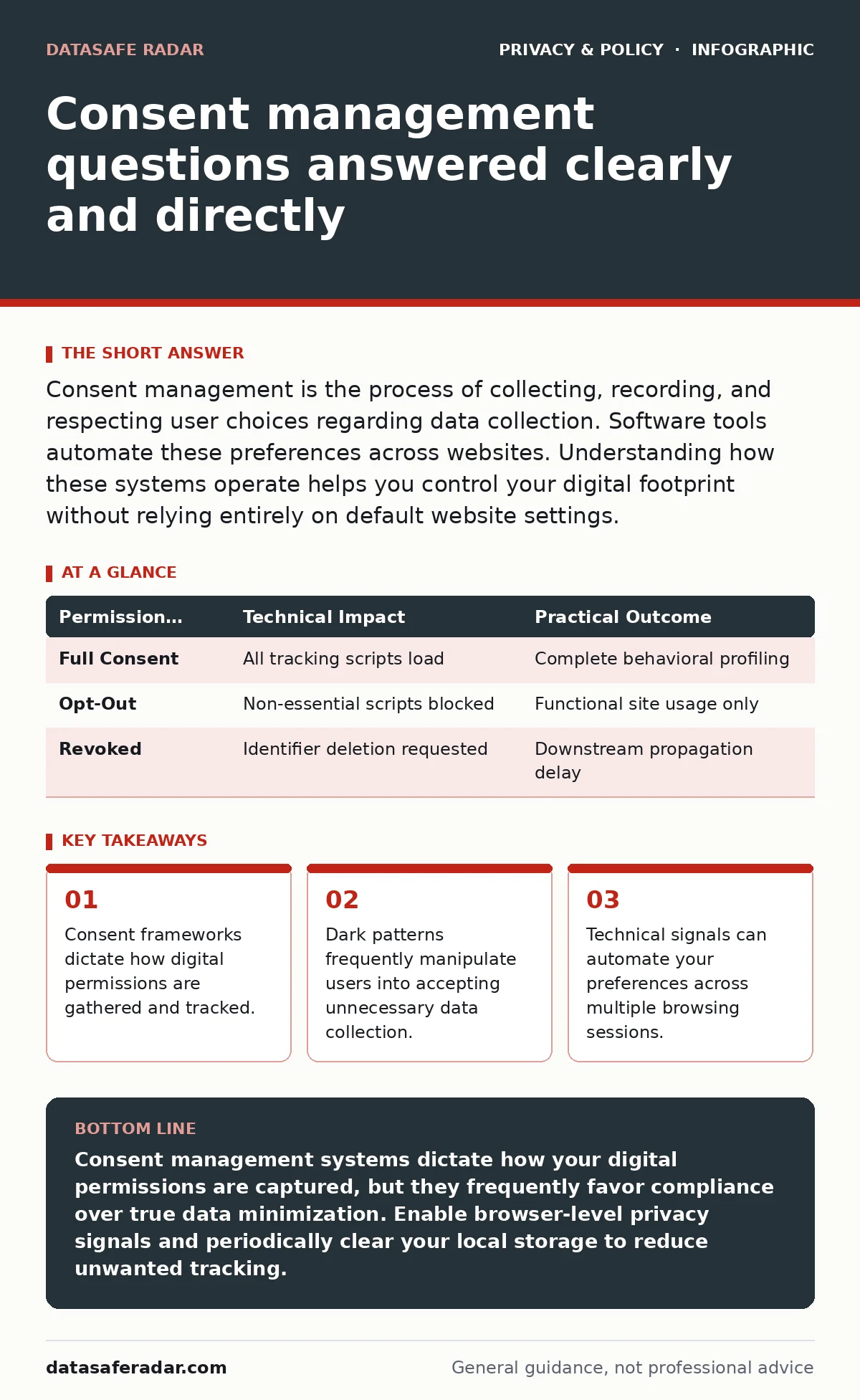
Consent management is the process of collecting, recording, and respecting user choices regarding data collection. Software tools automate these preferences across websites. Understanding how these systems operate helps you control your digital footprint without relying entirely on default website settings.
What is a consent management platform?
A consent management platform is a software tool designed to gather, store, and manage user permissions for data collection across digital properties. These systems power the consent banners, preference centers, and popups you encounter daily. Organizations deploy them to demonstrate compliance with regional regulations governing data privacy without manually tracking every individual interaction.
These platforms bridge the gap between legal requirements and technical execution. They maintain audit trails proving that a user granted or denied specific categories of processing at a precise timestamp.
How do websites track your consent choices?
Websites track your consent choices primarily by storing a small text file called a cookie inside your browser storage partition. This token remembers whether you accepted or rejected specific data processing categories like analytics or marketing. Subsequent page loads read this token immediately to determine which scripts are allowed to execute.
The reliability of this mechanism depends heavily on your browser storage settings. If you use aggressive clearing rules, the token vanishes, and the site treats you as a brand-new visitor upon your next arrival.
Why do consent popups keep reappearing?
Consent popups keep reappearing because your browser deletes its local storage tokens, or because the website updates its tracking vendors and operational terms. Clearing your cache erases the memory of your previous choices entirely. Furthermore, companies intentionally reset these prompts to request fresh permissions when regulations change or when they integrate new third-party cookies into their infrastructure.
Frequent reappearances also happen when sites deploy multiple independent consent frameworks on a single domain. Each framework stores its own token, meaning clearing one does not satisfy the other.
What happens when you reject optional data collection?
Rejecting optional data collection means the website should restrict itself strictly to necessary operations required for basic site functionality and security. Non-essential scripts responsible for ad tracking and deep behavioral profiling remain dormant during your session. However, enforcement varies wildly between jurisdictions, and some sites degrade core features or block access entirely until you submit.
Technical validation of this rejection requires inspecting network traffic using developer tools. You will often notice that some minor analytics requests slip through despite an explicit opt-out choice.
Can browser settings replace website consent banners?
Browser settings can replace manual consent interactions by automatically broadcasting your privacy preferences to every visiting website in the background. Modern browsers include native signals that communicate your desire to opt out of data collection without requiring you to click through endless banner menus. These built-in controls streamline your browsing experience significantly while maintaining your personal boundaries.
Relying solely on browser defaults does not guarantee compliance from all operators. Smaller sites frequently ignore these signals until forced by strict regulatory enforcement actions.
See also: Browser Fingerprinting Techniques: How Sites Track You Without Cookies
How do dark patterns affect your choices?
Dark patterns affect your choices by using manipulative visual design and confusing language to trick you into granting unnecessary permissions. Brightly colored acceptance buttons contrast sharply with hidden, grayed-out rejection links located at the bottom of the menu. Designers deliberately engineer these interfaces to exploit cognitive biases, making consent feel like a mandatory chore rather than a genuine choice.
Regulatory bodies increasingly penalize these deceptive design choices. Yet, the financial incentive to capture user data ensures that manipulative layouts remain widespread across the web.
Where does your revoked consent actually go?
Revoked consent instructions trigger automated programming interfaces that signal downstream vendors to halt data processing for your unique identifier. Yet, the reality of distributed databases means deletion is rarely instantaneous across all connected nodes. Information already shared with data brokers may persist in backup archives long after you click the toggle switch.
Timing delays introduce a significant window of vulnerability. During this propagation phase, your profile continues to circulate through automated advertising auctions before final suppression occurs.
What is the role of global privacy control signals?
Global privacy control signals act as a universal legal and technical mechanism that communicates your opt-out preferences automatically without user intervention. When enabled, your device tells every visited server that you refuse the sale or sharing of your personal information. This approach eliminates the fatigue of interacting with individual consent banners entirely.
Adoption of this standard simplifies compliance for publishers while returning control to the individual. Implementation requires both browser support and legal recognition from governing bodies.
| Permission State | Technical Impact | Practical Outcome |
|---|---|---|
| Full Consent | All tracking scripts load | Complete behavioral profiling |
| Opt-Out | Non-essential scripts blocked | Functional site usage only |
| Revoked | Identifier deletion requested | Downstream propagation delay |
Key takeaways
- Consent frameworks dictate how digital permissions are gathered and tracked.
- Dark patterns frequently manipulate users into accepting unnecessary data collection.
- Technical signals can automate your preferences across multiple browsing sessions.
Consent management systems dictate how your digital permissions are captured, but they frequently favor compliance over true data minimization. Enable browser-level privacy signals and periodically clear your local storage to reduce unwanted tracking.
Frequently asked questions
How do mobile apps handle consent compared to browsers?
Mobile apps rely on operating system permissions rather than web cookies to restrict data collection. These platform-level controls force applications to request explicit access to identifiers and location data before tracking begins.
Are consent banners legally binding for companies?
Consent banners carry legal weight under modern privacy regulations, requiring companies to honor the choices you submit. Failure to respect a recorded opt-out can result in severe financial penalties for the organization.
Can a virtual private network bypass consent requirements?
Virtual private networks mask your IP address and location, but they do not interact with consent management platforms or stop cookie placement. These tools protect network transit rather than browser-level tracking choices.
What happens if a website ignores your rejection?
Websites that ignore rejections violate regulatory frameworks, though enforcement relies heavily on user complaints and audits. Technical monitoring is often required to catch companies secretly processing data after an opt-out.
How this guide was produced: written by the DataSafe Radar editorial team with AI assistance, checked against the public references listed below, and reviewed when the facts change. See our editorial policy or report an error.