Privacy by Design: Real Benefits and Hidden Costs
Privacy by Design shifts data protection from a compliance checkbox to an architectural constraint, forcing you to solve hard engineering problems before code runs in production.

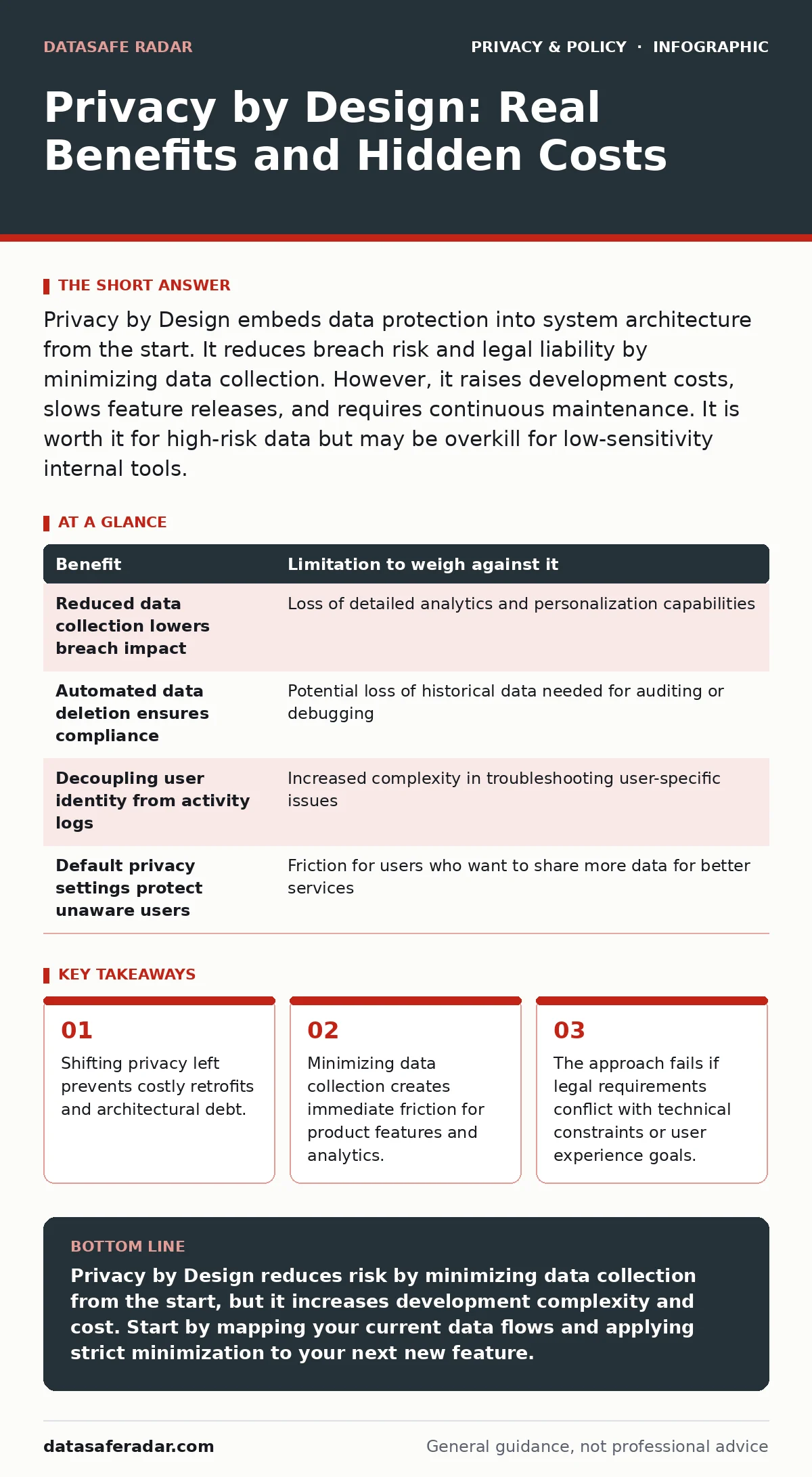
Privacy by Design embeds data protection into system architecture from the start. It reduces breach risk and legal liability by minimizing data collection. However, it raises development costs, slows feature releases, and requires continuous maintenance. It is worth it for high-risk data but may be overkill for low-sensitivity internal tools.
The Architecture of Restraint
Privacy by Design is not a software library or a compliance checklist. It is an engineering philosophy that treats data minimization as a core system requirement. You build the system to collect only what is strictly necessary, for only as long as necessary. This changes how you structure databases, APIs, and user interfaces.
Most development teams treat privacy as a filter applied at the end. They build a feature, then ask legal to review it. Privacy by Design reverses this order. You define the data boundaries before you write the code. This forces you to confront difficult trade-offs early. You cannot hide the cost of data collection in a later patch.
Concrete Benefits of Early Integration
The primary benefit is reduced attack surface. If you do not collect a data element, it cannot be stolen, leaked, or misused. This simplifies security audits and reduces the scope of liability. You also avoid the technical debt of retrofitting privacy controls. Adding encryption or access controls to a legacy system is exponentially harder than building them in from the start.
This approach also improves user trust. When users see that you only ask for the data you need, they are more likely to engage. This contrasts with the current trend of permission fatigue, where users blindly accept requests or abandon apps. For a deeper look at how permissions affect trust, see our guide on app permission management.
Furthermore, it streamlines regulatory compliance. Laws like GDPR and CCPA require data protection by design and by default. Building these into the architecture means you are not scrambling to create records of processing activities when an auditor arrives. You simply point to the system design.
The Hidden Costs and Limitations
Privacy by Design is expensive. It requires more time in the planning phase. Engineers must understand data flows, legal requirements, and security implications before coding begins. This slows down initial development velocity. Product managers may resist because they want to test features quickly.
Data minimization often conflicts with business intelligence goals. Marketing teams want detailed user profiles. Engineering teams want verbose logs for debugging. Privacy by Design forces you to reject much of this data. You must find alternative ways to measure success or debug issues that do not rely on personal data. This requires creativity and often new tooling.
Another limitation is the risk of over-engineering. Teams may implement complex anonymization or pseudonymization schemes that do not actually provide protection. If an adversary can link anonymized data to external sources, the privacy controls fail. This is why understanding metadata exposure is critical; often the hidden data, not the main payload, reveals identity.
When It Is Worth It
You should invest in Privacy by Design when handling sensitive data. Health records, financial information, and biometric data carry high risk. A breach here causes severe harm to users and massive reputational damage to your organization. The cost of prevention is lower than the cost of response.
It is also worth it for consumer-facing products with large user bases. The network effect of bad privacy practices spreads quickly. One misstep can lead to widespread churn. For these products, privacy is a competitive advantage. Users are increasingly aware of data privacy issues and choose services that respect their boundaries.
If you operate in highly regulated industries, this approach is mandatory. The penalties for non-compliance are severe. Building privacy into the design ensures you meet these standards without constant firefighting. See our guide on data subject access requests to understand the operational burden of handling user data inquiries when you have collected too much.
When It Is Not Worth It
For internal tools used by a small, trusted team, full Privacy by Design may be overkill. If the data is not sensitive and the user base is limited, the cost of implementation may outweigh the benefits. Simple access controls and standard encryption may suffice.
Startups in the early validation phase may also find it restrictive. They need to iterate quickly to find product-market fit. Strict data minimization can hinder the rapid experimentation needed at this stage. However, they should still avoid collecting unnecessary personal data. The goal is balance, not paralysis.
If the technical complexity required to protect data exceeds the value of the data itself, reconsider. Do not build a fortress to protect a diary. Evaluate the risk and cost objectively. Sometimes, the best privacy control is to not build the feature at all.
Balancing Act: The Trade-Off Table
Every privacy control has a cost. You must weigh the benefit against the limitation. This table helps you evaluate specific measures.
| Benefit | Limitation to weigh against it |
|---|---|
| Reduced data collection lowers breach impact | Loss of detailed analytics and personalization capabilities |
| Automated data deletion ensures compliance | Potential loss of historical data needed for auditing or debugging |
| Decoupling user identity from activity logs | Increased complexity in troubleshooting user-specific issues |
| Default privacy settings protect unaware users | Friction for users who want to share more data for better services |
Implementing Without Stalling
You do not need to rewrite your entire system to start. Begin with a data map. Identify what data you collect, where it goes, and why. Then, pick one new feature and apply Privacy by Design principles. Ask: "Can we do this without collecting personal data?"
Involve legal and security teams early. Do not wait until the code is written. Use threat modeling to identify privacy risks. Consider how data might be misused by insiders or external attackers. For network-level privacy, secure DNS can help prevent tracking via domain lookups.
Document your decisions. Why did you choose to collect this data? Why did you reject that request? This documentation proves due diligence. It also helps future teams understand the constraints. Privacy is not a one-time task. It is a continuous process of evaluation and adjustment.
Key takeaways
- Shifting privacy left prevents costly retrofits and architectural debt.
- Minimizing data collection creates immediate friction for product features and analytics.
- The approach fails if legal requirements conflict with technical constraints or user experience goals.
Privacy by Design reduces risk by minimizing data collection from the start, but it increases development complexity and cost. Start by mapping your current data flows and applying strict minimization to your next new feature.
Frequently asked questions
Does Privacy by Design replace traditional security controls?
No. It complements them by reducing the amount of data that needs protection. You still need encryption, access controls, and monitoring.
Can existing legacy systems adopt Privacy by Design?
Partially. You can refactor specific modules to minimize data collection, but full adoption usually requires significant architectural changes.
How do I explain this to non-technical stakeholders?
Frame it as risk reduction and brand trust. Less data means fewer breaches and happier customers, which supports long-term business goals.
Is there a standard certification for Privacy by Design?
The Ontario Information and Privacy Commissioner offers certification, but it is not a technical standard. It validates your process, not your code.
How this guide was produced: written by the DataSafe Radar editorial team with AI assistance, checked against the public references listed below, and reviewed when the facts change. See our editorial policy or report an error.