Reducing Your Digital Footprint: Benefits, Limits, and Real Trade-offs
Shrinking your online presence lowers risk but creates friction in daily services, requiring a careful balance between privacy and convenience.

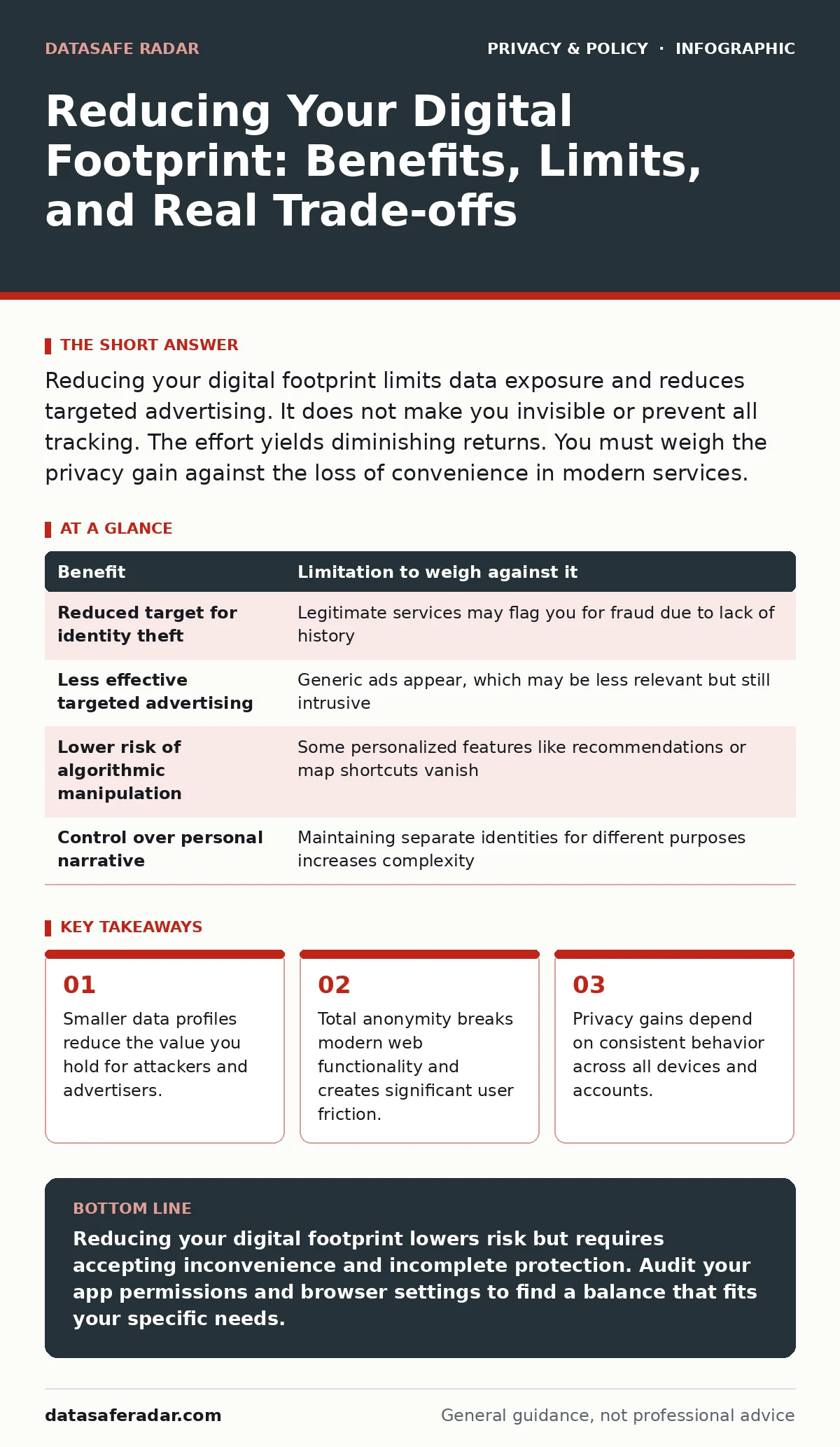
Reducing your digital footprint limits data exposure and reduces targeted advertising. It does not make you invisible or prevent all tracking. The effort yields diminishing returns. You must weigh the privacy gain against the loss of convenience in modern services.
The Mechanics of Data Collection
Your digital footprint consists of every interaction you have with connected systems. Browsers send headers that reveal your operating system and language settings. Applications request permissions to access your location, contacts, and microphone. Each click, search, and login event generates a data point. These points aggregate into a profile that predicts your behavior. Companies use this profile to serve advertisements and optimize user experiences. The more data they hold, the more accurate their predictions become. This accuracy drives revenue but increases your exposure to data breaches and misuse.
Concrete Benefits of a Smaller Footprint
Limiting your data output reduces the attack surface available to malicious actors. If a service provider suffers a breach, less personal information is available for identity theft. A smaller footprint also reduces the effectiveness of algorithmic manipulation. Advertisers cannot target you with persuasive content if they lack a detailed history. This reduces the psychological pressure to purchase or engage with specific content. You also limit the ability of employers or insurers to discriminate based on inferred traits. Privacy is not just about hiding; it is about controlling who knows what about you.
| Benefit | Limitation to weigh against it |
|---|---|
| Reduced target for identity theft | Legitimate services may flag you for fraud due to lack of history |
| Less effective targeted advertising | Generic ads appear, which may be less relevant but still intrusive |
| Lower risk of algorithmic manipulation | Some personalized features like recommendations or map shortcuts vanish |
| Control over personal narrative | Maintaining separate identities for different purposes increases complexity |
Honest Limitations and Hidden Costs
Reducing your footprint does not erase your existence from the internet. Public records, social media posts from others, and data broker aggregations persist regardless of your efforts. You cannot control what third parties collect about you through cross-site tracking or physical surveillance. Attempting to hide completely often creates a distinct behavioral signature.
Security researchers note that users who aggressively block all trackers behave differently from the norm. This anomaly can draw attention rather than deflect it. The friction of constant logins and disabled cookies also reduces productivity. You may miss out on legitimate discounts or personalized services that rely on accurate data.
When It Is Worth It
You should invest effort in reducing your footprint when the potential harm of exposure is high. Journalists, activists, and whistleblowers face direct threats from data misuse. In these cases, the cost of privacy measures is justified by safety. Individuals with sensitive health conditions or financial vulnerabilities also benefit from strict data minimization. If you have been targeted by harassment or stalking, limiting your digital trail is a necessary safety step. The goal here is not invisibility but risk reduction. You accept the inconvenience of fewer services to protect your physical and financial security.
When It Is Not Worth It
For the average user, extreme privacy measures often yield minimal security benefits. Spending hours configuring obscure browser settings provides little protection against well-funded adversaries. The time and mental energy required to maintain a near-zero footprint have an opportunity cost. If you use standard services for entertainment or basic communication, the risk of harm is low.
Over-optimizing for privacy can lead to "privacy fatigue," where users abandon good practices because they are too difficult. It is better to use standard, widely accepted tools than to attempt complex, fragile configurations. Balance is key. Accepting some data collection allows for a smoother user experience.
See also: Privacy Browsers for Small Teams That Work · Private file sharing services explained for secure transfers
Practical Steps for Balanced Privacy
Start by auditing your app permissions. Review which applications have access to your location, camera, and microphone. Disable permissions that are not strictly necessary for the app’s function. Use tracker blockers in your browser to stop third-party scripts from collecting data. These tools block common advertising networks and analytics platforms. Enable two-factor authentication on all critical accounts to protect them from credential stuffing attacks. Regularly review your privacy settings on social media platforms to limit who can see your posts. These steps provide significant protection with minimal disruption.
Understanding Data Privacy Trade-offs
Every privacy decision involves a trade-off between security and convenience. You must decide what level of exposure you accept. Using secure DNS can prevent your internet provider from seeing which websites you visit. However, some networks may block traffic if they cannot inspect it. Understanding these mechanisms helps you make informed choices. You do not need to eliminate your footprint entirely. You need to reduce it to a level that matches your risk tolerance. Regular privacy audits help you stay current with new threats and tools.
The Role of Technology in Privacy
Technology plays a dual role in privacy. It enables collection but also provides tools for protection. Differential privacy adds statistical noise to data sets, allowing companies to learn trends without identifying individuals. This technique protects user privacy while maintaining data utility. Biometric data offers convenient authentication but carries unique risks if compromised. You cannot change your face or fingerprint like a password. Understanding these technologies helps you evaluate their privacy implications. Choose tools that align with your values and risk profile.
Key takeaways
- Smaller data profiles reduce the value you hold for attackers and advertisers.
- Total anonymity breaks modern web functionality and creates significant user friction.
- Privacy gains depend on consistent behavior across all devices and accounts.
Reducing your digital footprint lowers risk but requires accepting inconvenience and incomplete protection. Audit your app permissions and browser settings to find a balance that fits your specific needs.
Frequently asked questions
Does deleting my social media accounts erase my digital footprint?
No. Data brokers and other users may have already copied or archived your information. Deleting accounts stops future collection but does not remove existing data from the internet.
Is using incognito mode enough to protect my privacy?
No. Incognito mode only prevents your browser from saving history locally. Your internet provider, the websites you visit, and employer networks can still track your activity.
How do I know if a privacy tool is trustworthy?
Look for open-source tools that undergo independent security audits. Avoid proprietary black-box solutions that claim to offer total anonymity without transparent code.
Can I use a VPN to bypass regional content restrictions safely?
Using a VPN for this purpose may violate the terms of service of the content provider. Additionally, free or cheap VPNs often log and sell your traffic data, defeating the privacy purpose.
How this guide was produced: written by the DataSafe Radar editorial team with AI assistance, checked against the public references listed below, and reviewed when the facts change. See our editorial policy or report an error.