Privacy audits best practices: Map data flows before writing policies
Most privacy audits fail because teams document where data should go rather than tracing where software actually sends it.

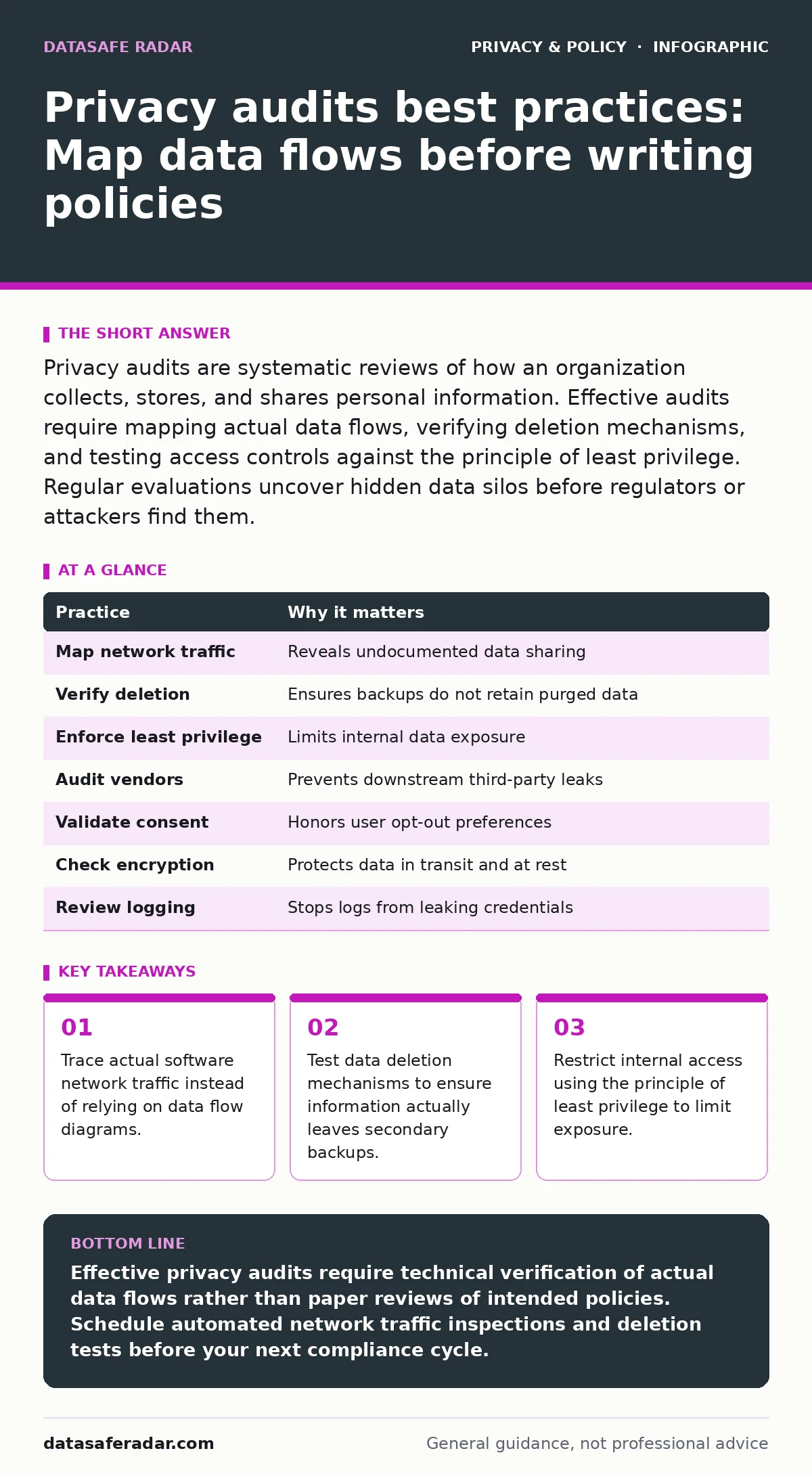
Privacy audits are systematic reviews of how an organization collects, stores, and shares personal information. Effective audits require mapping actual data flows, verifying deletion mechanisms, and testing access controls against the principle of least privilege. Regular evaluations uncover hidden data silos before regulators or attackers find them.
1. Map actual network traffic
Data flow diagrams often reflect design intentions rather than operational reality. Software dependencies, third-party libraries, and misconfigured cloud buckets frequently route information to unexpected destinations. Tracing actual network traffic reveals where bits travel during routine application use.
Inspect outbound requests generated by your applications using packet analysis tools to capture real-time destinations. Compare these captured endpoints against your existing data inventory to spot undocumented third-party sharing.
2. Verify deletion mechanisms
Deleting a database record rarely removes information from every system layer. Backups, transaction logs, and analytical replicas often retain personal data indefinitely. Verifying deletion mechanisms ensures that user removal requests trigger complete eradication across all storage tiers.
Test your deletion procedures by creating a unique test record, initiating removal, and querying every backup archive and log repository for remnants. Document the exact time required for complete erasure to meet regulatory timelines.
3. Enforce least privilege access
Internal data exposure remains a primary driver of privacy incidents. Limiting who can view sensitive information reduces the blast radius of compromised credentials. Enforcing the principle of least privilege ensures employees access only the specific records required for their current tasks.
Review permission lists quarterly and remove accounts that retain access after changing roles or leaving the organization. Pair this access review with zero-knowledge encryption where storage providers cannot read your stored data even if compromised.
4. Audit third-party vendors
External service providers often process your customer data without direct oversight. Vendor contracts establish legal obligations, but technical audits verify actual adherence. Reviewing third-party data handling practices prevents downstream leaks from damaging your reputation.
Request technical compliance reports and inspect API integrations maintained by external partners for excessive data permissions. Limit third-party access tokens to single-purpose functions rather than broad database credentials.
5. Validate consent collection
User consent mechanisms must be granular, informed, and easily reversible. Broken consent flags often continue tracking users who opted out of analytics or marketing cookies. Validating these pathways ensures user preferences propagate instantly to every tracking script.
Test your opt-out toggles in a clean browser session to confirm that tracking scripts cease execution immediately upon withdrawal. Pair this workflow with proper consent management to maintain accurate preference ledgers across platforms.
6. Check encryption standards
Data requires protection both in transit across networks and at rest in storage volumes. Weak cipher suites or missing transport layer security expose information to passive interception. Checking encryption standards confirms that cryptographic controls match current mathematical recommendations.
Scan your public endpoints for outdated protocol versions and verify that database storage volumes employ strong symmetric encryption keys. Store decryption keys separately from encrypted data repositories to maintain adequate security boundaries.
7. Review logging practices
System logs often capture sensitive personal information such as passwords, session tokens, or unencrypted email addresses during error handling. Reviewing logging practices prevents audit trails from becoming secondary data leaks.
Inspect application log outputs for Personally Identifiable Information and implement automated masking rules to sanitize text before it hits log storage. Establish strict retention limits on operational logs so historical records do not accumulate indefinitely.
| Practice | Why it matters |
|---|---|
| Map network traffic | Reveals undocumented data sharing |
| Verify deletion | Ensures backups do not retain purged data |
| Enforce least privilege | Limits internal data exposure |
| Audit vendors | Prevents downstream third-party leaks |
| Validate consent | Honors user opt-out preferences |
| Check encryption | Protects data in transit and at rest |
| Review logging | Stops logs from leaking credentials |
Key takeaways
- Trace actual software network traffic instead of relying on data flow diagrams.
- Test data deletion mechanisms to ensure information actually leaves secondary backups.
- Restrict internal access using the principle of least privilege to limit exposure.
Effective privacy audits require technical verification of actual data flows rather than paper reviews of intended policies. Schedule automated network traffic inspections and deletion tests before your next compliance cycle.
Frequently asked questions
How often should an organization conduct a privacy audit?
Organizations should conduct formal privacy audits annually, while continuously monitoring automated data flows and software dependency updates.
What is the difference between a security audit and a privacy audit?
Security audits focus on preventing unauthorized access and system breaches, whereas privacy audits examine how personal data is collected, used, and shared.
Who should be responsible for leading a privacy audit?
Cross-functional teams comprising engineering, legal, and product staff should collaborate on privacy audits to ensure technical accuracy and policy compliance.
How do shadow IT systems impact privacy audits?
Unapproved software tools deployed by employees create hidden data silos that bypass standard governance and evade routine privacy tracking.
How this guide was produced: written by the DataSafe Radar editorial team with AI assistance, checked against the public references listed below, and reviewed when the facts change. See our editorial policy or report an error.