Privacy Audits: Benefits, Limits, and When They Actually Help
Privacy audits reveal hidden data flows but cannot fix broken engineering or stop determined attackers from bypassing controls.

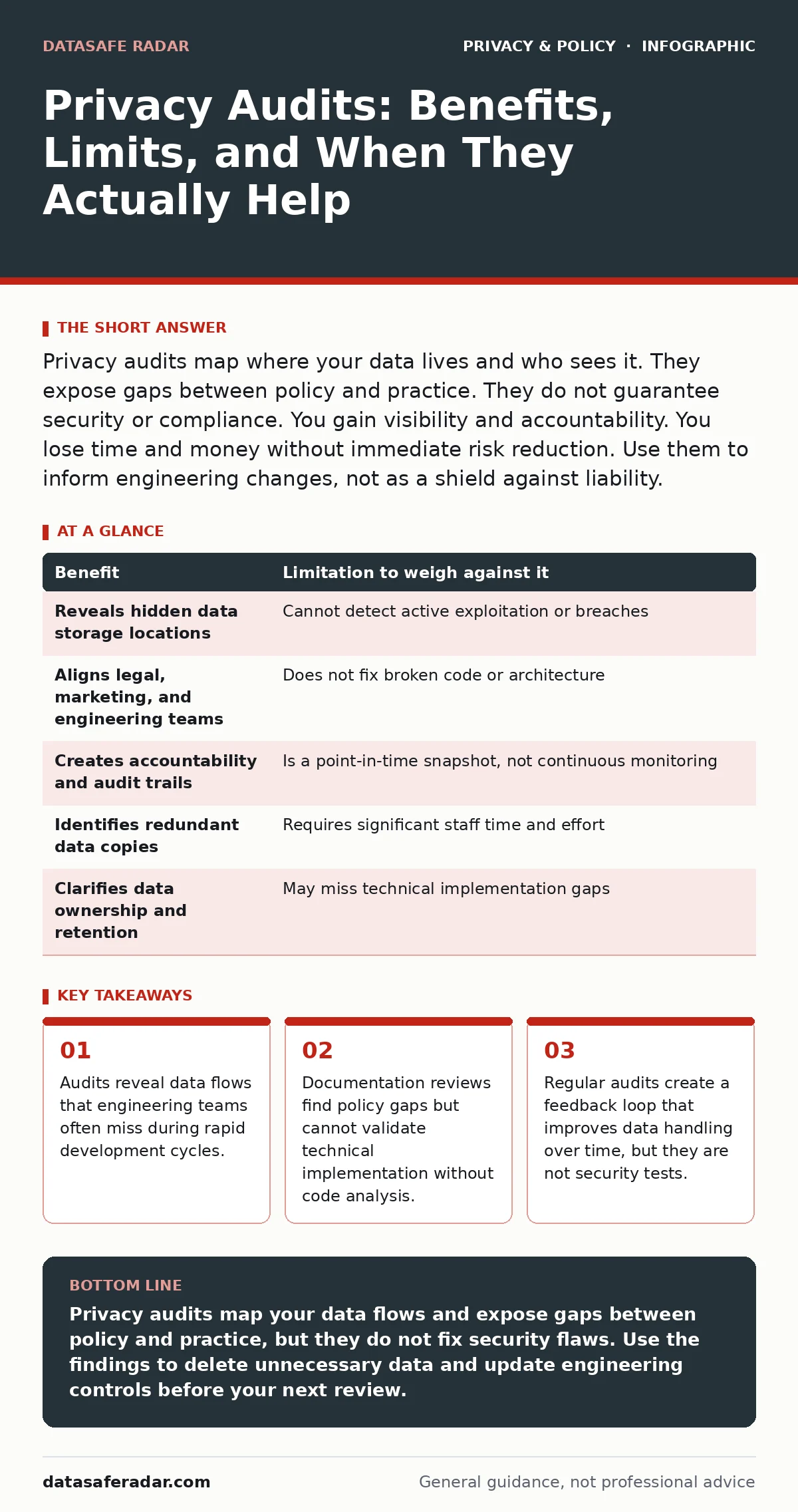
Privacy audits map where your data lives and who sees it. They expose gaps between policy and practice. They do not guarantee security or compliance. You gain visibility and accountability. You lose time and money without immediate risk reduction. Use them to inform engineering changes, not as a shield against liability.
What a Privacy Audit Actually Does
A privacy audit examines how an organization collects, processes, stores, and shares personal data. It compares actual practices against stated policies and legal requirements. The process involves reviewing documentation, interviewing staff, and inspecting data flows. It does not test for vulnerabilities like hackers would. It checks if the rules on paper match the reality on the server.
The output is a report of findings. These findings highlight discrepancies. A discrepancy might be data kept longer than necessary. It might be sharing data with a vendor not listed in contracts. The audit creates a record of what you knew and when you knew it. This record matters for accountability. It shows you tried to manage risk. It does not prove you are safe.
Concrete Benefits of Regular Reviews
You gain visibility into hidden data dependencies. Engineers often add logging or tracking for debugging. They forget to remove it. An audit finds these leftover data points. It also identifies redundant copies of data. Storing the same user profile in 3 different systems increases risk. An audit flags this inefficiency.
You improve internal alignment. Marketing might promise one thing to users. Engineering might build another. Legal might draft a third. The audit forces these teams to agree on the truth. This reduces legal exposure. It clarifies who owns what data. It establishes clear ownership for data retention decisions.
You build a baseline for change. When you launch a new feature, you need to know the starting point. An audit provides that baseline. It makes future changes easier to assess. You can measure improvement against a known state. This is better than guessing about your current posture.
Honest Limitations and Hidden Costs
An audit is a snapshot in time. Data flows change daily. A finding from last month may be obsolete today. You cannot audit continuously without significant cost. The gap between audits is a risk window. Attackers do not wait for your next review. They exploit current weaknesses.
Documentation often differs from implementation. You can write a perfect policy. Your code might ignore it. An audit that only reads documents misses this gap. It gives a false sense of security. You believe you are compliant because the paper says so. The reality is different. Code reviews and testing are needed to verify technical controls.
The process consumes engineering time. Staff must answer questions. They must trace data paths. This pulls them from feature development. The cost is not just the auditor's fee. It is the lost developer hours. Small teams feel this burden most. They may resist the process. This resistance can lead to incomplete answers.
| Benefit | Limitation to weigh against it |
|---|---|
| Reveals hidden data storage locations | Cannot detect active exploitation or breaches |
| Aligns legal, marketing, and engineering teams | Does not fix broken code or architecture |
| Creates accountability and audit trails | Is a point-in-time snapshot, not continuous monitoring |
| Identifies redundant data copies | Requires significant staff time and effort |
| Clarifies data ownership and retention | May miss technical implementation gaps |
When It Is Worth It
You should conduct a privacy audit when you change data handling significantly. Launching a new product that collects sensitive information requires a review. Adding a new third-party vendor changes your risk profile. You need to verify their practices. An audit helps you negotiate better contracts. It ensures you know what data they receive.
You need an audit when facing regulatory scrutiny. If you operate in regions with strict data laws, you must demonstrate compliance. An audit provides evidence of due diligence. It shows you actively manage privacy. This can reduce penalties if a breach occurs. It proves you tried to follow the rules. It is not a get-out-of-jail-free card, but it helps.
You benefit from an audit when scaling rapidly. Growth introduces chaos. New hires may not know the rules. New systems may bypass old checks. An audit resets the baseline. It catches the drift that happens during fast growth. It prevents small issues from becoming systemic problems. It is an investment in stability.
When It Is Not Worth It
Do not audit if you have no data to protect. If you only collect anonymized analytics, the cost outweighs the benefit. Focus on security instead. If you do not process personal information, a privacy audit is a waste of resources. You should still secure your systems, but privacy rules do not apply in the same way.
Avoid auditing if you lack basic security. You cannot build privacy on a broken foundation. If your servers are unpatched and your access controls are weak, an audit is pointless. Fix the security holes first. Privacy measures will be bypassed by attackers anyway. Secure the perimeter before you map the interior.
Skip the audit if you are only doing it for marketing. If you cannot act on the findings, do not start. An audit creates liability if you ignore its recommendations. You knew about the risk and did nothing. This is worse than not knowing. Only audit if you are ready to change processes. You must be willing to delete data, update policies, and retrain staff.
See also: SaaS Data Exposure Prevention Checklist for Secure Apps · Difference Between ISO 27001 and 27701: Scope, Privacy, and Audit Reality
Integrating With Other Privacy Practices
A privacy audit works best with other tools. It complements your efforts in reducing your digital footprint. The audit shows where you collect data. Reducing the footprint minimizes what you collect. These two practices reinforce each other. Less data means less to audit and less to protect.
You should also review your use of third-party cookies. Many audits miss these tracking mechanisms. They are often embedded in analytics scripts. The audit should specifically check for these hidden trackers. This connects to your broader strategy for digital privacy rights. You need to know how you track users to respect their choices.
Consider how biometric data fits into your audit. If you use facial recognition or fingerprints, the stakes are higher. This data cannot be changed if breached. Your audit must verify strict controls for this data. It should also check your encrypted cloud storage practices. You need to ensure this sensitive data is encrypted at rest and in transit.
Making the Findings Actionable
The report is useless if it sits on a shelf. You must convert findings into tasks. Prioritize them by risk and effort. Fix the easy wins first. Delete unnecessary data. Update retention policies. These changes show immediate progress. They build momentum for harder fixes.
Assign owners to each finding. Do not leave tasks vague. Name a person and a deadline. Track progress in your project management tool. Review status in weekly meetings. This keeps privacy on the agenda. It prevents the audit from becoming a one-time event. It becomes part of your development cycle.
The Long-Term View
Privacy is not a destination. It is a continuous process. You will always have new data flows. You will always have new vendors. The audit is a check-up, not a cure. Use it to maintain health. Do not expect it to solve everything. Combine it with strong security and clear policies. This creates a resilient system. It protects your users and your business.
You should also understand data subject access requests. These requests test your audit findings. If you cannot find a user's data quickly, your audit missed something. Use these requests as a real-world test. They validate your data maps. They show where your documentation fails. This feedback loop improves your next audit.
Key takeaways
- Audits reveal data flows that engineering teams often miss during rapid development cycles.
- Documentation reviews find policy gaps but cannot validate technical implementation without code analysis.
- Regular audits create a feedback loop that improves data handling over time, but they are not security tests.
Privacy audits map your data flows and expose gaps between policy and practice, but they do not fix security flaws. Use the findings to delete unnecessary data and update engineering controls before your next review.
Frequently asked questions
How often should we conduct a privacy audit?
Conduct a full audit annually or whenever you launch a major new feature. Perform lightweight checks before adding new vendors or data types.
Can a privacy audit prevent a data breach?
No. Audits identify where data lives and who can access it. They do not patch vulnerabilities or stop attackers. You need security testing for that.
Do we need a third-party auditor?
Not always. Internal teams can perform audits if they have the expertise and objectivity. Third parties offer fresh eyes and legal defensibility.
What if the audit finds major violations?
Create a remediation plan immediately. Prioritize fixing the highest risks. Document your actions. Ignoring findings increases legal liability significantly.
How this guide was produced: written by the DataSafe Radar editorial team with AI assistance, checked against the public references listed below, and reviewed when the facts change. See our editorial policy or report an error.