Rowhammer Attacks: How Memory Flipping Breaks Security
Rowhammer exploits physical interference in RAM to flip bits, bypassing software protections that assume memory cells are electrically isolated.

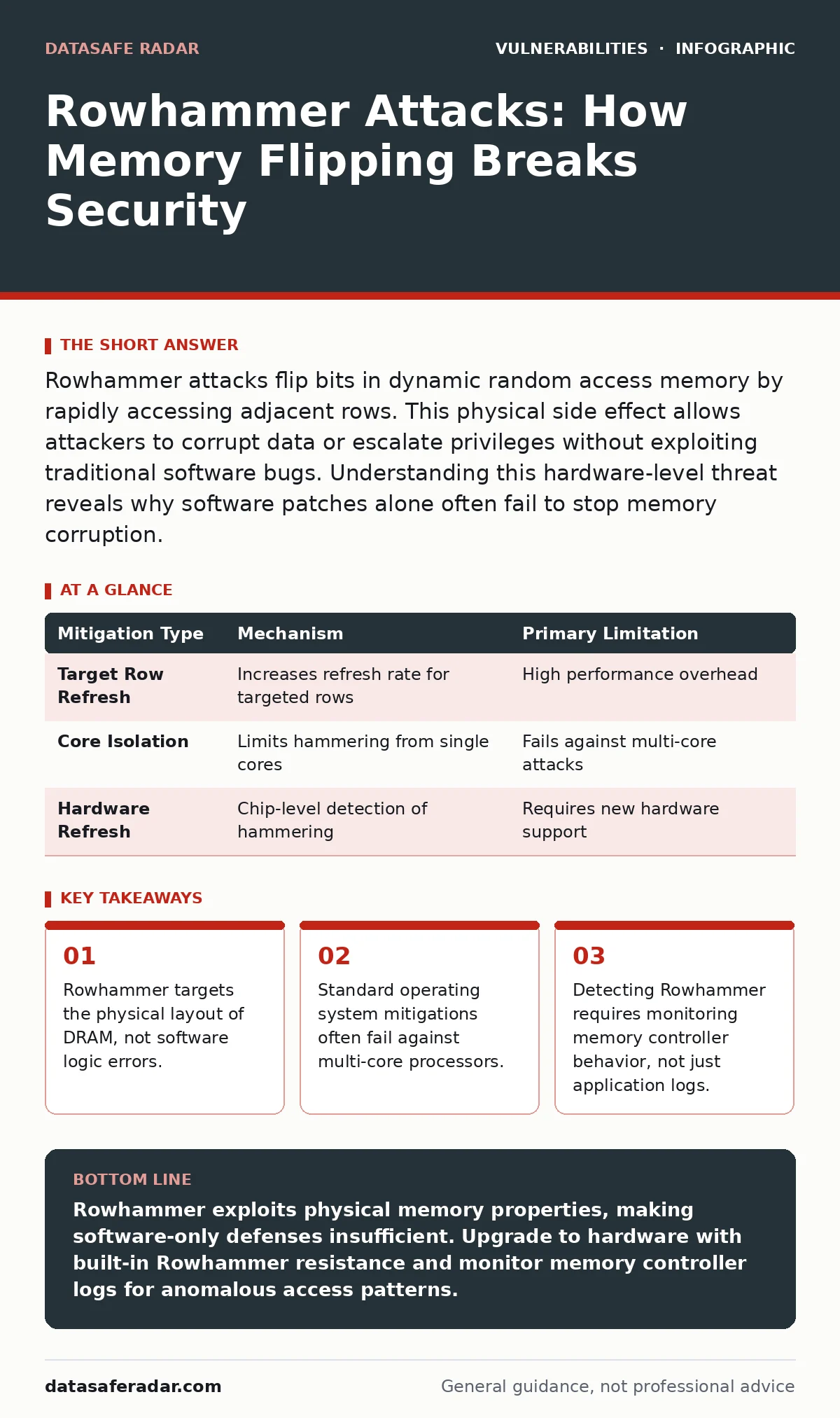
Rowhammer attacks flip bits in dynamic random access memory by rapidly accessing adjacent rows. This physical side effect allows attackers to corrupt data or escalate privileges without exploiting traditional software bugs. Understanding this hardware-level threat reveals why software patches alone often fail to stop memory corruption.
What is a Rowhammer attack?
Rowhammer is a technique that exploits the physical proximity of memory cells in dynamic random access memory. DRAM stores data in capacitors that leak charge over time. The memory controller refreshes these cells periodically to prevent data loss. When an attacker repeatedly accesses a specific row, the electrical interference causes adjacent rows to lose charge faster than the refresh cycle can compensate. This results in bit flips, where a zero becomes a one or vice versa.
How does Rowhammer differ from a buffer overflow?
Buffer overflow vulnerabilities arise from software logic errors where data exceeds allocated memory boundaries. Rowhammer operates at the hardware level, independent of software coding practices. A buffer overflow requires a specific code path to trigger. Rowhammer requires only sustained memory access patterns. This distinction matters because patching code does not fix the underlying physical weakness in the memory chip. You cannot write your way out of a physics problem.
Can Rowhammer affect my personal computer?
Personal computers using standard DDR memory are susceptible to Rowhammer attacks. The attack requires the ability to execute code that hammers memory rows rapidly. Modern operating systems include mitigations to slow down or prevent these access patterns. However, these mitigations are not perfect. If you run untrusted code in a browser or a virtual machine, the isolation between that code and your system can be broken. The risk is lower than in server environments, but it is not zero.
Why do software patches often fail to stop Rowhammer?
Software patches attempt to restrict how frequently memory rows can be accessed. Attackers adapt by using multiple processor cores to hammer memory from different angles simultaneously. This parallel approach overwhelms single-core mitigation strategies. The fundamental issue is that the memory controller cannot distinguish between legitimate high-frequency access and malicious hammering. This creates a hidden cost: performance penalties for all users to protect against a specific attack vector.
| Mitigation Type | Mechanism | Primary Limitation |
|---|---|---|
| Target Row Refresh | Increases refresh rate for targeted rows | High performance overhead |
| Core Isolation | Limits hammering from single cores | Fails against multi-core attacks |
| Hardware Refresh | Chip-level detection of hammering | Requires new hardware support |
How does Rowhammer impact cloud security?
Cloud environments run multiple tenants on shared physical hardware. Rowhammer allows a malicious tenant to corrupt the memory of neighboring tenants. This breaks the fundamental assumption of multi-tenancy isolation. An attacker can potentially extract cryptographic keys or escalate privileges across virtual machines. This threat model shifts responsibility from the cloud provider to the hardware manufacturer. Software-defined security boundaries are porous when the underlying memory is physically compromised.
See also: GitHub Actions Workflow Injection Explained: Risks and Fixes · Detect Medical Device Vulnerabilities: Signals, Tools and Blind Spots
What is the relationship between Rowhammer and privilege escalation?
Privilege escalation occurs when a process gains higher access rights than intended. Rowhammer can flip bits in memory structures that define these rights. For example, flipping a single bit in a capability mask might grant a user administrator privileges. This bypasses traditional authentication and authorization checks. The attack does not need to guess passwords or exploit complex logic flaws. It simply alters the state of the system at the lowest level.
How can I detect a Rowhammer attack in progress?
Detection is difficult because the attack mimics legitimate high-memory-usage applications. You must monitor for unusual patterns in memory controller logs. Look for rapid, repetitive access to specific memory regions without corresponding data processing. Some advanced monitoring tools can flag these patterns as potential Rowhammer activity. However, false positives are common due to legitimate database operations or video rendering tasks.
Does Rowhammer make encryption useless?
Encryption protects data at rest and in transit. Rowhammer attacks data in active memory. If an attacker flips bits in an encrypted key while it is being used, the decryption process fails or produces corrupted output. This does not break the encryption algorithm itself. It disrupts the operation of the system using the key. However, if the attacker can predict the bit flip location, they might manipulate the key to a known value. This is rare but theoretically possible with precise control.
What hardware features prevent Rowhammer attacks?
Modern memory chips include hardware-level protections. These features detect rapid row accesses and automatically increase the refresh rate for affected areas. This prevents bit flips without requiring software intervention. When purchasing new hardware, look for specifications that mention Rowhammer resistance or double-rank modules. Double-rank modules have more physical distance between memory cells, reducing electrical interference. This is a more effective long-term solution than software patches.
How does Rowhammer relate to vulnerabilities in AI model serving frameworks?
AI models often require large amounts of memory and sustained processing power. This high memory usage can inadvertently create conditions favorable for Rowhammer attacks. While the AI framework itself may not be vulnerable, the hardware strain it causes can weaken memory integrity for other processes. This intersection highlights the need for holistic security assessments. You must consider the physical impact of computational workloads, not just the code quality.
Key takeaways
- Rowhammer targets the physical layout of DRAM, not software logic errors.
- Standard operating system mitigations often fail against multi-core processors.
- Detecting Rowhammer requires monitoring memory controller behavior, not just application logs.
Rowhammer exploits physical memory properties, making software-only defenses insufficient. Upgrade to hardware with built-in Rowhammer resistance and monitor memory controller logs for anomalous access patterns.
Frequently asked questions
Can antivirus software detect Rowhammer?
Traditional antivirus software cannot detect Rowhammer because it looks for known malware signatures, not physical memory interference patterns.
Is Rowhammer a risk for IoT devices?
Most IoT devices use static memory or have limited processing power, making them less susceptible to Rowhammer than high-performance servers.
How often should I check for Rowhammer vulnerabilities?
You should verify hardware support for Rowhammer resistance during procurement and monitor system logs periodically for anomalous memory access.
Does disabling JavaScript prevent Rowhammer?
Disabling JavaScript reduces the attack surface for browser-based Rowhammer attempts, but does not protect against attacks from native applications.
How this guide was produced: written by the DataSafe Radar editorial team with AI assistance, checked against the public references listed below, and reviewed when the facts change. See our editorial policy or report an error.