LDAP Injection Mechanics: Step-by-Step Attack Breakdown
Attackers manipulate directory queries by inserting operators, turning simple lookups into full administrative commands without needing network access.

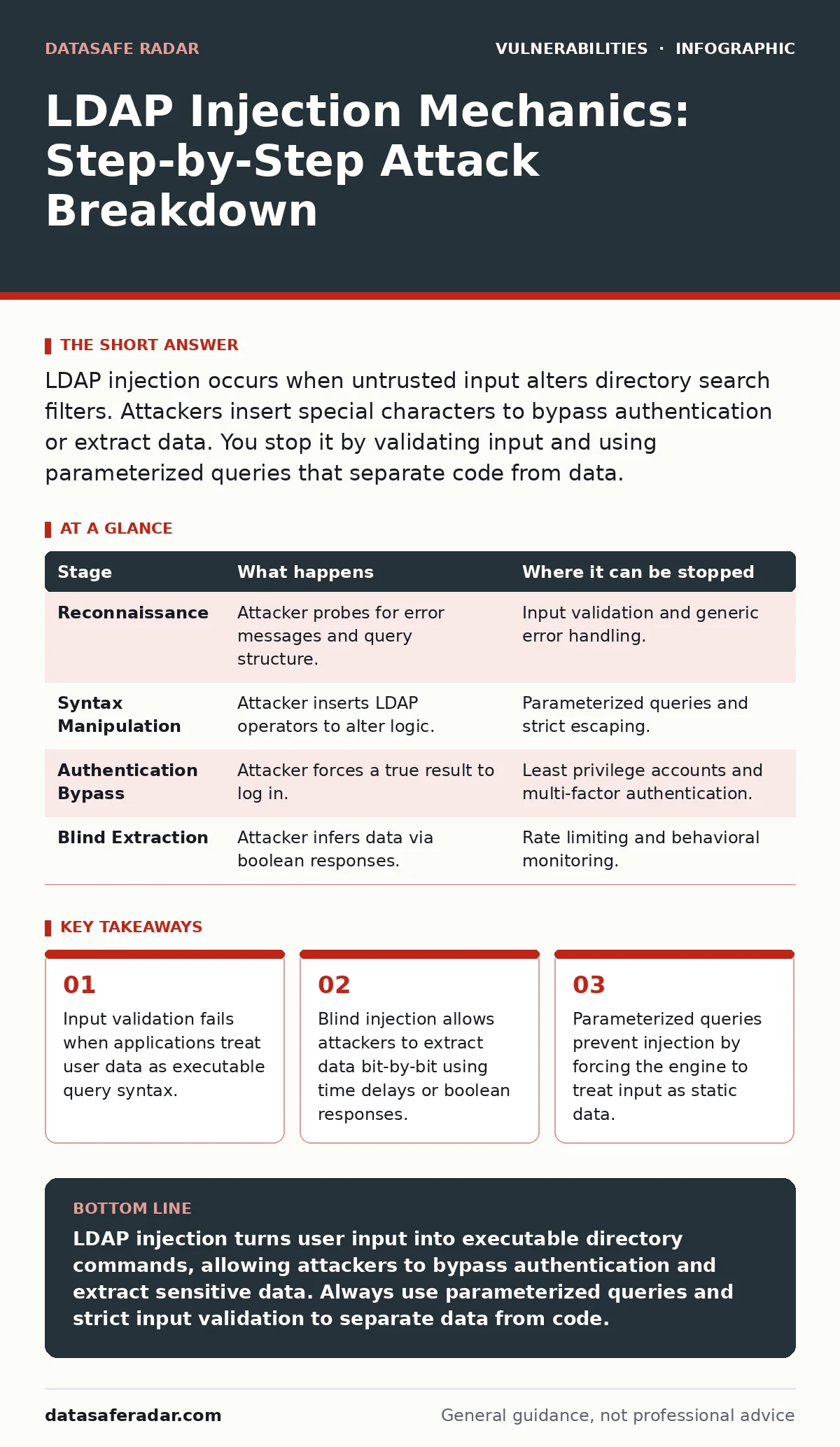
LDAP injection occurs when untrusted input alters directory search filters. Attackers insert special characters to bypass authentication or extract data. You stop it by validating input and using parameterized queries that separate code from data.
The Query Construction Flaw
Lightweight Directory Access Protocol (LDAP) is a standard protocol for accessing and maintaining distributed directory information services. Many organizations use it to manage user identities, permissions, and device configurations. The vulnerability arises when an application builds an LDAP query by concatenating user input directly into the command string.
Suppose a login form asks for a username and password. The backend code might construct a filter like (uid=INPUT)(password=INPUT). If the application does not sanitize the input, an attacker can inject LDAP operators. These operators change the logic of the search, allowing the attacker to bypass authentication or retrieve sensitive records.
This flaw relies on the application trusting the user. It assumes the input is just a string of text. In reality, the input becomes part of the instruction set sent to the directory server. This distinction between data and code is the core of the vulnerability.
Stage 1: Reconnaissance and Scope
The attacker begins by identifying which fields accept LDAP queries. This often involves testing login forms, search bars, or profile update pages. They look for error messages that reveal the structure of the underlying query.
Imagine an attacker submits a single quote or a parenthesis in the username field. If the application returns a generic error, the attacker knows the input is being processed. If it returns a specific syntax error, they have confirmed the injection point.
This stage is silent. No data is stolen yet. The attacker maps the boundaries of the query. They determine if the application uses simple string matching or complex filter logic. Understanding this structure is necessary for crafting the next payload.
Stage 2: Syntax Manipulation
Once the injection point is confirmed, the attacker manipulates the query syntax. LDAP filters use specific characters to define logic. Parentheses group conditions. Ampersands (&) combine conditions with AND. Pipes (|) combine them with OR.
The attacker inserts these characters to break the intended query. For example, they might close the initial parenthesis and add a new condition that is always true. This changes a search for a specific user into a search for any user.
This manipulation exploits the lack of escaping. The application fails to neutralize special characters. The directory server receives the modified string and executes it as if it were legitimate code. The attacker does not need to know the password; they only need to know the query structure.
Stage 3: Authentication Bypass
The most common goal is bypassing authentication. The attacker crafts a payload that makes the filter return true regardless of the credentials provided. A typical payload might look like admin')(|(uid=*))(.
When the application inserts this into the query, the filter becomes logically invalid but syntactically acceptable to the parser. It might evaluate as "if uid is admin OR uid is anything, then grant access." The directory returns a match.
The application sees a valid match and grants access. The attacker logs in as the administrator. This works because the application trusts the directory response. It does not verify that the credentials actually matched the intended user, only that a match existed.
Stage 4: Data Extraction via Blind Injection
If the application suppresses error messages, the attacker uses blind injection. They cannot see the query results directly. Instead, they infer data by observing the application's behavior.
Suppose the application returns a different page for valid users versus invalid users. The attacker sends a query that asks if the first letter of the password is 'A'. If the page changes, the letter is 'A'. They repeat this for every character.
This process is slow but effective. It relies on boolean logic. The attacker builds the password or username one character at a time. This method bypasses simple input filters that block obvious injection strings. It turns the application into an oracle that reveals secrets through side effects.
| Stage | What happens | Where it can be stopped |
|---|---|---|
| Reconnaissance | Attacker probes for error messages and query structure. | Input validation and generic error handling. |
| Syntax Manipulation | Attacker inserts LDAP operators to alter logic. | Parameterized queries and strict escaping. |
| Authentication Bypass | Attacker forces a true result to log in. | Least privilege accounts and multi-factor authentication. |
| Blind Extraction | Attacker infers data via boolean responses. | Rate limiting and behavioral monitoring. |
See also: Detect Medical Device Vulnerabilities: Signals, Tools and Blind Spots · Web Application Firewall Tuning: Mechanisms, Limits, and False Positives
Stage 5: Privilege Escalation
Access is not always the end goal. The attacker may use the directory to find other resources. LDAP often stores group memberships and permission sets. By querying these attributes, the attacker maps the internal structure.
Imagine the attacker finds a group named "Server Admins." They query the members of this group. They now know which accounts have high privileges. They can then target those accounts with further attacks.
This stage expands the breach. The initial injection was a key. Now the attacker walks through the unlocked doors. They look for credentials stored in the directory, such as service account passwords. These credentials allow lateral movement across the network.
Mitigation and Defense
Stopping LDAP injection requires separating data from code. Parameterized queries are the primary defense. Instead of concatenating strings, the application passes the input as a distinct parameter. The LDAP library escapes the input automatically.
Input validation is also necessary. The application should reject any input that contains unexpected characters. A whitelist approach is best. Only allow alphanumeric characters and a few safe symbols.
Consider how this relates to path traversal vulnerabilities. Both flaws arise from trusting user input to construct system commands. In path traversal, the input affects file paths. In LDAP injection, it affects directory queries. The mitigation strategy is similar: never trust the input.
Hidden Costs and Edge Cases
One unexpected consequence is the impact on performance. Blind injection attacks can generate hundreds of requests. This consumes server resources and can degrade service for legitimate users.
Another hidden cost is the complexity of legacy systems. Older applications may not support parameterized queries. Refactoring these systems is expensive and risky. Organizations often patch these flaws with web application firewalls, which can be bypassed by sophisticated attackers.
Do not rely on blacklists. Attackers can encode characters to bypass simple filters. For instance, they might use Unicode escapes or double encoding. The only reliable defense is structural separation of code and data.
This vulnerability highlights a broader issue in software development. Many developers focus on preventing common attacks like SQL injection but overlook LDAP. The mechanics are similar, but the tools and awareness are different.
Long-Term Resilience
Security is not a one-time fix. You must monitor for new variants of injection. Attackers constantly refine their techniques. They find new ways to encode payloads and bypass filters.
Regular code reviews are necessary. Look for places where user input is concatenated into queries. Ensure that all LDAP operations use safe libraries. Train developers on the specific risks of directory services.
This approach aligns with vulnerability prioritization. Not all flaws are equal. LDAP injection allows direct access to identity data. It should be treated as high risk. Fixing it reduces the attack surface significantly.
Consider how this differs from side-channel attacks. Side-channel attacks exploit physical implementation details, like power consumption or timing. LDAP injection exploits logical flaws in code. Both require different defensive strategies, but both demand rigorous testing.
Summary of Controls
Implementing these controls reduces the risk of LDAP injection. You do not need perfect security, but you need consistent application of safe coding practices.
- Use parameterized queries for all LDAP operations.
- Validate input against a whitelist of allowed characters.
- Apply least privilege principles to directory accounts.
- Monitor for unusual query patterns and high error rates.
These steps are straightforward but often overlooked. The cost of implementation is low compared to the cost of a breach. Protecting your directory is protecting your identity infrastructure.
Key takeaways
- Input validation fails when applications treat user data as executable query syntax.
- Blind injection allows attackers to extract data bit-by-bit using time delays or boolean responses.
- Parameterized queries prevent injection by forcing the engine to treat input as static data.
LDAP injection turns user input into executable directory commands, allowing attackers to bypass authentication and extract sensitive data. Always use parameterized queries and strict input validation to separate data from code.
Frequently asked questions
Does using a Web Application Firewall stop LDAP injection?
WAFs can block known attack signatures, but they are not a complete solution. Sophisticated attackers can bypass WAF rules. Code-level fixes like parameterized queries are more reliable.
Is LDAP injection only a risk for external-facing applications?
No. Internal applications that handle user input are also at risk. Attackers who gain access to the internal network can target these applications to escalate privileges.
How do I know if my application is vulnerable?
Look for places where user input is concatenated into LDAP query strings. If the application does not use parameterized queries or strict escaping, it is likely vulnerable.
Can I use input sanitization instead of parameterized queries?
Sanitization is a secondary defense. It is hard to sanitize all possible inputs correctly. Parameterized queries are the primary defense because they structurally prevent injection.
How this guide was produced: written by the DataSafe Radar editorial team with AI assistance, checked against the public references listed below, and reviewed when the facts change. See our editorial policy or report an error.