Default Credentials: 6 Myths That Leave Systems Exposed
Default credentials are rarely removed by administrators, and attackers do not need to guess them because the information is publicly documented.
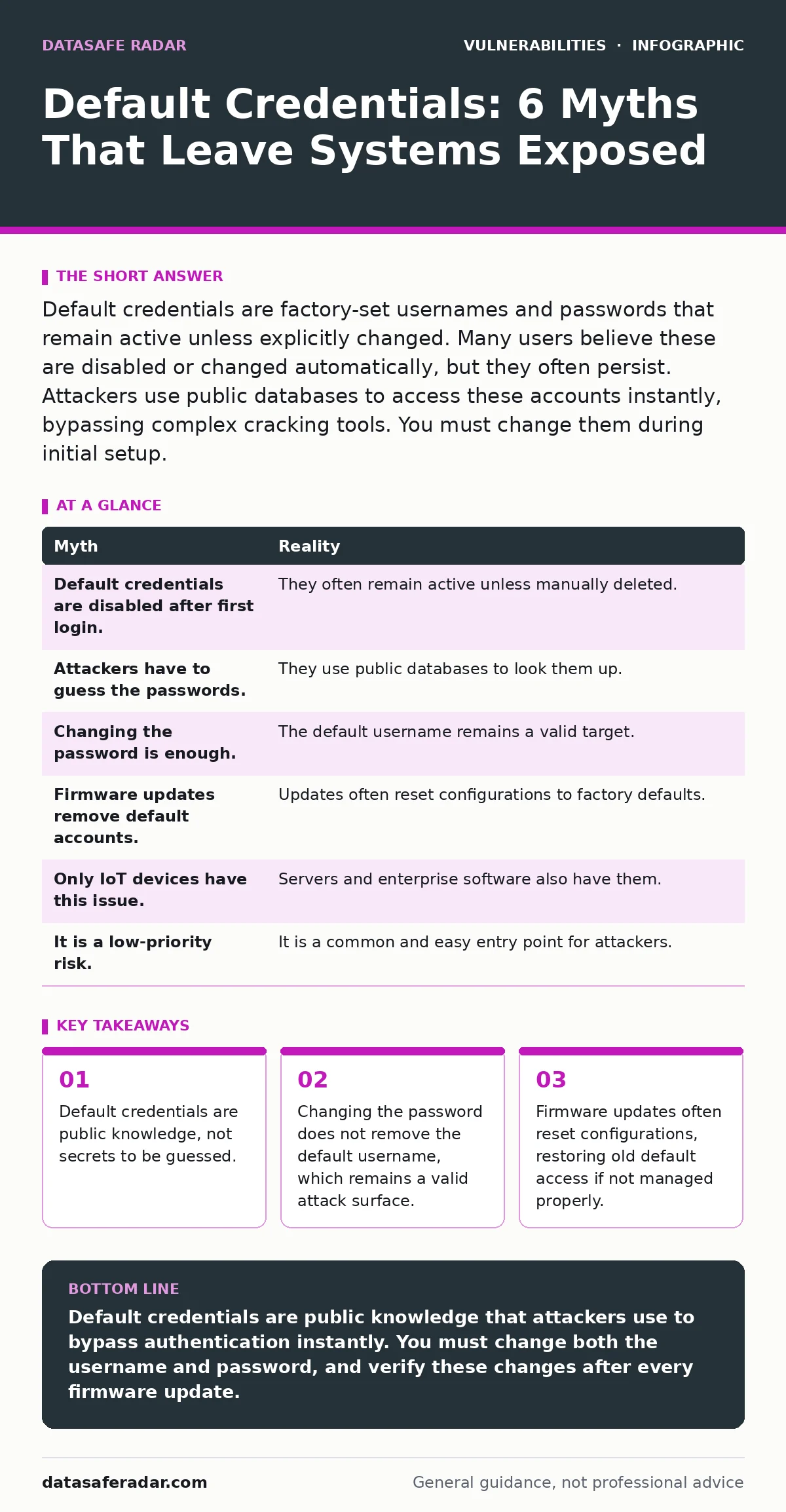
Default credentials are factory-set usernames and passwords that remain active unless explicitly changed. Many users believe these are disabled or changed automatically, but they often persist. Attackers use public databases to access these accounts instantly, bypassing complex cracking tools. You must change them during initial setup.
Myth: Default credentials are disabled after the first login
Reality: Most devices do not force a password change upon initial access. Manufacturers ship products with known accounts to allow quick setup and troubleshooting. This convenience becomes a liability when the device connects to a network. The account remains active with its original permissions unless you manually intervene.
Imagine a network printer that requires a login for administrative functions. The setup wizard asks for a new password, but it does not disable the original "admin" account. An attacker can still use the factory default credentials to access the management interface. This happens because the software treats the new password as an addition, not a replacement.
This behavior is common in embedded systems where storage space is limited. Developers often skip complex account management features to keep the firmware small. You must check the device documentation to see if the default account is disabled or just renamed. If it is still active, you have two sets of valid credentials on the system.
Myth: Attackers have to guess default credentials
Reality: Attackers do not guess; they look them up. Manufacturers publish default credentials in user manuals, on support websites, and in configuration files. These lists are aggregated into large public databases used by automated scanning tools. The attacker already knows the password before they ever touch your network.
This changes the nature of the threat. It is not a brute-force attack where software tries millions of combinations. It is a direct lookup. The attacker sends one request with the known username and password. If the device accepts it, the breach is immediate. This is why speed matters more than complexity in this scenario.
The existence of these databases means that obscurity provides zero security. You cannot rely on the idea that your specific device is obscure enough to be ignored. The tools used by attackers scan for thousands of known default pairs simultaneously. They move on quickly if the first attempt fails, so the window for detection is tiny.
Myth: Changing the password is enough protection
Reality: Changing the password leaves the default username exposed. Many systems hardcode the default username into the firmware. You can change the password, but the username remains the same. Attackers know the username, so they only need to target that specific account.
This creates a narrow attack surface that is easy to exploit. The attacker does not need to discover who has access. They only need to authenticate against the known identity. If you change the password to something complex, you have improved security, but you have not eliminated the risk. The username itself is a vector for targeted attacks.
In some systems, the default username has elevated privileges that cannot be removed. Even if you create a new administrator account, the old one may still exist. This is common in legacy software where account deletion is not supported. You must check if the default user can be deleted entirely, not just password-protected.
Myth: Default accounts are removed in firmware updates
Reality: Firmware updates often reset configuration settings to factory defaults. This is done to ensure stability and compatibility with new code. If you have not documented your changes, the update may restore the default credentials. Your security improvements vanish with a single click.
This is a hidden cost of maintaining embedded devices. The update process is designed to fix bugs, not preserve custom configurations. Many systems do not backup the current state before installing the new version. When the device reboots, it expects the original setup. You must reapply your security settings after every update.
This cycle creates a pattern of temporary security. You secure the device, it works for months, then an update breaks that security. The next time an attacker scans the network, the default credentials are valid again. You need a process to verify and restore configurations after maintenance. This is part of broader vulnerability prioritization efforts, where you manage the risk of updates versus the risk of known flaws.
Myth: Default credentials are only an issue for IoT devices
Reality: Default credentials exist in servers, databases, and industrial control systems. Any software that requires an initial setup may include a factory account. These accounts are often used for quick testing during development. They are sometimes left in production by mistake.
Enterprise software often comes with sample data and default admin accounts. These are meant to help users get started quickly. If not removed, they provide a backdoor into critical systems. Attackers target these high-value targets just as aggressively as they target home routers.
The scale of the impact is different, but the mechanism is the same. A default credential on a database server can expose millions of records. A default credential on a web server can lead to full system compromise. You must audit all software, not just consumer electronics, for pre-configured accounts. This is related to business logic flaws, where the application behaves as designed, but the design includes insecure defaults.
See also: Employee Offboarding Security: The Steps and Hidden Risks · GitHub Actions Workflow Injection Explained: Risks and Fixes
Myth: Default credentials are not a high-priority risk
Reality: Default credentials are one of the most common entry points for attackers. They require no specialized skills to exploit. Automated tools can scan entire networks for these vulnerabilities in minutes. The ease of exploitation makes them a top priority for remediation.
The risk is not just about access. It is about the speed of compromise. An attacker can move laterally through a network using default accounts on multiple devices. This allows them to establish persistence and gather data before detection. The window for response is extremely short.
You must treat default credentials as a critical vulnerability. They are not a minor configuration error. They are a direct path to system compromise. Regular audits should check for any accounts that match known default patterns. This helps in vulnerability prioritization, allowing you to focus on the most likely attack vectors first.
| Myth | Reality |
|---|---|
| Default credentials are disabled after first login. | They often remain active unless manually deleted. |
| Attackers have to guess the passwords. | They use public databases to look them up. |
| Changing the password is enough. | The default username remains a valid target. |
| Firmware updates remove default accounts. | Updates often reset configurations to factory defaults. |
| Only IoT devices have this issue. | Servers and enterprise software also have them. |
| It is a low-priority risk. | It is a common and easy entry point for attackers. |
Key takeaways
- Default credentials are public knowledge, not secrets to be guessed.
- Changing the password does not remove the default username, which remains a valid attack surface.
- Firmware updates often reset configurations, restoring old default access if not managed properly.
Default credentials are public knowledge that attackers use to bypass authentication instantly. You must change both the username and password, and verify these changes after every firmware update.
Frequently asked questions
How do I find default credentials for my device?
Check the user manual, the manufacturer's support website, or online databases that list known defaults for specific models.
Can I delete the default admin account?
Some systems allow you to delete the account, while others only allow you to change the password. Check the documentation for your specific device.
What if I forget the new password?
You may need to reset the device to factory settings, which will restore the default credentials. This is why documentation is important.
Are default credentials secure if I change the password?
No, because the username is still known. Attackers can target that specific account with known passwords from public lists.
How this guide was produced: written by the DataSafe Radar editorial team with AI assistance, checked against the public references listed below, and reviewed when the facts change. See our editorial policy or report an error.