EPSS Score Meaning: How Probability Changes Patch Priorities
The EPSS score predicts the likelihood a vulnerability will be exploited in the wild, separating urgent fixes from low-risk items to save time.

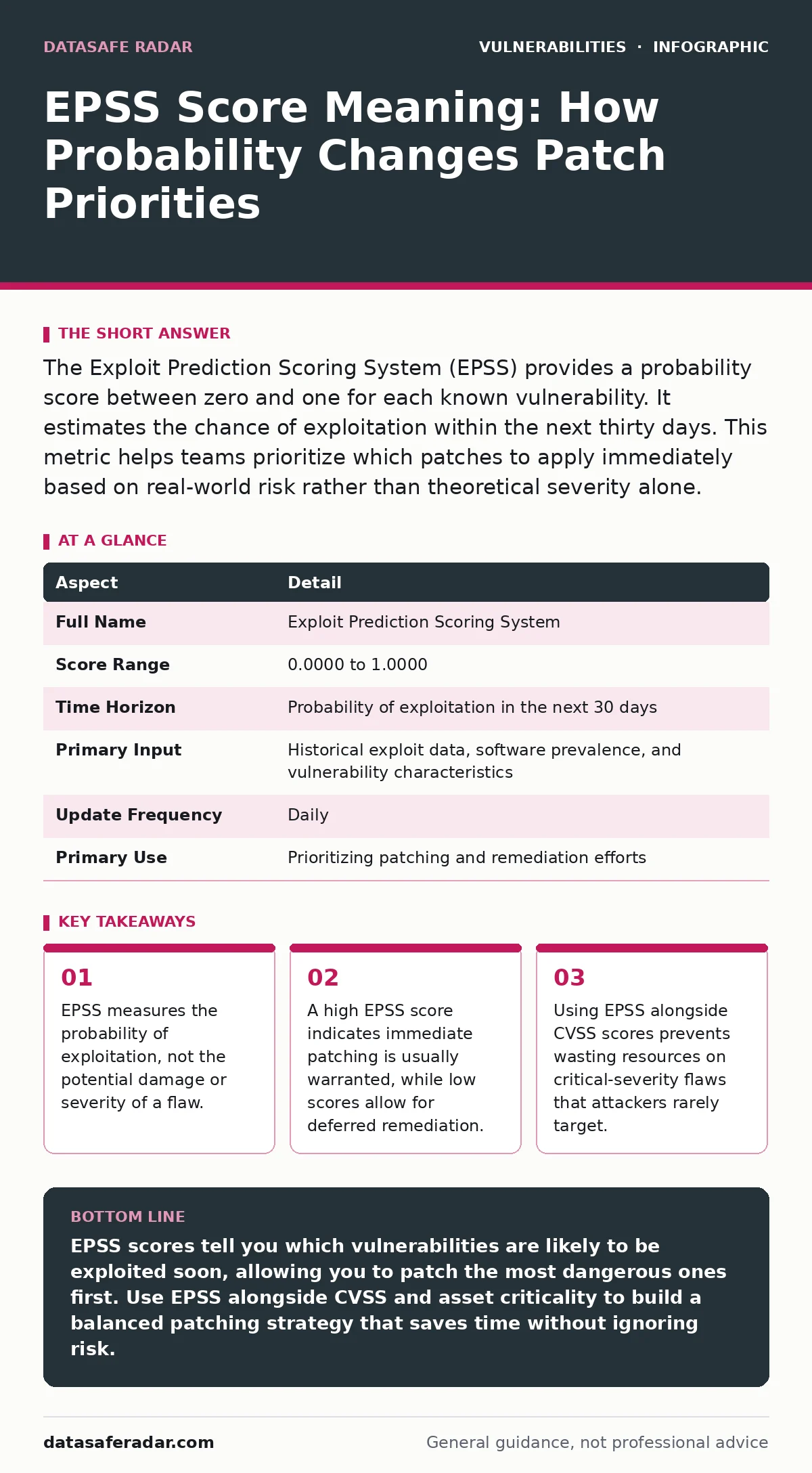
The Exploit Prediction Scoring System (EPSS) provides a probability score between zero and one for each known vulnerability. It estimates the chance of exploitation within the next thirty days. This metric helps teams prioritize which patches to apply immediately based on real-world risk rather than theoretical severity alone.
The Insurance Analogy for Vulnerabilities
Imagine you own a house. A broken window pane is a severe problem if someone throws a brick through it. However, if your house is in a quiet neighborhood where no one throws bricks, the broken window is a low priority. You might fix it eventually, but you won’t drop everything to replace it tonight.
Vulnerability management works the same way. Not all broken windows are equal. Some exist in systems that attackers target constantly, while others sit in obscure software that no one notices. The EPSS score helps you distinguish between the brick-throwing neighborhood and the quiet street. It tells you how likely it is that someone will actually use the flaw, not just how bad the flaw is on paper.
What EPSS Actually Measures
The EPSS stands for the Exploit Prediction Scoring System. It is a model that predicts the probability of a software vulnerability being exploited in the wild. The score is a decimal number between zero and one. A score of zero means there is virtually no chance of exploitation. A score of one means exploitation is almost certain.
This prediction focuses specifically on the likelihood of exploitation within the next thirty days. It does not measure the impact of an attack. It does not tell you if data will be stolen or if systems will crash. It only answers one question: will this specific flaw be used by an attacker soon? By isolating probability from impact, EPSS provides a clean signal for urgency.
| Aspect | Detail |
|---|---|
| Full Name | Exploit Prediction Scoring System |
| Score Range | 0.0000 to 1.0000 |
| Time Horizon | Probability of exploitation in the next 30 days |
| Primary Input | Historical exploit data, software prevalence, and vulnerability characteristics |
| Update Frequency | Daily |
| Primary Use | Prioritizing patching and remediation efforts |
Where the Data Comes From
The model behind EPSS relies on vast amounts of historical data. It analyzes records of vulnerabilities that have been exploited in the past. It looks at which types of software are commonly installed and which vulnerabilities in that software were targeted. It also considers the characteristics of the vulnerability itself, such as whether it requires user interaction or network access.
This data is not guessed. It is derived from observed exploit activity. The system learns patterns from years of security events. When a new vulnerability is published, the model compares it to these historical patterns. It calculates a probability based on how similar the new flaw is to past exploits. This approach removes human bias from the initial triage process.
Daily Use in Patch Management
In daily operations, security teams use EPSS to decide what to fix first. You likely have hundreds of unpatched vulnerabilities. You cannot fix them all at once. Resources are finite. EPSS helps you sort this backlog. You apply patches to vulnerabilities with high EPSS scores first. These are the flaws attackers are most likely to use.
Vulnerabilities with low EPSS scores can wait. They may still be severe, but the risk of them being used is minimal. This allows you to defer work without ignoring risk. You are not saying the flaw is safe. You are saying the probability of it being used is low enough that other tasks take precedence. This method reduces alert fatigue. It stops teams from rushing to fix every critical rating immediately.
The Common Confusion With CVSS
Many teams mistake EPSS for a replacement of the CVSS score. The Common Vulnerability Scoring System (CVSS) measures the severity and impact of a vulnerability. It rates how hard it is to exploit and how much damage it can do. EPSS measures the likelihood of exploitation. These two metrics answer different questions.
A flaw can have a high CVSS score but a low EPSS score. This happens when a vulnerability is technically severe but rare or difficult to find in the wild. Conversely, a flaw might have a moderate CVSS score but a high EPSS score. This indicates attackers are actively using it, perhaps because it is easy to automate. Relying on CVSS alone leads to wasted effort on severe but unused flaws. Relying on EPSS alone ignores the potential impact of a rare but catastrophic attack.
People usually get wrong the idea that a low EPSS score means "ignore forever." It does not. It means "defer." If the software becomes more popular or attackers change their tactics, the EPSS score will rise. You must monitor these scores over time. They are dynamic, not static labels.
See also: How CVSS Scores Work: The Math Behind Vulnerability Ratings · Vulnerability Prioritization for Small Businesses
Hidden Costs of Probability Models
One non-obvious consequence of using EPSS is the hidden cost of data dependency. The model is only as good as the data it has seen. If a new type of software emerges that has never been exploited before, the model may underestimate its risk. There is no historical data to compare against. The score might be low, giving a false sense of security.
Another hidden cost is the lag in detection. EPSS predicts based on past trends. If attackers suddenly shift to a new class of vulnerabilities, the model takes time to adjust. During this adjustment period, scores may not reflect the immediate surge in exploit activity. You must combine EPSS with other intelligence sources. Do not rely on it as the single source of truth for all risk decisions.
Integrating With Other Controls
EPSS works best when combined with other risk factors. You should consider the value of the asset containing the vulnerability. A low-proability flaw on a database holding customer records is riskier than the same flaw on a test server. You should also consider compensating controls. If a firewall blocks access to the vulnerable service, the effective risk is lower.
This integration is part of broader vulnerability prioritization strategies. By layering EPSS with asset criticality and environmental context, you create a more accurate picture of risk. This approach helps you avoid pitfalls like default credentials in IoT device vulnerabilities, which are often ignored by automated scanners but remain high-risk. It also helps contextualize complex issues like business logic flaws, which may not have traditional exploit signatures but can be abused if the underlying system is widely used.
The Limits of Prediction
No model can predict the future with certainty. EPSS provides a statistical probability, not a guarantee. A score of 0.01 still means there is a small chance of exploitation. In a large organization with thousands of servers, even a small probability translates to real incidents. You must account for scale.
Furthermore, EPSS does not account for targeted attacks. If an attacker specifically targets your organization, they may exploit low-probability vulnerabilities that the model deems unlikely. The model assumes opportunistic, broad-spectrum attacks. It does not model sophisticated, resource-intensive campaigns aimed at specific victims. Understanding this distinction prevents over-reliance on the score for high-value targets.
Key takeaways
- EPSS measures the probability of exploitation, not the potential damage or severity of a flaw.
- A high EPSS score indicates immediate patching is usually warranted, while low scores allow for deferred remediation.
- Using EPSS alongside CVSS scores prevents wasting resources on critical-severity flaws that attackers rarely target.
- The model updates daily, reflecting new data on exploit activity and software usage patterns.
EPSS scores tell you which vulnerabilities are likely to be exploited soon, allowing you to patch the most dangerous ones first. Use EPSS alongside CVSS and asset criticality to build a balanced patching strategy that saves time without ignoring risk.
Frequently asked questions
Is EPSS free to use?
The data provided by First.org is available for download and use, though commercial platforms may charge for integrated access or additional features.
How often does the EPSS score change?
The scores are updated daily to reflect new data on exploit activity and changes in software prevalence.
Can I use EPSS for internal-only systems?
Yes, but the scores are based on internet-facing exploit data. Internal systems may have different risk profiles, so you should adjust expectations accordingly.
Does EPSS replace CVSS?
No, EPSS complements CVSS. CVSS measures severity and impact, while EPSS measures the probability of exploitation. Both are needed for a complete view.
How this guide was produced: written by the DataSafe Radar editorial team with AI assistance, checked against the public references listed below, and reviewed when the facts change. See our editorial policy or report an error.