How CVSS Scores Work: The Math Behind Vulnerability Ratings
A high CVSS score measures the ease of remote exploitation, but it ignores the likelihood of an attacker actually finding and using the flaw in your specific environment.

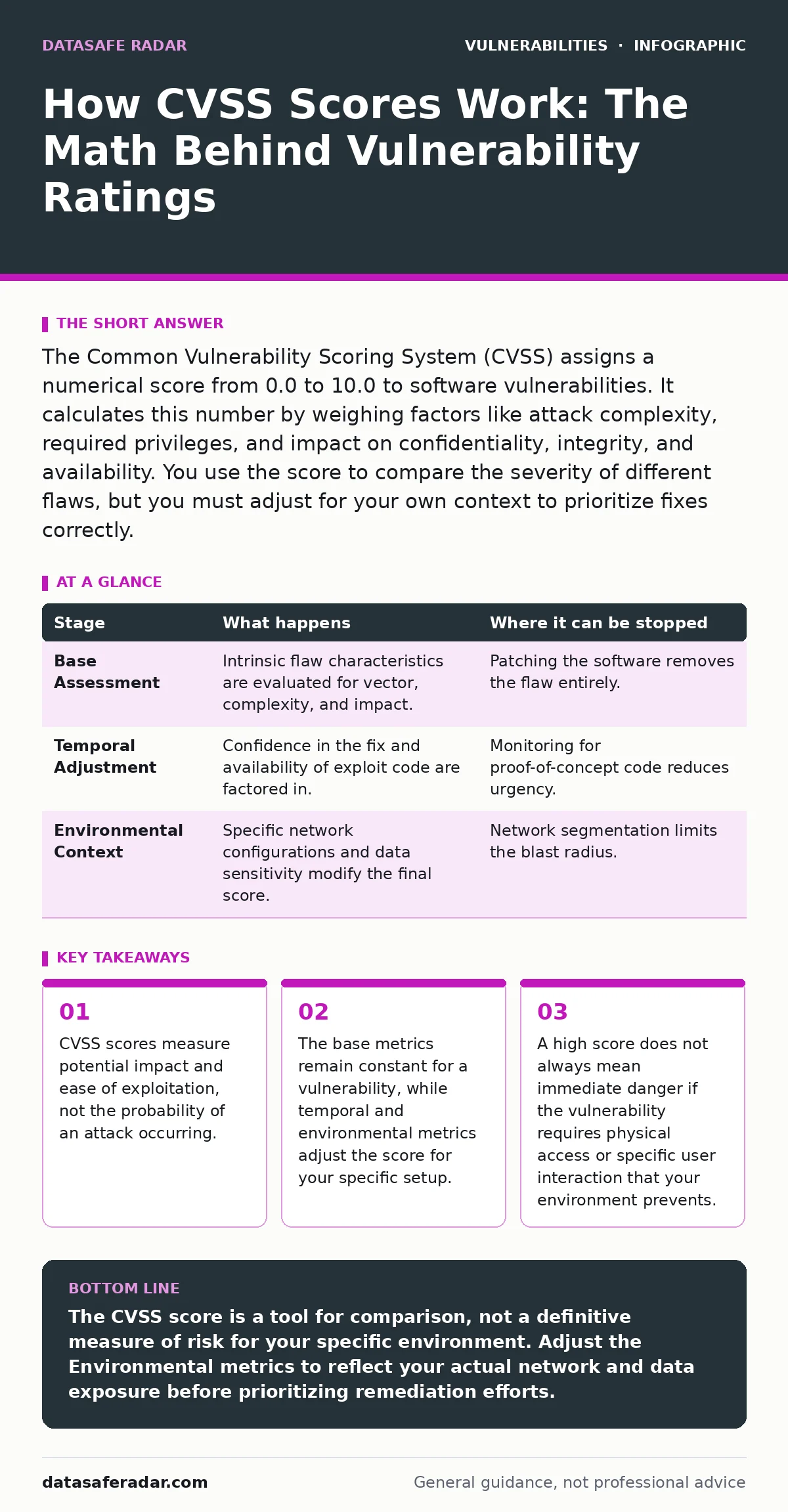
The Common Vulnerability Scoring System (CVSS) assigns a numerical score from 0.0 to 10.0 to software vulnerabilities. It calculates this number by weighing factors like attack complexity, required privileges, and impact on confidentiality, integrity, and availability. You use the score to compare the severity of different flaws, but you must adjust for your own context to prioritize fixes correctly.
The Anatomy of a CVSS Score
The Common Vulnerability Scoring System (CVSS) provides a standardized way to describe vulnerability characteristics. Security teams use these scores to communicate the severity of a flaw across different organizations and tools. The system breaks down into three distinct metric groups: Base, Temporal, and Environmental. Each group addresses a different layer of reality, from the theoretical nature of the bug to the practical context of your network.
You will see the final score presented as a single number between 0.0 and 10.0. This number is not an arbitrary rating. It is the result of a complex formula that multiplies and adds weighted values from the three metric groups. Understanding the moving parts helps you see why two similar vulnerabilities might have different scores, or why a "Critical" score might not apply to your server.
Stage 1: Base Metrics
Stage 1: Base Metrics
The Base metrics represent the intrinsic qualities of the vulnerability itself. These factors do not change over time or across different environments. If a flaw exists in a piece of code, its Base score remains the same whether it runs on a web server in New York or a laptop in Tokyo. This stage defines the maximum potential severity of the flaw.
The Base metrics focus on how an attacker exploits the vulnerability and what happens after successful exploitation. Key factors include Attack Vector, which describes how the vulnerability is reached, such as over a network or through physical access. Attack Complexity measures the conditions required for exploitation, ranging from simple to complex. Privileges Required indicates whether the attacker needs existing access to the system.
| Stage | What happens | Where it can be stopped |
|---|---|---|
| Base Assessment | Intrinsic flaw characteristics are evaluated for vector, complexity, and impact. | Patching the software removes the flaw entirely. |
| Temporal Adjustment | Confidence in the fix and availability of exploit code are factored in. | Monitoring for proof-of-concept code reduces urgency. |
| Environmental Context | Specific network configurations and data sensitivity modify the final score. | Network segmentation limits the blast radius. |
Stage 2: Temporal Metrics
Stage 2: Temporal Metrics
The Temporal metrics reflect how the vulnerability’s severity changes over time. This stage accounts for the current state of knowledge about the exploit. If researchers have published detailed proof-of-concept code, the score increases because the barrier to entry for attackers is lower. Conversely, if a vendor has released a complete fix, the score decreases.
These metrics help you decide how urgently to act. A vulnerability with a high Base score but no known exploits might wait in your backlog. The same vulnerability with active exploit code in the wild demands immediate attention. You must weigh the cost of emergency patching against the risk of a known exploit being used against you. This is where concepts like the EPSS score often complement the CVSS, by predicting the likelihood of exploitation in the wild.
Stage 3: Environmental Metrics
Stage 3: Environmental Metrics
The Environmental metrics allow you to customize the CVSS score for your specific organization. This is the most underutilized part of the system. You adjust the weights of Confidentiality, Integrity, and Availability based on what matters to your business. For a database server, Confidentiality might be paramount. For a real-time control system, Availability might be the only thing that counts.
You also define the Modified Attack Vector and Modified Privileges Required. If your application is behind a firewall that blocks external access, you can adjust the Attack Vector from Network to Local. This lowers the score, reflecting the reduced risk. This stage bridges the gap between theoretical severity and practical risk. It allows you to ignore vulnerabilities that cannot affect your specific architecture.
Reading the Vector String
Stage 4: Vector String Interpretation
Behind every CVSS score is a Vector String. This is a compact text representation of the metric values. It looks like a code, such as CVSS:3.1/AV:N/AC:L/PR:N/UI:N/S:U/C:H/I:H/A:H. Each segment corresponds to a specific metric. AV:N means Attack Vector is Network. AC:L means Attack Complexity is Low. PR:N means Privileges Required are None.
You can read this string to understand exactly why a vulnerability received its score. It reveals the assumptions made by the researcher who calculated it. If you disagree with an assumption, such as the required user interaction, you can modify the vector string in your own scoring tool to get a more accurate score for your environment. This transparency is one of the strengths of the CVSS framework. It allows for debate and refinement rather than blind acceptance of a single number.
See also: Vulnerability Prioritization for Small Businesses · How to Implement Cloud Vulnerability Management Step by Step
Applying the Score to Prioritization
Stage 5: Prioritization Strategy
A high CVSS score should trigger a review, not an automatic panic. You must combine the score with context to prioritize remediation. Consider the exposure of the affected asset. A critical flaw in an internal tool with no external access is less dangerous than a medium flaw in a public-facing login page. This is the core challenge of vulnerability prioritization.
You should also look for compensating controls. If a vulnerability requires default credentials to exploit, and your systems are configured to change them during setup, the risk is mitigated. Similarly, if a flaw involves LDAP injection but your directory service is properly sanitized and segmented, the impact is limited. The CVSS score gives you a starting point, but your security posture determines the final risk.
Common Misinterpretations
Stage 6: Avoiding Pitfalls
One common mistake is treating the CVSS score as a measure of likelihood. The score measures ease of exploitation and impact, not probability. A vulnerability can be easy to exploit (high score) but never exploited if no one targets it. Another pitfall is ignoring the Environmental metrics. Many teams accept the default Base score and never adjust for their specific network topology or data sensitivity.
This leads to a backlog of high-severity items that cannot be addressed quickly, while lower-severity items with higher actual risk remain unfixed. You must actively manage your CVSS data. Adjust scores based on your environment. Combine them with threat intelligence to see which vulnerabilities are actively being used. This holistic approach ensures that your limited resources are spent on the risks that truly matter.
The Human Element in Scoring
Stage 7: Researcher Bias and Context
The person who calculates the CVSS score makes subjective judgments. Two researchers might assess the same vulnerability differently. One might view a required user interaction as "None" because it is a standard action, while another might view it as "Required" because it involves a specific trick. These differences lead to variations in scores.
You should treat the initial score as a hypothesis, not a fact. Verify the details against your own understanding of the application. If the vendor provides a CVSS score, check their reasoning. If you are calculating it yourself, document your assumptions. This transparency helps others understand your risk assessment. It also allows for correction if new information emerges about the vulnerability.
Key takeaways
- CVSS scores measure potential impact and ease of exploitation, not the probability of an attack occurring.
- The base metrics remain constant for a vulnerability, while temporal and environmental metrics adjust the score for your specific setup.
- A high score does not always mean immediate danger if the vulnerability requires physical access or specific user interaction that your environment prevents.
The CVSS score is a tool for comparison, not a definitive measure of risk for your specific environment. Adjust the Environmental metrics to reflect your actual network and data exposure before prioritizing remediation efforts.
Frequently asked questions
Why do two different sources show different CVSS scores for the same vulnerability?
Different researchers may interpret the metrics differently, or one source may use an older version of the CVSS standard. Vendor updates can also change the score as more information becomes available.
Does a higher CVSS score always mean I should patch first?
No. A high score may reflect a theoretical worst-case scenario that does not apply to your environment. Consider exposure, exploitability, and the impact on your specific business operations before prioritizing.
How often are CVSS scores updated?
Scores are updated when new information about the vulnerability becomes available, such as exploit code or patches. Vendors and security teams may revise scores to reflect the current state of knowledge.
Can I calculate my own CVSS score?
Yes. Many organizations have the expertise to calculate their own scores, particularly for internal applications. This allows for more accurate Environmental metric adjustments based on specific network configurations.
How this guide was produced: written by the DataSafe Radar editorial team with AI assistance, checked against the public references listed below, and reviewed when the facts change. See our editorial policy or report an error.