Stop Kubernetes Admission Controller Mistakes That Leave Clusters Exposed
Misconfigured admission controllers often create silent gaps in your defense, allowing policy violations that bypass standard network controls and container runtime security checks.
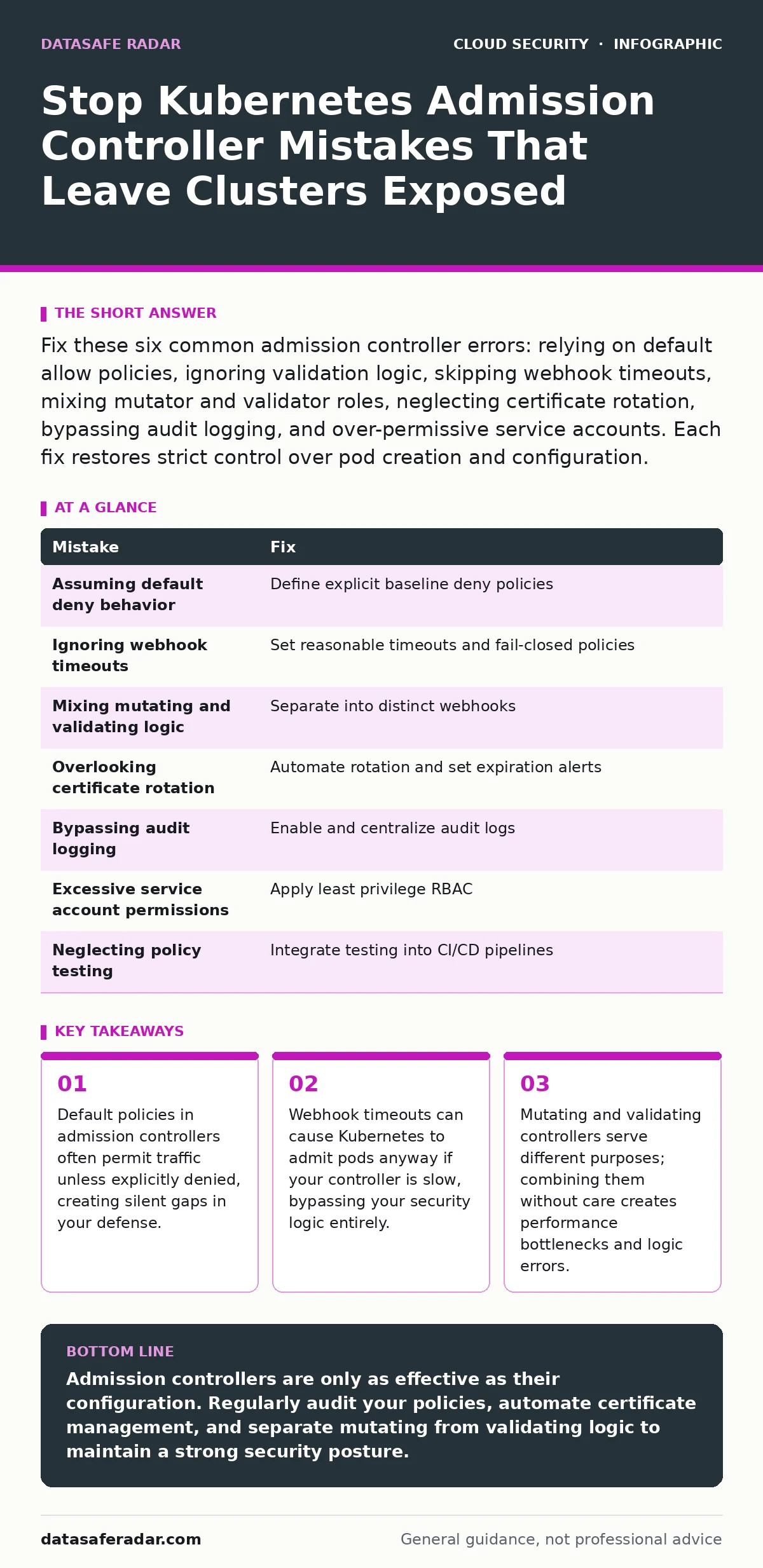
Fix these six common admission controller errors: relying on default allow policies, ignoring validation logic, skipping webhook timeouts, mixing mutator and validator roles, neglecting certificate rotation, bypassing audit logging, and over-permissive service accounts. Each fix restores strict control over pod creation and configuration.
Admission controllers act as gatekeepers for your Kubernetes cluster. They intercept requests to the API server before objects like pods are persisted. You use them to enforce security policies, inject sidecars, or modify configurations. However, configuring these controllers is error-prone. A small mistake can render your entire policy framework ineffective.
Mistake 1: Assuming Default Deny Behavior
Many administrators assume that if a controller is installed, it blocks everything by default. This is rarely true. Most admission controllers are designed to be opt-in or require explicit policy definitions to reject requests. Without a specific "deny all" policy, legitimate and malicious traffic passes through unchanged.
Why it hurts: Your cluster remains open to misconfigured or compromised workloads. Attackers who gain access to your API can deploy containers with excessive privileges, knowing the admission layer will not stop them. This gap often exists alongside weak cloud key management services, where sensitive data is exposed because the container running it was never validated.
The fix: Define a baseline policy that explicitly denies all requests unless they match known-good criteria. Test this policy in a staging environment before applying it to production. Verify that the controller logs rejections for unauthorized attempts.
Mistake 2: Ignoring Webhook Timeouts
Admission webhooks communicate with external services to validate or mutate requests. If your webhook server is slow or unreachable, Kubernetes must decide whether to wait or proceed. The default timeout is often too short for complex validation logic, or too long for user experience.
Why it hurts: If the timeout expires, Kubernetes may admit the pod anyway, depending on your failure policy. This creates a race condition where security checks are skipped under load. In high-pressure environments, this bypass allows non-compliant configurations to slip through, undermining your multi-cloud security strategy.
The fix: Set a reasonable timeout value that balances security with availability. Configure the failure policy to "Fail" for critical validation webhooks, ensuring that pods are rejected if the controller cannot respond. Monitor your webhook latency to ensure it stays within this window.
Mistake 3: Mixing Mutating and Validating Logic
Some teams combine mutating and validating logic in a single webhook to reduce infrastructure overhead. Mutating controllers change the request before it is stored, while validating controllers check the request against rules. Combining them can lead to complex interactions and unexpected behavior.
Why it hurts: If the mutating logic fails, the validating logic may never run, or vice versa. This coupling makes debugging difficult and can cause cascading failures. It also complicates your cloud incident response plans, as you must trace issues through intertwined logic rather than distinct policy stages.
The fix: Separate mutating and validating webhooks into distinct controllers. Use a mutating webhook to inject standard labels or sidecars, and a validating webhook to enforce security constraints. This separation of concerns ensures that one failure does not disable the other.
Mistake 4: Overlooking Certificate Rotation
Admission webhooks rely on TLS certificates to secure communication with the API server. These certificates expire, and if they are not rotated, the webhook becomes unreachable. Many teams forget to automate this process, leading to sudden policy enforcement gaps.
Why it hurts: An expired certificate causes the webhook to fail. If your failure policy is set to "Ignore," pods are admitted without checking. This is a critical failure point for container runtime security, as it allows unverified containers to launch. It also creates shadow IT risks, as developers may bypass the broken controller to keep applications running.
The fix: Automate certificate rotation using tools like cert-manager or Kubernetes-native admission controller features. Set up alerts for upcoming certificate expirations. Ensure your renewal process is tested regularly to avoid outages.
Mistake 5: Bypassing Audit Logging for Webhooks
Admission controllers generate logs that record every decision made. Some teams disable these logs to reduce storage costs or noise. However, these logs are the only record of what was allowed or denied by your policies.
Why it hurts: Without audit logs, you cannot detect policy evasion or misconfigurations. If a pod is admitted unexpectedly, you have no way to determine why. This lack of visibility hinders your cloud vulnerability management efforts, as you cannot correlate admission events with security findings.
The fix: Enable audit logging for admission webhooks. Store these logs in a secure, centralized location. Configure your logging system to alert on unexpected denial patterns or high volumes of rejected requests.
See also: How Cloud Disaster Recovery Works: The Mechanics and Limits · Container Image Scanning: A Step-by-Step Implementation Plan
Mistake 6: Granting Excessive Permissions to Service Accounts
Admission controllers run as service accounts within the cluster. To function, they need permissions to read and write certain resources. Teams often grant broad permissions to avoid "permission denied" errors during deployment.
Why it hurts: A compromised admission controller with excessive permissions can read secrets, create pods, or modify other controllers. This elevates a simple misconfiguration into a full cluster takeover. It also complicates SaaS data exposure scenarios, as the controller could potentially access sensitive data stored in the cluster.
The fix: Apply the principle of least privilege. Grant only the specific permissions required for the controller to function. Regularly review and audit the roles and bindings assigned to admission controller service accounts.
Mistake 7: Neglecting Policy Testing in CI/CD
Admission policies are often applied directly to production clusters without prior testing. This "move fast and break things" approach leads to unexpected pod rejections or security gaps.
Why it hurts: Broken policies can halt deployments or allow insecure configurations. This disrupts your virtual private clouds setups, where network policies and admission controls must work in tandem. It also erodes trust in your security framework, leading teams to bypass controls entirely.
The fix: Integrate policy testing into your CI/CD pipeline. Use tools to simulate admission requests and verify that policies behave as expected. Automate this testing to catch regressions before they reach production.
| Mistake | Fix |
|---|---|
| Assuming default deny behavior | Define explicit baseline deny policies |
| Ignoring webhook timeouts | Set reasonable timeouts and fail-closed policies |
| Mixing mutating and validating logic | Separate into distinct webhooks |
| Overlooking certificate rotation | Automate rotation and set expiration alerts |
| Bypassing audit logging | Enable and centralize audit logs |
| Excessive service account permissions | Apply least privilege RBAC |
| Neglecting policy testing | Integrate testing into CI/CD pipelines |
Key takeaways
- Default policies in admission controllers often permit traffic unless explicitly denied, creating silent gaps in your defense.
- Webhook timeouts can cause Kubernetes to admit pods anyway if your controller is slow, bypassing your security logic entirely.
- Mutating and validating controllers serve different purposes; combining them without care creates performance bottlenecks and logic errors.
Admission controllers are only as effective as their configuration. Regularly audit your policies, automate certificate management, and separate mutating from validating logic to maintain a strong security posture.
Frequently asked questions
Do admission controllers slow down pod creation?
Yes, especially if webhooks are slow or timeouts are high. Optimize your validation logic and monitor latency to minimize impact.
Can admission controllers protect against runtime attacks?
No. They only control what is allowed to enter the cluster. You need additional tools for runtime detection and response.
What happens if my webhook server goes down?
It depends on your failure policy. If set to "Ignore," pods are admitted. If set to "Fail," pod creation is blocked until the webhook recovers.
Should I use a single admission controller or multiple?
Multiple specialized controllers are generally better for separation of concerns, easier debugging, and independent scaling.
How this guide was produced: written by the DataSafe Radar editorial team with AI assistance, checked against the public references listed below, and reviewed when the facts change. See our editorial policy or report an error.