Exposed Kubernetes Dashboards: 7 Mistakes That Leak Your Cluster Data
Default Kubernetes dashboards often lack authentication, turning your cluster’s internal state into a public directory for attackers to map your infrastructure.
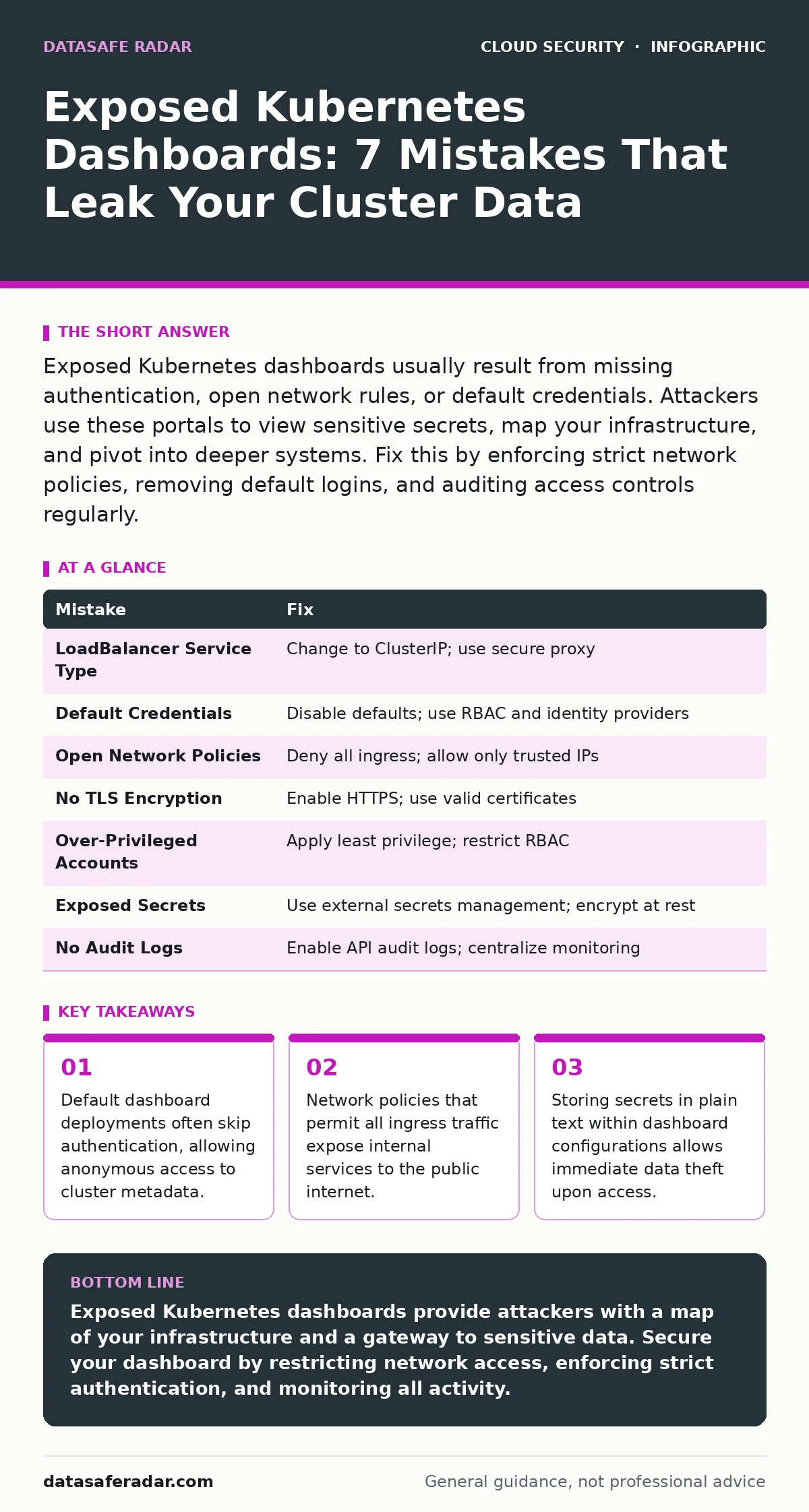
Exposed Kubernetes dashboards usually result from missing authentication, open network rules, or default credentials. Attackers use these portals to view sensitive secrets, map your infrastructure, and pivot into deeper systems. Fix this by enforcing strict network policies, removing default logins, and auditing access controls regularly.
Mistake 1: Leaving the Dashboard Service Type as LoadBalancer
Kubernetes service types determine how external traffic reaches your applications. A LoadBalancer service provisions an external IP address, making the service accessible from the internet. Many administrators deploy the Kubernetes dashboard using this type for convenience during testing. This convenience becomes a severe liability when the test environment moves to production. The external IP address acts as a direct door to your cluster’s control plane interface. Attackers scan for these open ports constantly. Once they find the dashboard, they can view pod details, node information, and service accounts. This visibility helps them plan deeper attacks against your workload.
Why it hurts: The dashboard exposes internal cluster topology. Attackers use this map to identify high-value targets like database pods or privileged service accounts. They do not need to hack the dashboard itself to cause damage; they only need to see what is inside.
The fix: Change the service type to ClusterIP. This restricts access to within the cluster network. If you need external access, use a secure proxy or an ingress controller with TLS termination and strict authentication. Never expose the dashboard directly to the internet.
Mistake 2: Using Default or Hardcoded Credentials
The Kubernetes dashboard often comes with a default admin token or service account. Administrators sometimes leave these credentials active because they are convenient for initial setup. Hardcoding these tokens into configuration files or scripts creates a static secret. If that file is committed to a public repository or leaked, the credentials are compromised. Unlike passwords that rotate, hardcoded tokens remain valid until manually revoked. This creates a permanent backdoor into your cluster. Attackers searching for known default tokens can gain immediate access.
Why it hurts: Default credentials are well-known. Attackers automate checks for these tokens. Success grants them full administrative privileges. They can create new service accounts, escalate permissions, and install malicious workloads. The damage occurs before you even notice the breach.
The fix: Disable default service accounts immediately. Use Kubernetes RBAC (Role-Based Access Control) to create specific roles for dashboard users. Integrate with an identity provider for authentication. Rotate tokens regularly and store them in a secure secrets manager. Never hardcode credentials in configuration files.
Mistake 3: Ignoring Network Policies for Ingress Traffic
Kubernetes clusters have a default network behavior that allows all traffic to flow between pods and services. Without explicit network policies, any service on the internet can attempt to connect to any service inside the cluster. This flat network model assumes that all traffic is trusted. In reality, the internet is hostile. If the dashboard service is exposed, even slightly, network policies should block unwanted connections. Ignoring these policies leaves the dashboard vulnerable to lateral movement. An attacker who compromises one pod can reach the dashboard if no rules stop them.
Why it hurts: The lack of segmentation allows attackers to move freely. They can pivot from a low-privilege application to the high-privilege dashboard. This lateral movement expands the blast radius of any single compromise. It turns a minor breach into a cluster-wide disaster.
The fix: Implement strict network policies. Deny all ingress traffic by default. Allow only specific, trusted IP ranges to reach the dashboard. Use labels to define which pods can communicate with the dashboard service. Regularly audit these policies to ensure they match your current architecture.
Mistake 4: Failing to Enable TLS Encryption
The Kubernetes dashboard serves content over HTTP by default in many configurations. HTTP transmits data in plain text. This means credentials, session tokens, and cluster data travel unprotected across the network. Attackers on the same network can intercept this traffic using simple packet sniffing tools. They can steal session cookies and hijack active dashboard sessions. This man-in-the-middle attack requires no hacking skills, just network proximity. Without encryption, the dashboard is transparent to anyone watching the wire.
Why it hurts: Session hijacking allows attackers to impersonate legitimate users. They gain access without needing the actual password. The dashboard logs show a valid login, masking the intrusion. Sensitive data like API keys and secrets are exposed in transit. This undermines the entire security posture of the cluster.
The fix: Configure the dashboard to use HTTPS. Provide valid TLS certificates. Ensure all HTTP requests redirect to HTTPS. Use strong cipher suites and disable older, insecure protocols. Verify that the certificate is signed by a trusted authority to prevent spoofing attacks.
Mistake 5: Over-Privileged Service Accounts
The dashboard runs as a service account within the cluster. Administrators often grant this account cluster-admin privileges to avoid permission errors. This broad access allows the dashboard to read, write, and delete any resource. If the dashboard is compromised, the attacker inherits these god-like privileges. They can modify RBAC rules, create persistent backdoors, and exfiltrate data. Principle of least privilege is ignored in favor of convenience. This mistake turns the dashboard into a high-value target for attackers.
Why it hurts: Cluster-admin access removes all safety nets. The attacker can disable security controls, delete audit logs, and cover their tracks. They can also inject malicious containers into any namespace. The damage is immediate and difficult to contain. Recovery requires rebuilding trust in the entire cluster.
The fix: Create a dedicated service account for the dashboard. Grant only the minimum permissions required for its operation. Use RBAC to restrict access to specific namespaces or resource types. Regularly review and tighten these permissions. Monitor for any unusual activity from this account.
See also: How Cloud Disaster Recovery Works: The Mechanics and Limits · Container Image Scanning: A Step-by-Step Implementation Plan
Mistake 6: Exposing Secrets in Dashboard Configurations
Administrators sometimes store sensitive data like database passwords or API keys in Kubernetes secrets. These secrets are then mounted into the dashboard pod. If the dashboard is exposed, these secrets are accessible. Attackers can read the mounted files directly. They can also query the Kubernetes API to list and read secret objects. This exposure compromises not just the cluster, but every system that relies on those secrets. The breach extends beyond the cloud environment.
Why it hurts: Secrets are the keys to your kingdom. Losing them means losing access to databases, external APIs, and other services. Attackers use these credentials to move laterally into other systems. The compromise is no longer limited to the Kubernetes cluster. Recovery involves resetting every affected credential.
The fix: Never mount secrets directly into the dashboard pod. Use external secrets management solutions. Reference secrets dynamically at runtime. Encrypt secrets at rest and in transit. Audit access to secret objects regularly. Consider using ephermal secrets that expire after use.
Mistake 7: Neglecting Audit Logs and Monitoring
Many clusters run without proper logging for dashboard access. Administrators assume that if the dashboard is secure, no one will access it. This assumption fails when breaches occur. Without logs, you cannot detect unauthorized access. You cannot see who viewed what data. You cannot trace the attacker’s steps. This blindness delays incident response. By the time you notice the breach, the attacker has already exfiltrated data.
Why it hurts: Lack of visibility prevents detection. Attackers operate with impunity. They know you cannot see them. They take their time to map the environment and steal data. The longer the breach persists, the greater the damage. Recovery becomes more complex and costly.
The fix: Enable audit logging for the Kubernetes API server. Configure logs to capture all dashboard access events. Send these logs to a centralized monitoring system. Set up alerts for unusual access patterns. Review logs regularly to identify anomalies. Integrate with your cloud logging and monitoring strategy for broader context.
| Mistake | Fix |
|---|---|
| LoadBalancer Service Type | Change to ClusterIP; use secure proxy |
| Default Credentials | Disable defaults; use RBAC and identity providers |
| Open Network Policies | Deny all ingress; allow only trusted IPs |
| No TLS Encryption | Enable HTTPS; use valid certificates |
| Over-Privileged Accounts | Apply least privilege; restrict RBAC |
| Exposed Secrets | Use external secrets management; encrypt at rest |
| No Audit Logs | Enable API audit logs; centralize monitoring |
Key takeaways
- Default dashboard deployments often skip authentication, allowing anonymous access to cluster metadata.
- Network policies that permit all ingress traffic expose internal services to the public internet.
- Storing secrets in plain text within dashboard configurations allows immediate data theft upon access.
Exposed Kubernetes dashboards provide attackers with a map of your infrastructure and a gateway to sensitive data. Secure your dashboard by restricting network access, enforcing strict authentication, and monitoring all activity.
Frequently asked questions
How do I check if my Kubernetes dashboard is exposed?
Scan your cluster’s external IP addresses for open ports associated with the dashboard. Check your service definitions for LoadBalancer types. Verify that network policies block unauthorized ingress traffic.
Can I use the Kubernetes dashboard in production?
It is generally discouraged. The dashboard is a high-privilege interface that increases the attack surface. Use command-line tools or specialized management platforms for production environments.
What is the risk of using a ClusterIP service type?
ClusterIP restricts access to within the cluster. It prevents direct internet access. However, you must still secure internal access using network policies and authentication to prevent lateral movement from compromised pods.
How often should I rotate dashboard credentials?
Rotate credentials immediately after any suspected breach. Implement regular rotation schedules, such as every 90 days. Automate rotation to reduce human error and ensure consistent security hygiene.
How this guide was produced: written by the DataSafe Radar editorial team with AI assistance, checked against the public references listed below, and reviewed when the facts change. See our editorial policy or report an error.